




HPE Aruba 501 Wireless Client Bridge Series: технические характеристики и документация
В архивеOverview
|
Aruba 501 Wireless Client Bridge Series | |
|
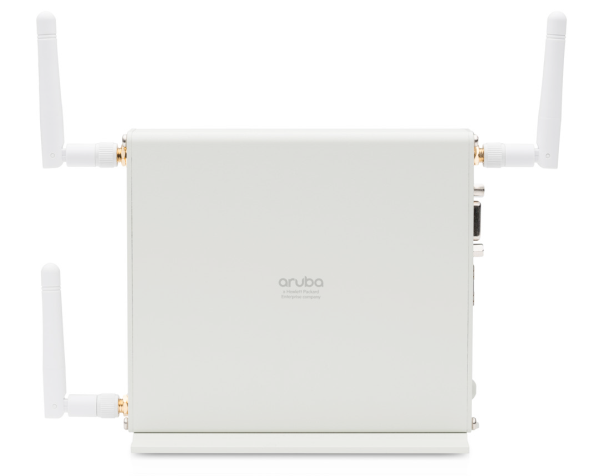
The Aruba 501 Wireless Client Bridge enables you to easily integrate devices with no native wireless support into a wireless LAN (WLAN). It provides strong enterprise-class layered security features, including an IEEE 802.1X supplicant, to protect the network from intrusions.
The 501 Wireless Client Bridge can bridge up to 15 Ethernet client devices running a legacy networking protocol to the WLAN - extending wireless network access to a wide range of protocols. An integrated serial to TCP/IP converter enables a RS-232 asynchronous terminal device to communicate with a compatible station on the network. Hardware-accelerated encryption provides higher performance when using WPA2/AES security.
This bridge provides the benefits of wireless mobility for devices like electronic cash registers, scales, servers, printers, medical equipment and other devices. It can be deployed in any location where a WLAN signal is available - saving the time and expense of installing Ethernet cables for wired network access.
The 501 Wireless Client Bridge integrates into the Aruba Mobile First solution architecture and is interoperable with the IEEE 802.11a/b/g/n/ac wireless network infrastructure in a multi-vendor environment. | |
|
| |
|
| |
|
Aruba 501 Wireless Client Bridge Series | |
|
| |
|
Models | |
|
Aruba 501 Wireless Client Bridge |
J9835A |
|
| |
|
Highlights
| |
|
| |
Standard Features
|
Quality of Service (QoS)
- Support for DSCP and WMM - SNMP v2c, SNMP v3, MIB-II with traps, and RADIUS authentication client MIB (RFC 2618) - Embedded HTML management tool with secure access - Scheduled configuration and firmware upgrades via a network management station
- RSSI logging - Email alert tool |
|
|
|
Connectivity
- Simplifies deployment and dramatically reduces installation costs by helping eliminate the time and cost involved in supplying local power at each client bridge
- Provides automatic adjustments for straight-through or crossover cables on all 10/100/1000 ports
- Selects the channel automatically, based on the access point it connects to; and avoids DFS (Dynamic- Frequency-Selection) issues by following the access point to a clear channel |
|
|
|
Mobility
- Provides single IEEE 802.11a/b/g/n/ac radio client bridge - Offers radio software-selectable configuration of frequency bands - Utilizes IEEE 802.3af PoE or local power supply
- Meets Wi-Fi Alliance Certification standards, including IEEE 802.11a/b/g/n/ac and WPA2-to ensure multivendor interoperability
- Support Windows-based PCs equipped with Ethernet cards; includes point-of-sale devices, scales, network printers, thin clients Mac/Apple machines, Linux/Unix workstations, Ethernet-enabled appliances, medical equipment, or manufacturing machinery - Connects RS232 asynchronous terminal devices to the wireless network
Connects up to 15 Ethernet-enabled devices via a multiport switch |
|
|
|
Security
- Provides user authentication with support for EAP-TLS and PEAP-with choice of Advanced Encryption Standard (AES), Temporal Key Integrity Protocol (TKIP), and Wired Equivalent Privacy (WEP) encryption for protecting wireless traffic between authenticated clients and the access point
- Secures the data integrity of wireless traffic, using robust AES or TKIP encryption |
|
|
|
Warranty and support
|
|
|
Configuration Information
|
Build To Order: BTO is a standalone unit with no integration. BTO products ship standalone are not part of a CTO or Rack-Shippable solution. | ||
|
BTO Models |
| |
|
Remarks |
Description |
SKU |
|
|
Aruba 501 Wireless Client Bridge |
J9835A |
|
|
|
|
|
Notes: |
OCA Only Model Selection Form - HPE Offering > Aruba > Clent Bridge: Aruba 501 Wireless Clent Bridge |
|
|
| ||
|
Antennas |
| |
|
|
Dual-Band Antennas |
|
|
|
Std (Min 0 // max 1) User Selection (min 0 // max 1) |
|
|
1 |
AP-ANT-20W 2.4-2.5GHz (2dBi)/4.9-5.875GHz (2dBi) Compact Omni-Dir DMt Indr White Antenna |
JW011A |
|
1 |
AP-ANT-1W 2.4-2.5GHz (4dBi)/4.9-5.875GHz (6dBi) Hi Gain Dual-band Omni-Dir Indoor Antenna |
JW009A |
|
1 |
AP-ANT-19 2.4/5G Dual Band Omni-Dir 3dBi/6dBi Indr/Otdr RPSMA Cnctr Ant w/36in Intgrtd Cable |
JW004A |
|
|
Configuration Rules |
|
|
1 |
Must select Qty 0 or Qty 3 |
|
|
Notes: |
AP-ANT-1W, and AP-ANT-20W are usually direct connect to the chassis AP-ANT-19 includes external antenna mounting brackets |
|
|
| ||
|
Power Options |
| |
|
Remarks |
Description |
SKU |
|
|
Power Options |
|
|
* |
Aruba 501 Client Bridge 5V Power Supply |
J9405C |
|
** |
AP-POE-AFGE 1-Port GbE 802.3af 15.4W midspan injector |
R6P68A |
|
Notes: |
*Localization required. (See Localization Menu) **If this Power Supply is selected, bring in (Min 1 // Max 1) Localized power cord based on the Aruba Localization Menu |
|
|
| ||
Technical Specifications
|
Aruba 501 Wireless Client Bridge (J9835A) | ||
|
I/O ports and slots |
1 RJ-45 autosensing 10/100/1000 port; Duplex: 10BASE-T/100BASE-TX: half or full; 1000BASE-T: full only (IEEE 802.3 Type 10BASE-T, IEEE 802.3u Type 100BASE-TX, IEEE 802.3ab Type 1000BASE-T) 1 RS-232C serial console port | |
|
Characteristics |
Radios (built-in) |
802.11 a/b/g/n/ac |
|
Radio operation modes |
Client bridge | |
|
Wi-Fi Alliance Certification |
a/b/g/n/ac Wi-Fi Certified | |
|
Antenna connector |
Three RP-SMA | |
|
Antenna |
2 dBi dual-band omnidirectional | |
|
Number of external antennas |
3 | |
|
Three spatial streams for up to 1.3 Gbps PHY rate | ||
|
Three RP-SMA connectors for a range of antenna options | ||
|
Notes: When using outdoor antennas, customer must supply RP-SMA to Type N adapter | ||
|
Physical characteristics |
Dimensions |
5.5 (w) x 1.3 (d) x 5.0 (h) in (13.97 x 3.3 x 12.7 cm) |
|
Weight |
2.01 lb (0.91 kg) | |
|
Environment |
Operating temperature |
32°F to 122°F (0°C to 50°C) |
|
Operating relative humidity |
5% to 95%, non-condensing | |
|
Non-operating/Storage temperature |
-40°F to 158°F (-40°C to 70°C) | |
|
Non-operating/Storage relative humidity |
5% to 95%, non-condensing | |
|
Shock and vibration |
EN 61373 | |
|
Altitude |
10,000 feet (3,048 meters) | |
|
Electrical characteristics |
Description |
IEEE 802.3af PoE compliant or 5-15 VDC from external DC power source |
|
Maximum power rating |
9 W from external DC power source 11 W from PoE power source | |
|
|
|
RF Performance Table | ||
|
|
Maximum transmit power (dBm) per transmit chain and includes the 2dBi dipole antenna that ships with the bridge |
Receiver sensitivity (dBm) per receive chain and includes the 2dBi dipole antenna that ships with the bridge |
|
802.11b 2.4 GHz | ||
|
1 Mbps |
21 |
-96 |
|
11 Mbps |
21 |
-88 |
|
802.11g 2.4 GHz and 802.11a 5 GHz | ||
|
6 Mbps |
20 (21 at 2.4 GHz) |
-92 (-93 at 2.4 GHz) |
|
54 Mbps |
19 |
-75 |
|
802.11n HT20 2.4 GHz and 5 GHz | ||
|
MCS0/8/16 |
18 (21 at 2.4 GHz) |
-90 (-93 at 2.4 GHz) |
|
MCS7/15/23 |
15 (16 at 2.4 GHz) |
-71 |
|
802.11n HT40 2.4 GHz and 5 GHz | ||
|
MCS0/8/16 |
20 (14 at 2.4 GHz) |
-90 |
|
MCS7/15/23 |
15 (14 at 2.4 GHz) |
-68 |
|
802.11ac VHT80 5 GHz | ||
|
MCS0 |
20 |
-86 |
|
MCS9 |
13 |
-59 |
|
Maximum capability of the hardware provided. Maximum transmit power is limited by local regulatory settings. | ||
|
|
|
Wireless Radio Specifications
- --2.4000 GHz to 2.4835 GHz - --5.150 GHz to 5.250 GHz - --5.250 GHz to 5.350 GHz - --5.470 GHz to 5.725 GHz - --5.725 GHz to 5.850 GHz
- 802.11b: Direct-sequence spread-spectrum (DSSS) - 802.11a/g/n/ac: Orthogonal frequency-division multiplexing (OFDM) - 802.11n/ac: 3x3 MIMO with up to three spatial streams
- 802.11b: BPSK, QPSK, CCK - 802.11a/g/n: BPSK, QPSK, 16-QAM, 64-QAM - 802.11ac: BPSK, QPSK, 16-QAM, 64-QAM, 256-QAM
- 802.11b: 1, 2, 5.5, 11 - 802.11a/g: 6, 9, 12, 18, 24, 36, 48, 54 - 802.11n: 6.5 to 450 (MCS0 to MCS23) - 802.11ac: 6.5 to 1,300 (MCS0 to MCS9, NSS = 1 to 3)
|
|
|
|
Regulatory
FCC Part 15.247; EN 300 328; FCC Part 15.407; MIC Notice No. 88, App. 43 & 45; EN 301 893; RSS-210
UL 2043; UL 60950-1; EN 60950-1; CAN/CSA-C22.2 No. 60950-1
FCC Bulletin OET-65C; RSS-102; EN 62311
EN 55022 Class B; EN 60601-1-2; EN 301 489-1; EN 301 489-17; ICES-003 Class B; FCC Part 15, VCCI Class B
MRLBB-1302 |
|
|
|
Security
Provides user authentication with support for EAP-TLS and PEAP-with choice of Advanced Encryption Standard (AES), Temporal Key Integrity Protocol (TKIP), and Wired Equivalent Privacy (WEP) encryption for protecting wireless traffic between authenticated clients and the access point
Secures the data integrity of wireless traffic, using robust AES or TKIP encryption |
|
|
|
Warranty and Support
|
|
|
|
Software Releases
|
|
|
Summary of Changes
|
Date |
Version History |
Action |
Description of Change: |
|
01-Aug-2022 |
Version 11 |
Changed |
Configuration Information section was updated. |
|
08-Sep-2020 |
Version 10 |
Changed |
Configuration Information section was updated. New SKUs were added. |
|
06-Jan-2020 |
Version 9 |
Changed |
Configuration Information section was updated. |
|
04-Sep-2018 |
Version 8 |
Changed |
Configuration section added with the updated information |
|
10-Mar-2017 |
Version 7 |
Changed |
Document name and content updated with Aruba information |
|
01-Aug-2016 |
Version 6 |
Changed |
Adding #AC3 Option on Configuration Menu |
|
10-Jun-2016 |
Version 5 |
Changed |
Changes made on Technical Specifications |
|
01-Dec-2015 |
Version 4 |
Changed |
Overview and Technical Specifications updated |
|
01-Dec-2014 |
Version 3 |
Changed |
Warranty and support updated |
|
20-Dec-2013 |
Version 2 |
Added |
Configuration was added. |
|
09-Dec-2013 |
Version 1 |
New |
New QuickSpecs |
Copyright
|
|
| |||||
|
|
|
© Copyright 2022 Hewlett Packard Enterprise Development LP. The information contained herein is subject to change without notice. The only warranties for Hewlett Packard Enterprise products and services are set forth in the express warranty statements accompanying such products and services. Nothing herein should be construed as constituting an additional warranty. Hewlett Packard Enterprise shall not be liable for technical or editorial errors or omissions contained herein.
HPE access points and access devices are Wi-Fi Certified, providing our customers with the assurance that these products have met and passed the rigorous interoperability testing performed by the Wi-Fi Alliance Organization. See the Specifications section of this series for more information. UNIX® is a registered trademark of The Open Group.
To learn more, visit: http://www.hpe.com/networking
c04111338 - 14754 - Worldwide - V11 - 01-August-2022 |