








HPE M-series SN2700M Switch: технические характеристики и документация
В архивеOverview
|
HPE M-series SN2700M Switch |
|
|
|
With an increasing need to access data faster and accommodate growing workloads, rising levels of east-west traffic, and new storage arrays based on flash storage technologies, a high bandwidth, low-latency, zero packet loss network becomes paramount. The HPE SN2700M switches offer a 100GbE-based network platform capable of delivering unbelievable networking speed and agility to keep pace with the most intense workloads small- to large-scale enterprises can produce. With port speeds spanning from 1Gb/s to 100 Gb/s and a switching capacity of 6.4Tb/s from 32 ports at 100GbE, the switch enables non-blocking throughput at wire-speed transfers-across all packet sizes. All this enables the SN2700M to deliver a landmark 4.76 Bpps processing capacity and an uncompromising 300ns cut-through latency in a compact 1RU form factor. The M-Series are perfect for Top-Of-Rack (TOR) deployments and optimized for virtualized environments, hyperconverged infrastructure, and storage deployments.
With HPE M-Series Ethernet switches give you the right network bandwidth with consistent performance for high-performance and storage workloads. Delivering the highest feature set at the right price allows you to get the most out of your Ethernet infrastructure to best support a variety of use cases, including media and entertainment; streaming video, financial services industry, virtualized data centers, and next generation storage, including software-defined storage and NVMe flash. With HPE M-Series switches, you can:
|
|
|
|
SN2700M is available in following models
- Power-to-Connector and Connector-to-Power Airflow - TAA SKU option - ONIE SKU option
SN2700M offers cost-effective options with entry at 16-ports and a pay as you grow with a software license. Offering more flexibility to customers to add capacity when needed. |
|
|
|
| |||||
|
| |||||
|
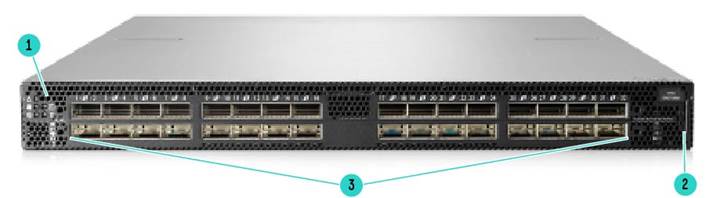
HPE M-Series SN2700M - Front View | |||||
|
| |||||
|
1. |
Status LEDs |
3. |
QSFP/QSFP28 Ports (1-32) | ||
|
2. |
Inventory Information Pull-out tab |
|
| ||
|
Notes: - Port Connectivity options, all ports support 1GbE - 100GbE (100GbE QSFP28 can be configured as 100GbE or 40GbE) - Each odd numbered QSFP28 port can breakout (Optical/DAC/AOC) into four 10 GbE sub-ports. - Each odd numbered QSFP28 port can breakout (Optical/DAC/AOC) into four 25 GbE sub-ports. | |||||
|
| |||||
|
| |||||
|
| |||||
|
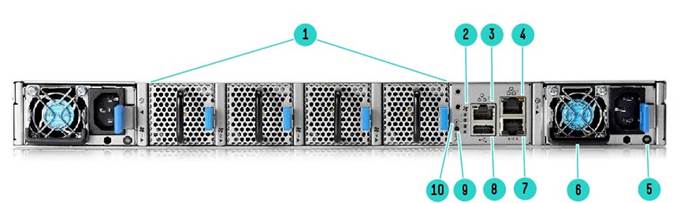
HPE M-Series SN2700M - Rear View | |||||
|
1. |
Fans (4 Units) |
6. |
Power Supply | ||
|
2. |
Fans Status LEDs |
7. |
Serial Console Port (115200 BAUD rate) | ||
|
3. |
MGMT0 100Mb/s to 1Gb/s Port |
8. |
USB Port | ||
|
4. |
MGMT1 100Mb/s to 1Gb/s Port |
9. |
System Health LED | ||
|
5. |
Power Supply |
10. |
Reset button | ||
|
| |||||
|
Models
| |
|
Description |
SKU |
|
HPE M-Series SN2700M Ethernet Switch |
|
|
HPE SN3700cM 100GbE 32QSFP28 ONIE Connector to Power Airflow Switch |
R3A98A |
|
Notes: - HPE ONIE switch SKUs are intended for customer installation of NVIDIA® Cumulus® or another NOS and cannot be converted to ONYX switch SKUs under any circumstances. HPE switch SKUs with factory installed ONYX cannot be converted to HPE ONIE switch SKUS and do not support NVIDIA® Cumulus® or any other NOS. - This switch model is not supported in standard HPE racks, but only racks which are less than 23.6" in length. For Standard HPE racks use any SN2700M SKU |
|
|
HPE SN3700cM 100GbE 32QSFP28 ONIE Power to Connector Airflow Switch |
R3A97A |
|
Notes: This switch model is not supported in standard HPE racks, but only racks which are less than 23.6" in length. For Standard HPE racks use any SN2700M SKU |
|
|
HPE SN2700M 100GbE 16-port Upgrade E-LTU |
S0N96AAE |
|
| |
Standard Features
|
Key Features and Benefits |
|
|
|
HPE M-Series SN2700M Ethernet Switch Models
- QSFP28 50GbE operation is configured as 2x2x25GbE breakout and all 32 ports can operate at 2x50GbE.
|
|
|
|
User Interfaces: Command Line & Web Interface
|
|
|
|
System Management
|
|
Management Interface Management interfaces are used in order to provide access to switch management user interfaces (e.g. CLI, WebUI). HPE Switch Management supports out-of-band (OOB) dedicated interfaces (e.g. mgmt0, mgmt1) and in-band dedicated interfaces. In addition, HPE M-Series Switches feature a standard 115200 baud rate RJ45 serial port that provides access to the CLI. |
|
|
|
NTP, Clock & Time Zones Network Time Protocol (NTP) is a networking protocol for clock synchronization between computer systems over packet-switched, variable-latency data networks. NTP is intended to synchronize all participating computers to within a few milliseconds of Coordinated Universal Time (UTC) and is designed to mitigate the effects of variable network latency. |
|
|
|
PTP IEEE Standard for a Precision Clock Synchronization Protocol for Networked Measurement and Control Systems (standard number 1588) defines the means to achieve time synchronization in the orders of sub microseconds. |
|
|
|
Software Management |
|
Configuration Management Onyx's built-in automation infrastructure reduces operational expenses and time to service by minimizing manual operations and eliminating configuration and provisioning errors. Automation tools such as Ansible, SaltStack, ZTP and Puppet enable you to automate fabric configuration and large scale deployments. |
|
|
|
Saving, Loading & restore to factory defaults of the Configuration Files
There are two types of configuration files that can be applied on the switch, BIN files (binary) and text-based configuration files. BIN configuration files are not human readable. Additionally, these files are encrypted and contain integrity verification preventing them from being edited and used. Text configuration files are text-based and editable. It is similar in form to the output of the command "show running config expanded". Automated configuration file backup feature can be used to upload the active configuration file on every "configuration write". The switch WEBUI and CLI can be used to load a BIN or text configuration file. By default, or after a system reset, the system loads the default "initial" configuration file. Support is provided to load a different configuration file and make it the active configuration. |
|
|
|
Logging Logging of system events in several severity level over a configurable period of time. |
|
|
|
Debugging Support save sysdmp file collects configuration, status, counters, log files, What-Just-Happened, and WireShark traces for Ethernet modules to enable timely review of problems and facilitate service support. There are 31 per port packet counters and an additional 22 discard packet classification counters to help you identify why there are packet processing problems, should they occur. |
|
|
|
What Just Happened (WJH) As an innovative network telemetry technology, 'What Just Happened' (WJH) monitors and alerts on data plane anomalies to reduce system downtime. With built-in capabilities to inspect packets across all ports at line-rate, multi-terabit speeds, WJH avoids time-consuming data collection and manual searches for network problems. In addition, a streaming WJH telemetry application, supported by other management applications, can be installed as a Docker container. |
|
|
|
Link Diagnostic Per Port Enables an insight into the physical layer components - see information such as a cable status (plugged/unplugged), speed mismatch, auto-negotiation failures, signal quality failures, link training failures, forward error code mismatch, etc. |
|
|
|
Signal Degradation Monitoring A system can monitor the bit error rate (BER) in order to ensure a quality of the link and take an automatic action to disable offending ports. |
|
|
|
Telemetry Sampling (histograms) - a network administrator can enable a sampling of the port buffer occupancy, record occupancy changes over time, and provide information for different levels of buffer occupancy, and amount of time the buffer has been occupied during the observation period. Thresholds - thresholds may be enabled per port to record the network time when port buffer occupancy crosses the defined threshold and when buffer occupancy drops below it. |
|
|
|
User Management and Security
|
|
|
|
Cryptographic (X.509, IPSec) and Encryption
|
|
|
|
802.1x Protocol Authenticate hosts (or supplicants) and to allow connection only to a list of allowed hosts pre-configured on an authentication server |
|
|
|
Network Management Interfaces SNMP, JSON & XML Puppet Agent Built-in agent for the open-source "Puppet" configuration change management system |
|
|
|
Additional Management & Automation Features
|
|
|
|
Linux Docker Containers Run your applications as a Linux docker image embedded in the switch flash:
|
|
|
|
Software Components, Standard, Base Models |
|
Ethernet Switching |
|
Interface Isolation Group interfaces in sets where traffic from each port is isolated from other interfaces in the group. |
|
|
|
Link Aggregation Group (LAG) Several same speed links are combined into a single logical entity with the accumulated bandwidth of the originating ports |
|
|
|
MLAG Extending the implementation of the LAG to more than a single device provides yet another level of redundancy that extends from the link level to the node level. |
|
|
|
VLANs L2 segment of the network which defines a broadcast domain and is identified by a tag added to all Ethernet frames running within the domain |
|
|
|
Voice VLAN Provide QoS to voice and data traffic in a scenario where a terminal is connected to an IP phone which is in turn connected to the port on the switch |
|
|
|
QinQ Segregate the traffic of different customers in their infrastructure, while still giving the customer a full range of VLANs for their internal use by adding a second 802.1Q VLAN tag to an already tagged frame |
|
|
|
Spanning Tree Rapid Spanning Tree Protocol (RSTP) provides for rapid recovery of connectivity following the failure of a bridge/bridge port or a LAN. The following are supported: BPDU Filter, BPDU Guard, Loop Guard, Root Guard, MSTP and RPVST |
|
Virtual routing and forwarding functions (VRFs) Virtual routing and forwarding (VRF) is a technology included in IP (Internet Protocol) network routers that allows multiple instances of a routing table to exist in a router and work simultaneously. This increases functionality by allowing network paths to be segmented without using multiple devices. Because traffic is automatically segregated, VRF also increases network security.. Currently, OnyxTM supports 64 VRF instances. |
|
|
|
OpenFlow - Support for OpenFlow 1.3 OpenFlow is a network protocol that facilitates direct communication between network systems via Ethernet. Software Defined Networks (SDN) allows a centralist management of network equipment. OpenFlow allows the SDN controller to manage SDN equipment. The OpenFlow protocol allows communication between the OpenFlow controller and OpenFlow agent. |
|
|
|
VXLAN VXLAN (Virtual eXtensible Local Area Network) addresses the requirements of the L2 and L3 data center network infrastructure in the presence of virtual networks in a multi-tenant environment. It runs over the existing networking infrastructure and provides a means to "stretch" a L2 broadcast domain over a layer 3 network. |
|
|
|
IGMP Snooping Snooping and updating tables based on the IGMP protocol used by hosts and adjacent routers on IP networks to establish multicast group memberships |
|
|
|
Link Layer Discovery Protocol (LLDP) A vendor-neutral Link Layer protocol in the Internet Protocol Suite used by network devices for advertising their identity, capabilities, and neighbors on a IEEE 802 LAN |
|
|
|
Quality of Service (QoS)
QoS Classification, QoS ReWrite, Queuing and Scheduling, RED & ECN are supported |
|
Access Control List An Access Control List (ACL) is a list of permissions attached to an object, to filter or match switches packets. When the pattern is matched at the hardware lookup engine, a specified action (e.g. permit/deny) is applied Other QOS features:
|
|
|
|
Port Mirroring Port mirroring enables data plane monitoring functionality which allows the user to send an entire traffic stream for testing. |
|
|
|
sFlow sFlow (ver. 5) is a procedure used for statistical monitoring of traffic in networks. MLNX-OS supports an sFlow sampling mechanism (agent), which includes collecting traffic samples and data from counters. The sFlow datagrams are then sent to a central collector. |
|
|
|
RDMA over Converged Ethernet (RoCE) Remote Direct Memory Access (RDMA) is the remote memory management capability that allows server to server data movement directly between application memory without any CPU involvement. Simplified RoCEv2 switch configuration automation supported by just one command: roce {lossy | semi-lossless | lossless}. |
|
|
|
Priority Flow Control Provides an enhancement to the existing pause mechanism in Ethernet. The global Ethernet pause option stops all traffic on a link. PFC creates eight separate virtual links on the physical link and allows any of these links to be paused and restarted independently, enabling the network to create a no-drop class of service for virtual links. |
|
|
|
Shared Buffers All successfully received packets by a switch are stored on internal memory from the time they are received until the time they are transmitted. The packet buffer is fully shared between all physical ports and is hence called a shared buffer. Buffer configuration is applied in order to provide lossless services and to ensure fairness between the ports and priorities. |
|
|
|
Storm Control Storm Control is a feature which can be enabled on L2 Ethernet ports and port-channels to monitor inbound traffic to prevent disruptions caused by a broadcast, multicast, or unicast traffic storm on the physical interfaces |
|
|
|
Store-and-Forward Store-and-Forward is used to describe a functionality where a switch receives a complete packet, stores it, and only then forwards it. Since the switch makes forwarding decisions based on the destination address which is at the header of the packet, the switch can make the forwarding decision before receiving the complete packet. This process is called cut-through, as the switch forwards part of the packet before receiving the complete packet. Cut-through and store-and-forward modes are configurable as a switch global or per port option. |
|
|
|
IP Routing
|
|
IP Interfaces The following 3 types of IP interfaces are supported:
|
|
|
|
IPv6 IP version 6 (IPv6) is a routing protocol which succeeds IPv4. With the expansion of the Internet and data bases IPv6 addresses consist of 128 bits whose purpose is to allow networks to include a significantly higher number of nodes by increasing the pool of available unique IP addresses. IPv6 packets alleviate overhead and allow for future customizability. |
|
|
|
OSPF Open Shortest Path First (OSPF) is a link-state routing protocol for IP networks. It uses a link state routing algorithm and falls into the group of interior routing protocols, operating within a single autonomous system (AS). |
|
|
|
BGP unnumbered This BGP feature enables a user to establish a BGP session through a P2P Layer-3 link (port or port-channel) without specifying what the IP address of the remote neighbor is, nor what the neighbor's ASN number is. This feature is useful when provisioning a big data center fabric. It does not require allocation of an IP subnet on each pair of connected switches and simplifies the massive configuration and enables automation.
|
|
BGP Border Gateway Protocol (BGP) is an exterior gateway protocol which is designed to transfer routing information between routers. It maintains and propagates a table of routes which designates network reachability among autonomous systems (ASs). |
|
|
|
BFD Infrastructure Many protocols use slow Hello mechanisms and failure detection is usually within seconds after the problem occurs. The BFD goal is to provide low overhead short duration detection of failures between adjacent nodes and single mechanism that can be used for liveness detection over any media. BFD session is established by the application that uses it. There is no discovery mechanism. e.g. in OSPF BFD session is established to neighbors that were discovered by OSPF hello protocol. |
|
|
|
Policy Rules |
|
Route Map Route maps define conditions for redistributing routes between routing protocols. A route map clause is identified by a name, filter type (permit or deny) and a sequence number. Clauses with the same name are components of a single route map; the sequence number determines the order in which the clauses are compared to a route. |
|
|
|
IP Prefix-List Prefix-list is a list of entries, each of which can match one or more IP prefixes. A prefix-list is usually used to match a specific IP prefix, mostly in relation to IP route destinations. |
|
|
|
Multicast (IGMP and PIM) Protocol independent multicast (PIM) is a collection of protocols that deal with efficient delivery of IP multicast (MC) data. Those protocols are published in the series of RFCs and define different ways and aspects of multicast data distribution. PIM protocol family includes PIM dense mode (PIM-DM), PIM sparse mode (PIM-SM, which is not supported on Mellanox platforms), Bidirectional PIM (PIM-BIDIR) and Bootstrap router (BSR) protocol.
PIM builds and maintains multicast routing tables based on the unicast routing information provided by unicast routing tables that can be maintained statically or dynamically by IP routing protocols like OSPF and BGP. |
|
|
|
VRRP The Virtual Router Redundancy Protocol (VRRP) is a computer networking protocol that provides for automatic assignment of available IP routers to participating hosts. This increases the availability and reliability of routing paths via automatic default gateway selections on an IP subnetwork. |
|
|
|
MAGP Multi-active gateway protocol (MAGP) is aimed to solve the default gateway problem when a host is connected to a set of switch routers (SRs) via MLAG. The network functionality in that case requires that each SR is an active default gateway router to the host, thus reducing hops between the SRs and directly forwarding IP traffic to the L3 cloud regardless which SR traffic comes through. |
|
|
|
DHCP Relay Since Dynamic Host Configuration Protocol must work correctly even before DHCP clients have been configured, the DHCPserver and DHCP client need to be connected to the same network.
In larger networks, this is not always practical because each network link contains one or more DHCP relay agents. These DHCP-R agents receive messages from DHCP clients and forward them to DHCP servers thus extending the reach of the DHCP beyond the local network. |
|
|
|
Feature Summary
|
|
Layer 3 Feature Set
Network Virtualization
Quality of Service (QoS)
Security
|
|
Synchronization
Docker Container
Software Defined Network (SDN)
|
|
Layer 2 Feature Set |
Monitoring & Telemetry
|
|
Management and Automation
|
|
|
Service and Support
|
Warranty (3-3-3) Hardware Warranty; 3-year parts; 3-year on-site (standard business hours, next business day response) and 3-year labor. Notes: The hardware warranty covers firmware. For extended hardware support and installation information, please see the "Services and Support" Section. |
|
|
|
HPE Services No matter where you are in your transformation journey, you can count on HPE Services to deliver the expertise you need when, where and how you need it. From planning to deployment, ongoing operations and beyond, our experts can help you realize your digital ambitions. https://www.hpe.com/services
|
|
Consulting services No matter where you are in your journey to hybrid cloud, experts can help you map out your next steps. From determining what workloads should live where, to handling governance and compliance, to managing costs, our experts can help you optimize your operations. https://www.hpe.com/services/consulting
|
|
HPE Managed Services HPE runs your IT operations, providing services that monitor, operate, and optimize your infrastructure and applications, delivered consistently and globally to give you unified control and let you focus on innovation. HPE Managed Services | HPE
|
|
Operational services Optimize your entire IT environment and drive innovation. Manage day-to-day IT operational tasks while freeing up valuable time and resources. Meet service-level targets and business objectives with features designed to drive better business outcomes. https://www.hpe.com/services/operational
|
|
|
|
Recommended Services HPE Tech Care Service HPE Tech Care Service is the operational support service experience for HPE products. The service goes beyond traditional support by providing access to product specific experts, an AI driven digital experience, and general technical guidance to not only reduce risk but constantly search for ways to do things better. HPE Tech Care Service delivers a customer-centric, AI driven, and digitally enabled customer experience to move your business forward. HPE Tech Care Service is available in three response levels. Basic, which provides 9x5 business hour availability and a 2-hour response time. Essential which provides a 15-minute response time 24x7 for most enterprise level customers, and Critical which includes a 6-hour repair commitment where available and outage management response for severity 1 incidents. https://www.hpe.com/services/techcare
|
|
HPE Complete Care Service HPE Complete Care Service is a modular, edge-to-cloud IT environment service designed to help optimize your entire IT environment and achieve agreed upon IT outcomes and business goals through a personalized experience. All delivered by an assigned team of HPE Services experts. HPE Complete Care Service provides:
https://www.hpe.com/services/completecare |
|
|
|
Other related services from HPE Services
HPE Installation and Start-up Service Provides for the hardware installation and startup of HPE branded M-Series switches with ONYXTM, according to the product specifications. The HPE service delivery technician will assist you in bringing your new hardware into operation in a timely and professional manner. https://www.hpe.com/h20195/v2/Getdocument.aspx?docname=a00025816enw HPE Hardware Installation Provides for the basic hardware installation of HPE branded M-Series ONIE switches to assist you in bringing your new hardware into operation in a timely and professional manner. https://www.hpe.com/h20195/v2/Getdocument.aspx?docname=5981-9356enw HPE Lifecycle Services HPE Lifecycle Services provide a variety of options to help maintain your HPE systems and solutions at all stages of the product lifecycle. A few popular examples include:
https://www.hpe.com/services/lifecycle
|
|
|
|
HPE Education Services Training and certification designed for IT and business professionals across all industries. Broad catalogue of course offerings to expand skills and proficiencies in topics ranging from cloud and cybersecurity to AI and DevOps. Create learning paths to expand proficiency in a specific subject. Schedule training in a way that works best for your business with flexible continuous learning options. https://www.hpe.com/services/training |
|
|
|
Defective Media Retention An
option available with HPE Consult your HPE Sales Representative or Authorized Channel Partner of choice for any additional questions and services options.
|
|
|
|
Parts and Materials HPE will provide HPE-supported replacement parts and materials necessary to maintain the covered hardware product in operating condition, including parts and materials for available and recommended engineering improvements. Parts and components that have reached their maximum supported lifetime and/or the maximum usage limitations as set forth in the manufacturer's operating manual, product QuickSpecs, or the technical product data sheet will not be provided, repaired, or replaced as part of these services. How to purchase services Services are sold by Hewlett Packard Enterprise and Hewlett Packard Enterprise Authorized Service Partners:
|
|
|
|
AI Powered and Digitally Enabled Support Experience Achieve faster time to resolution with access to product-specific resources and expertise through a digital and data driven customer experience. Sign into the HPE Support Center experience, featuring streamlined self-serve case creation and management capabilities with inline knowledge recommendations. You will also find personalized task alerts and powerful troubleshooting support through an intelligent virtual agent with seamless transition when needed to a live support agent.
https://support.hpe.com/hpesc/public/home/signin |
|
|
|
Consume IT on your terms HPE GreenLake edge-to-cloud platform brings the cloud experience directly to your apps and data wherever they are-the edge, colocations, or your data center. It delivers cloud services for on-premises IT infrastructure specifically tailored to your most demanding workloads. With a pay-per-use, scalable, point-and-click self-service experience that is managed for you, HPE GreenLake edge-to-cloud platform accelerates digital transformation in a distributed, edge-to-cloud world.
To learn more about HPE Services, please contact your Hewlett Packard Enterprise sales representative or Hewlett Packard Enterprise Authorized Channel Partner. Contact information for a representative in your area can be found at "Contact HPE" https://www.hpe.com/us/en/contact-hpe.html For more information: http://www.hpe.com/services |
|
|
Configuration Information
|
Step 1 - Base Configuration(Select one Model) | |
|
Description |
SKU |
|
HPE SN3700cM 100GbE 32QSFP28 ONIE Connector to Power Airflow Switch |
R3A98A |
|
Notes: This switch model is not supported in standard HPE racks, but only racks which are less than 23.6" in length. For Standard depth HPE racks use any SN2700M SKU or purchase an MTEF-KIT-S from the Mellanox on-line Store. | |
|
HPE SN3700cM 100GbE 32QSFP28 ONIE Power to Connector Airflow Switch |
R3A97A |
|
Notes: - SN2745M is a short-depth version of SN2700M switch. - This switch model is not supported in standard HPE racks, but only racks which are less than 23.6" in length. For Standard depth HPE racks use any SN2700M SKU or purchase an MTEF-KIT-S from the Mellanox on-line Store. | |
Notes: Requires optical transceivers listed below. |
|
Notes: Requires optical transceivers listed below. |
|
|
HPE SN2700M 100GbE 16-port Upgrade E-LTU |
S0N96AAE |
|
Notes: - Upgrade licenses (S0N96AAE) allow pay-as-you-grow model with additional 16-active-ports with Q6M26A. E-LTU Q6J39AAE is obsolete and replaced by S0N96AAE - For M-Series SN2700M ONIE SKU (R0P79A, R0P80A) refer to Transceivers & Cables supported by the NOS used. | |
|
| |
|
Step 2 - Options
| ||||
|
Note # |
Description |
SKU | ||
|
|
HPE 100GbE QSFP28 SR4 100m Transceiver |
Q2F19A | ||
|
|
HPE 100GbE QSFP28 500m 1310mm PSM4 Transceiver |
Q8J73A | ||
|
2 |
HPE 10GbE SFP+ SR Multi-mode 300m Transceiver |
Q6M30A | ||
|
2 |
HPE 10Gb SFP+ Short Wave 1-pack Pull Tab Optical Transceiver |
Q2P65A | ||
|
5, 6 |
HPE 100Gb QSFP28 LC SWDM4 Multi-mode 100m Transceiver |
R0R40A | ||
|
2, 7, 8 |
HPE 10GBASE-T SFP+ RJ45 30m 1-pack Transceiver |
R0R41B | ||
|
2 |
HPE 25Gb SFP28 SR 30m Transceiver |
R0R42A | ||
|
2 |
HPE BladeSystem c-Class 10Gb SFP+ SR Transceiver |
455883-B21 | ||
|
2 |
HPE Networking X110 100M SFP LC LX Transceiver |
JD120B | ||
|
2 |
HPE Networking X120 1G SFP LC SX Transceiver |
JD118B | ||
|
2 |
HPE Networking X120 1G SFP LC LX Transceiver |
JD119B | ||
|
2 |
HPE Networking X120 1G SFP RJ45 T Transceiver |
JD089B | ||
|
2 |
HPE Aruba Networking 25G SFP28 LC LR 10km SMF Transceiver |
JL486A | ||
|
2 |
HPE Aruba Networking 10G SFP+ LC LR 10km SMF Transceiver |
J9151E | ||
|
2 |
HPE Aruba Networking SFP-10GE-ZR 10GBASE-ZR SFP+ 1310nm LC Connector Pluggable 10GbE Transceiver |
JW148A | ||
|
2 |
HPE BladeSystem CClass Virtual Connect 1G SFP RJ45 Transceiver |
453154-B21 | ||
|
2 |
HPE Networking X130 10G SFP+ LC SR Transceiver |
JD092B | ||
|
2 |
HPE Networking X130 10G SFP+ LC LR Transceiver |
JD094B | ||
|
2 |
HPE Networking X130 10G SFP+ LC ER 40km Transceiver |
JG234A | ||
|
1, 2 |
HPE Networking X130 10G SFP+ LC LH 80km Transceiver |
JG915A | ||
|
|
HPE Networking X140 40G QSFP+ CSR4 300m Transceiver |
JG709A | ||
|
|
HPE Networking X140 40G QSFP+ LC LR4L 2km SM Transceiver |
JL286A | ||
|
|
HPE Networking X140 40G QSFP+ LC LR4 SM 10km 1310nm Transceiver |
JG661A | ||
|
|
HPE BladeSystem c-Class 40Gb QSFP+ MPO SR4 100m Transceiver |
720187-B21 | ||
|
|
HPE Networking X140 40G QSFP+ LC BiDi 100m MM Transceiver |
JL251A | ||
|
|
HPE 40Gb QSFP+ Bidirectional Transceiver |
841716-B21 | ||
|
2 |
HPE Networking X190 25G SFP28 LC SR 100m MM Transceiver |
JL293A | ||
|
2 |
HPE 25Gb SFP28 Short Wave Extended Temperature 1-pack Pull Tab Optical Transceiver |
Q2P64B | ||
|
2 |
HPE Networking X130 10G SFP+ LC SR Transceiver |
JD092B | ||
|
|
HPE Networking X140 40G QSFP+ MPO SR4 Transceiver |
JG325B | ||
|
2 |
HPE 25Gb SFP28 SR 100m Transceiver |
845398-B21 | ||
|
2 |
HPE QSFP28 to SFP28 Adapter |
845970-B21 | ||
|
Note # |
Descriptions |
SKU |
|
|
HPE Networking X150 100G QSFP28 LC LR4 10km SM Transceiver |
JL275A |
|
|
HPE Networking X150 100G QSFP28 CWDM4 2km SM Transceiver |
JH673A |
|
5, 6 |
HPE Networking X150 100G QSFP28 LC SWDM4 100m MM Transceiver |
JH419A |
|
5 |
HPE 100Gb QSFP28 Bidirectional Transceiver |
845972-B21 |
|
10 |
HPE 100GbE QSFP28 LC DR1 500m 1-pack Transceiver |
R8M61A |
|
2 |
HPE 25/50GbE SFP56 SR 100m 1-pack Transceiver |
R8M65A |
|
|
HPE Alletra 6000 2x100Gb QSFP28 MPO SR4 100m FIO Transceiver |
R7D08A |
|
|
HPE Alletra 6000 2x100Gb QSFP28 MPO SR4 100m Transceiver |
R7D12A |
|
2 |
HPE Alletra 6000 2x10Gb SFP+ SR FIO Transceiver |
R7D05A |
|
2 |
HPE Alletra 6000 2x10Gb SFP+ SR Transceiver |
R7D09A |
|
2 |
HPE Alletra 6000 2x25Gb SFP28 SR 100m FIO Transceiver |
R7D07A |
|
2 |
HPE Alletra 6000 2x25Gb SFP28 SR 100m Transceiver |
R7D11A |
|
Direct Attach Copper Cables (DAC) | ||
|
4 |
HPE 7.6m/25ft CAT5 RJ45 M/M Ethernet C/O Cable |
C7539A |
|
|
HPE Networking Comware X240 40G QSFP+ QSFP+ 1m Direct Attach Copper Cable |
JG326A |
|
|
HPE Networking Comware X240 40G QSFP+ QSFP+ 3m Direct Attach Copper Cable |
JG327A |
|
|
HPE Networking Comware X240 40G QSFP+ QSFP+ 5m Direct Attach Copper Cable |
JG328A |
|
|
HPE 100GbE QSFP28 to 4x25GbE SFP28 1m Direct Attach Copper Cable |
Q9S72A |
|
|
HPE Networking Comware X240 40G QSFP+ to 4x10G SFP+ 1m Direct Attach Copper Splitter Cable |
JG329A |
|
|
HPE Networking Comware X240 40G QSFP+ to 4x10G SFP+ 3m Direct Attach Copper Splitter Cable |
JG330A |
|
|
HPE Networking Comware X240 40G QSFP+ to 4x10G SFP+ 5m Direct Attach Copper Splitter Cable |
JG331A |
|
|
HPE BladeSystem c-Class 40G QSFP+ to QSFP+ 3m Direct Attach Copper Cable |
720199-B21 |
|
|
HPE BladeSystem c-Class 40G QSFP+ to QSFP+ 5m Direct Attach Copper Cable |
720202-B21 |
|
|
HPE Networking X242 40G QSFP+ to QSFP+ 1m Direct Attach Copper Cable |
JH234A |
|
|
HPE Networking X242 40G QSFP+ to QSFP+ 3m Direct Attach Copper Cable |
JH235A |
|
|
HPE Networking X242 40G QSFP+ to QSFP+ 5m Direct Attach Copper Cable |
JH236A |
|
3 |
HPE Networking X240 QSFP28 4xSFP28 1m Direct Attach Copper Cable |
JL282A |
|
3 |
HPE Networking X240 QSFP28 4xSFP28 3m Direct Attach Copper Cable |
JL283A |
|
3 |
HPE Networking X240 QSFP28 4xSFP28 5m Direct Attach Copper Cable |
JL284A |
|
|
HPE 100Gb QSFP28 to 4x25Gb SFP28 3m Direct Attach Copper Cable |
845416-B21 |
|
|
HPE 100Gb QSFP28 to QSFP28 5m Direct Attach Copper Cable |
845408-B21 |
|
|
HPE Aruba Networking 100G QSFP28 to QSFP28 1m Direct Attach Copper Cable |
R0Z25A |
|
2,3 |
HPE 25Gb SFP28 to SFP28 0.5m Direct Attach Copper Cable |
R4G18A |
|
2,3 |
HPE 25Gb SFP28 to SFP28 1m Direct Attach Copper Cable |
R4G19A |
|
2,3 |
HPE Aruba Networking 25G SFP28 to SFP28 0.65m Direct Attach Cable |
JL487A |
|
|
HPE Aruba Networking 100G QSFP28 to QSFP28 5m Direct Attach Copper Cable |
R0Z26A |
|
|
HPE Networking X240 100G QSFP28 1m DAC Cable |
JL271A |
|
|
HPE Networking X240 100G QSFP28 3m DAC Cable |
JL272A |
|
|
HPE Networking X240 100G QSFP28 5m DAC Cable |
JL273A |
|
|
HPE Aruba Networking 100G QSFP28 to QSFP28 3m Direct Attach Copper Cable |
JL307A |
|
Note # |
Active Optical Cable (AOC) |
SKU |
|
|
HPE 100Gb QSFP28 to QSFP28 3m Direct Attach Copper Cable |
845406-B21 |
|
|
HPE 200Gb QSFP56 to QSFP56 0.5m Direct Attach Copper Cable |
R5Z76A |
|
|
HPE 200Gb QSFP56 to QSFP56 1m Direct Attach Copper Cable |
R5Z77A |
|
|
HPE 200Gb QSFP56 to QSFP56 2m Direct Attach Copper Cable |
R5Z78A |
|
|
HPE 200Gb QSFP56 to QSFP56 2.5m Direct Attach Copper Cable |
R5Z79A |
|
2 |
HPE Alletra 6000 2x10Gb SFP+ to SFP+ 3m Direct Attach Copper Cable |
R7D16A |
|
2 |
HPE Alletra 6000 2x25Gb SFP28 to SFP28 3m Direct Attach Copper Cable |
R7D17A |
|
|
HPE Alletra 6000 2x100Gb QSFP28 to QSFP28 3m Direct Attach Copper Cable |
R7D18A |
|
2 |
HPE Aruba Networking 25G SFP28 to SFP28 3m Direct Attach Copper Cable |
JL488A |
|
2 |
HPE Aruba Networking 25G SFP28 to SFP28 5m Direct Attach Copper Cable |
JL489A |
|
2 |
HPE 25Gb SFP28 to SFP28 3m Direct Attach Copper Cable |
844477-B21 |
|
|
HPE 200GbE QSFP56 to 2xQSFP56 2m Direct Attach Copper Cable |
R8M57A |
|
|
HPE 200GbE QSFP56 to 2xQSFP56 2.5m Direct Attach Copper Cable |
R8M58A |
|
|
HPE 100Gb QSFP28 to QSFP28 0.5m Direct Attach Copper Cable |
R8M59A |
|
9 |
HPE 200Gb QSFP56 to 4x50/25Gb SFP56 2.5m Direct Attach Copper Cable |
R6F27A |
|
| ||
|
Active Optical Cable (AOC) | ||
|
Note # |
Active Optical Cable (AOC) |
SKU |
|
3 |
HPE 40GbE QSFP+ to 4x10GbE SFP+ 5m Active Optical Cable |
Q9S66A |
|
2 |
HPE 25GbE SFP28 to SFP28 3m Smart Active Optical Cable |
Q9S67A |
|
2 |
HPE 25GbE SFP28 to SFP28 5m Smart Active Optical Cable |
Q9S68A |
|
2 |
HPE 25GbE SFP28 to SFP28 10m Smart Active Optical Cable |
Q9S69A |
|
2 |
HPE 25GbE SFP28 to SFP28 15m Smart Active Optical Cable |
Q9S70A |
|
|
HPE 100GbE QSFP28 to QSFP28 5m Active Optical Cable |
Q9S71A |
|
|
HPE BladeSystem c-Class QSFP+ to 4x10G SFP+ 15m Active Optical Cable |
721076-B21 |
|
|
HPE BladeSystem c-Class 40G QSFP+ to QSFP+ 15m Active Optical Cable |
720211-B21 |
|
|
HPE 100Gb QSFP28 to QSFP28 7m Active Optical Cable |
845410-B21 |
|
|
HPE 100Gb QSFP28 to QSFP28 15m Active Optical Cable |
845414-B21 |
|
|
HPE QSFP28 to 4x25Gb SFP28 7m Active Optical Cable |
845420-B21 |
|
|
HPE QSFP28 to 4x25Gb SFP28 15m Active Optical Cable |
845424-B21 |
|
Configuration Rules and Notes Notes: - 1. JG915A - Storage connectivity support for this transceiver is limited to 40Km - 2. HPE QSA28 (QSFP28 to SFP28) adapter (845970-B21) is compatible with all M-Series switches and is required with this transceiver to convert a QSFP+/QSFP28 slot to a single SFP+/SFP28 slot for 25G or 10G operation with this switch model. - 3. The SN2010M 25G DAC connectivity to another M-Series switch or 3rd party switch is limited to a 0.5m DAC cable. End device connectivity may use 1m or a 3m (26 gauge) DAC. - 4. This RJ45 crossover cable is compatible and supported for use when directly connecting the two M-Series switch MGMT ports. When configuring MLAG and also utilizing in-band management, the MGMT0 ports of the two switches should be connected. - 5. The interoperable 845972-B21 and 855817-B21 HPE 100Gb QSFP28 Bidirectional XCVRs do not interoperate with the JH419A and R0R40A transceivers. - 6. 100Gbe SWDM4 LC transceivers JH419A and R0R40A are interoperable.
- 7. 10Gbase-T SFP+ RJ45 transceiver supports maximum length 30M CAT6a cable. R0R41B 10Gabse-T transceiver is not qualified for use at 1GbE and shall be operated only at 10GbE. - 8. ONYX-3.8.2008 and later revisions are required for support of R0R41B in a QSA28 in SN2700M switches. - 9. All 4 R6F27A cable ports must be set as NRZ or PAM4. A mix between the two technologies is not supported. - 10. The R8M61A class 6 power requirements limit use in the SN2700M to ports 1, 2, 31, 32.
| ||
|
| ||
|
Supported Optical Cables for all M-Series switch models | ||
|
Description |
SKU | |
|
HPE Premier Flex MPO/MPO Multi-mode OM4 12 Fiber 10m Cable |
QK729A | |
|
HPE Premier Flex MPO/MPO Multi-mode OM4 8 Fiber 50m Cable |
QK731A | |
|
HPE Premier Flex LC/LC Multi-mode OM4 2 Fiber 1m Cable |
QK732A | |
|
HPE Premier Flex LC/LC Multi-mode OM4 2 Fiber 2m Cable |
QK733A | |
|
HPE Premier Flex LC/LC Multi-mode OM4 2 Fiber 5m Cable |
QK734A | |
|
HPE Premier Flex LC/LC Multi-mode OM4 2 Fiber 15m Cable |
QK735A | |
|
HPE Premier Flex LC/LC Multi-mode OM4 2 Fiber 30m Cable |
QK736A | |
|
HPE Premier Flex LC/LC Multi-mode OM4 2 Fiber 50m Cable |
QK737A | |
|
HPE LC to LC Multi-mode OM3 2-Fiber 0.5m 1-Pack Fiber Optic Cable |
AJ833A | |
|
HPE LC to LC Multi-mode OM3 2-Fiber 1.0m 1-Pack Fiber Optic Cable |
AJ834A | |
|
HPE LC to LC Multi-mode OM3 2-Fiber 2.0m 1-Pack Fiber Optic Cable |
AJ835A | |
|
HPE LC to LC Multi-mode OM3 2-Fiber 5.0m 1-Pack Fiber Optic Cable |
AJ836A | |
|
HPE LC to LC Multi-mode OM3 2-Fiber 15.0m 1-Pack Fiber Optic Cable |
AJ837A | |
|
HPE LC to LC Multi-mode OM3 2-Fiber 30.0m 1-Pack Fiber Optic Cable |
AJ838A | |
|
HPE LC to LC Multi-mode OM3 2-Fiber 50.0m 1-Pack Fiber Optic Cable |
AJ839A | |
|
HPE Premier Flex MPO/MPO OM4 100m Cable |
H6Z30A | |
|
HPE Multi Fiber Push On to 4 x Lucent Connector 5m Cable |
K2Q46A | |
|
HPE Multi Fiber Push On to 4 x Lucent Connector 15m Cable |
K2Q47A | |
|
HPE Premier Flex MPO/MPO Multi-mode OM4 12 Fiber 1m Cable |
Q1H63A | |
|
HPE Premier Flex MPO/MPO Multi-mode OM4 12 Fiber 2m Cable |
Q1H64A | |
|
HPE Premier Flex MPO/MPO Multi-mode OM4 12 Fiber 5m Cable |
Q1H65A | |
|
HPE Premier Flex MPO/MPO Multi-mode OM4 12 Fiber 15m Cable |
Q1H66A | |
|
HPE Premier Flex MPO/MPO Multi-mode OM4 12 Fiber 30m Cable |
Q1H67A | |
|
HPE Premier Flex MPO to 4xLC 30m Cbl |
Q1H68A | |
|
HPE Premier Flex MPO to 4 x Lucent Connector 50m Cable |
Q1H69A | |
|
HPE 5m Single-Mode LC/LC Fibre Channel Cable |
AK346A | |
|
HPE Premier Flex MPO12 to MPO12 APC Single-mode 50m 1-pack Cable |
R6F28A | |
|
HPE Premier Flex MPO12 to MPO12 APC Single-mode 100m 1-pack Cable |
R6F29A | |
|
HPE Premier Flex MPO12 to MPO12 APC Single-mode 300m 1-pack Cable |
R6F30A | |
|
HPE Premier Flex MPO12 to MPO12 APC Single-mode 500m 1-pack Cable |
R6F31A | |
|
| ||
Technical Specifications
|
Family Information | |||||||||||||||||||||||||||||||||||||||||||||||||||||||||||||||||||||||||||||||||||||||||||||||
|
Notes: There are separate M-Series SKUs for ONIE and ONYXTM switch models. | |||||||||||||||||||||||||||||||||||||||||||||||||||||||||||||||
|
| |||||||||||||||||||||||||||||||||||||||||||||||||||||||||||||||
|
| |||||||||||||||||||||||||||||||||||||||||||||||||||||||||||||||
|
| |||||||||||||||||||||||||||||||||||||||||||||||||||||||||||||||
| |||||||||||||||||||||||||||||||||||||||||||||||||||||||||||||||
| ||||||||||||
|
|
|
|
|
|
|
Environment |
0°C to 40°C
-40ºC to 70ºC
5% to 85% noncondensing
RoHS compliant |
|
|
|
Electrical characteristics |
|
|
|
|
Safety EN 60950-1:2006+A11:2009+A1:2010+A12:2011+AC:2011+A2:2013, IEC 60950-1:2005 (Second Edition) + Am 1:2009 + Am 2:2013 and EN 60950-1:2006 + A11:2009 + A1:2010 + A12:2011 + AC:2011 + A2:2013, UL 60950-1:2007, CAN/CSA C22.2 60950 -1:2007+A1:2011+A2:2014, IEC 60950-1 Ed. 2.0 :2005 + Am 1:2009+ Am 2:2013, LV CU TR 004/2011 and EMC CU TR 020/2011 Technical Regulation, DSTU EN 55032:2014 and DSTU EN 60950-1:2014 |
|
|
AcousticEN 55032:2012 class A, EN 55024:2010, EN 61000-3-2:2014, EN 61000-3-3: 2013, EN 61000-4-2: 2002, EN 61000-4-3: 2006+A1(08)+A2(10), EN 61000-4-4: 2004+A1(10), EN 61000-4-5: 2006, EN 61000-4-6: 2014 EN 61000-4-11:2004, FCC 47 CFR, Part 15:2017, Sub-part B, Class A, ICES-003, Issue 6: 2016 Class A, VCCI V-3/2015.04 Class A, AZ/NZS CISPR 32:2015 Class A, KN22:2009 class A/ KN24:2009 |
|
|
|
EMC High-speed fan: : SN2700 - 71.6 dB(A) |
|
|
|
Typical power with passive cables (ATIS) 150W |
|
|
|
HPE Power Advisor To address a need to accurately estimate power requirements and to ensure the appropriate levels of power and cooling and power-related operating costs, HPE created the HPE Power Advisor utility. The HPE Power Advisor utility provides accurate and meaningful estimates of the power needs for HPE servers, storage, and switches including M-series Ethernet switches. |
|
|
|
Protocols Standards
SNMP MIBs
SNMP MIBs
|
|
|
Summary of Changes
|
Date |
Version History |
Action |
Description of Change |
|
26-Feb-2024 |
Version 21 |
Changed |
Networking product names were updated |
|
13-Nov-2022 |
Version 20 |
Changed |
HPE Service and Support Rebranding |
|
03-Oct-2022 |
Version 19 |
Changed |
Overview, Standard Features, Configuration Information and Technical Specifications sections were updated. |
|
06-Jun-2022 |
Version 18 |
Changed |
Overview, Standard Features and Service and Support sections were updated |
|
04-Oct-2021 |
Version 17 |
Changed |
Service and Support section was updated. |
|
02-Aug-2021 |
Version 16 |
Changed |
Service and Support section was updated. |
|
19-Abr-2021 |
Version 15 |
Changed |
Configuration Information section was updated. |
|
15-Feb-2021 |
Version 14 |
Changed |
Overview, Standard Features and Technical Specifications sections were updated. |
|
03-Aug-2020 |
Version 13 |
Changed |
Overview, Standard Features and Configuration Information sections were updated |
|
06-Jul-2020 |
Version 12 |
Changed |
QuickSpecs layout was updated and Branding Refresh was applied. |
|
16-Mar-2020 |
Version 11 |
Changed |
Configuration Information and Technical Specifications sections were updated. |
|
03-Feb-2020 |
Version 10 |
Changed |
Overview, Service and Support, Family Information and Technical Specifications sections were updated. |
|
07-Oct-2019 |
Version 9 |
Changed |
L3 Feature descriptions; updated transceivers section |
|
05-Aug-2019 |
Version 8 |
Changed |
Overview, Service and Support, Family Information and Technical Specifications sections were updated. |
|
02-Apr-2019 |
Version 7 |
Changed |
Family Information and Technical Specifications sections were updated. |
|
07-Jan-2019 |
Version 6 |
Changed |
Overview, Models, Service and Support, Family Information, Configuration Information and Technical Specifications sections were updated |
|
15-Oct-2018 |
Version 5 |
Changed |
Overview section was updated. SKUs descriptions were updated. Obsolete SKUs were removed from Configuration Information section. New SKUs were added in Configuration Information section. |
|
02-Apr-2018 |
Version 4 |
Changed |
SKU descriptions were updated. |
|
Removed |
Obsolete SKUs were removed | ||
|
08-Jan-2018 |
Version 3 |
Changed |
The support matrix was updated and few typos were fixed. |
|
02-Oct-2017 |
Version 2 |
Changed |
Fixed a typo on the main image |
|
25-Sep-2017 |
Version 1 |
New |
New QuickSpecs |
Copyright
|
|
| |||||
|
|
|
© Copyright 2024 Hewlett Packard Enterprise Development LP. The information contained herein is subject to change without notice. The only warranties for Hewlett Packard Enterprise products and services are set forth in the express warranty statements accompanying such products and services. Nothing herein should be construed as constituting an additional warranty. Hewlett Packard Enterprise shall not be liable for technical or editorial errors or omissions contained herein.
a00021857enw - 16027 - Worldwide - V21 - 26-February-2024 |