




Seagate ClusterStor A200: технические характеристики и документация
В архивеOverview
|
Seagate ClusterStor A200 Archive
The ClusterStor A200 is a tiered active archive object store for the ClusterStor product line. The Clusterstor A200 tiering solution includes active archiving and hierarchical storage management components that provide an automatic policy-driven archive storage tier for the ClusterStor systems. The ClusterStor A200 solution is engineered for productivity and provides an optimal combination of cost, performance, and availability for the most demanding HPC & commercial workloads. The A200 archive delivers up to 50% lower cost than HPC primary storage and 2-3x more performance and higher availability than other archive solutions in the marketplace, while providing near limitless scale-out capabilities in terms of capacity, number objects and throughput.
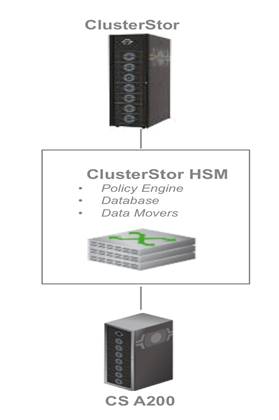
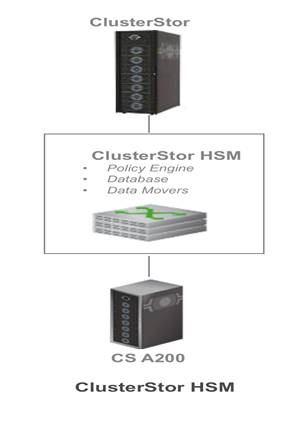
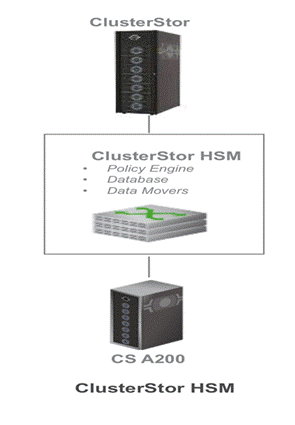
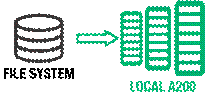
The A200 tiered archive solution delivers compelling storage solutions for two different data management challenges: storage tiering and data/disaster protection. From a storage tiering perspective, the A200 tiering solution is designed to manage ClusterStor and other third party Lustre configurations by offloading data from a higher level storage tier to a less expensive spinning disk storage tier based on customer-defined policies. In a data/disaster protection scenario, the A200 archive can also be used to provide policy-driven constant data backup and disaster protection for Lustre parallel file systems. Each scenario is described in more detail below.
| |
|
|
|
|
Lustre Data / Disaster Protection The A200 also provides a platform for disaster protection because of it cost, performance, and data durability capabilities. The ClusterStor A200 tiering and HSM solution can also be used to provide constant data and disaster protection for Lustre file systems. The protection scenario is very similar to the tiering one, except the data on the primary storage tier is copied to the A200 but isn't stubbed. In fact, many customers start out with a constant disaster protection on active data and then add the stubbing policies later as the data ages. If the A200 is remote from the Lustre system, a disaster protection solution can be implemented. The frequency, speed, and destination of the backup copy determine the strength of the data and disaster protection strategy. | |||
|
Disaster Protection Use Cases for Lustre Backing up to the ClusterStor A200 helps storage administrators recover from disaster scenarios that could affect a Lustre file system, including:
● Loss of all or part of an Object Storage Target (OST) ● Corruption or loss of one or more files
If the copy destination is a remote site, by backing up to a ClusterStor A200, one could even recover from a complete site failure. The ClusterStor A200 backup coverage includes the file metadata in the Metadata Target (MDT) and the file payload in the OST(s). Because the object ID is added to the MDT metadata when it is backed up, an administrator can reconstruct the entire Lustre filesystem using the information stored in the ClusterStor A200 and automated copies of the MDT metadata
Site Failure Protection If the ClusterStor A200 is at a remote site, it can protect against a complete failure of the primary site. The storage administrator can set up a cold standby or a warm standby using a combination of the A200 and a second, low-capacity Lustre file system. The difference is that a warm standby file system receives scheduled ongoing copies of the metadata in the primary Lustre MDT. | |||
|
| |||
|
|
|
| |
|
Remote Disaster Protection |
Local Data Protection |
| |
Cold and Warm Standby RecoveryStorage administrators perform the recovery process, possibly with some Seagate technical assistance, using the backup copies on the ClusterStor A200. The objects stored on the ClusterStor A200 contain the primary file system file payloads, file metadata (such as directories and permissions), and file layout.
With a cold standby file system, recovery could take days or weeks depending on the size of the primary system and whether the standby system hardware was already deployed and configured. In the event of a primary site failure, the administrator would locate the extended attribute metadata (MDT) from a metadata backup image or, if that is not available, would start a job to collect metadata from every object in the ClusterStor A200 and restore that metadata to a new Lustre file system at the remote site. Once the standby system was connected to the A200, the data could be loaded on demand or pre-loaded in bulk simply by accessing the file stubs in the standby system.
With a warm standby file system, recovery would take hours or days depending on how active the primary file system is and how often the metadata is copied to the standby file system. To configure a warm standby solution, a process would be implemented to regularly capture the metadata in the primary Lustre MDT and copy to the A200 or other backup target. This metadata would be restored to the standby system on an an ongoing basis or when the primary file system failed. In either case, the standby file system would show stubs for all files, and the files would be pre-loaded per dataset or retrieved individually per the customer’s workflow. The site administrator is responsible for defining the frequency of the Lustre MDT copy and file migration policies on the primary file system to meet disaster scenario recovery point objectives. |
| ||
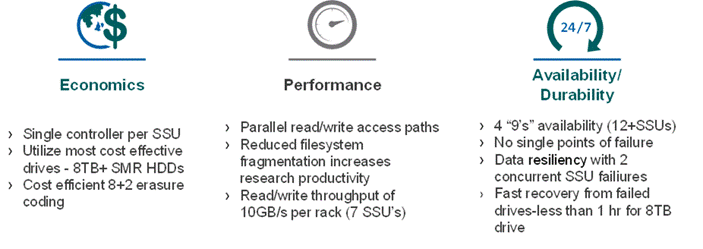
A200 Active ArchiveThe ClusterStor A200 active archive is engineered for productivity and provides an optimal combination of cost, performance, and availability for the most demanding HPC and commercial workloads. The A200 tiered archive delivers up to 50% lower cost than HPC primary storage and 2-3x more performance and higher availability than other archive solutions in the marketplace, while providing near limitless scale-out capabilities in terms of capacity, number of objects and throughput. Customers benefit from industry-leading economic savings, not only in terms of storage and performance costs but also from reduced data center floor space, power, cooling and administrative costs--up to 60% less than competitive active archive solutions. Customers using the A200 can scale the system indefinitely and save up to 50% in storage and operational costs by migrating static data from Lustre primary storage to the A200 active archive object store. · Storage Value: Utilizes cost-effective SMR drives and efficient erasure coding. · Limitless Scale: 3.4 Quintillion (2^128) objects, unlimited object size, unlimited storage capacity. · Linear performance scaling: Up to 10GB/s per rack, and add additional racks to increase performance linearly (up to the network limit). · 4 "nines" of availability. Less than 55 minutes of downtime per year for base configuration. · Over “13 nines” of data durability for base configuration (12 Scalable Store Units (SSU). Getting Archiving Right The A200 succeeds where other archiving solutions fall short, providing a balance of the best economics, highest performance and the best availability and data durability in the marketplace. A200 storage economics are driven by network erasure coding that eliminates the need for multiple controllers per SSU and use of cost-effective SMR drives which deliver 25-30% more capacity per drive platter. The A200 delivers performance through its massively parallel architecture, providing over 10GB/s per rack (7 SSU’s) which is over twice the performance of other object storage systems. The A200 has been designed with system resiliency in mind, ensuring no single points of failure and no single points of maintenance, delivering unmatched availability of over 4- 9's. The ClusterStor A200 utilizes 8+2 networked erasure coding, features less than 1 hour of data rebuild time for an 8TB drive failure and allows linear performance and capacity scalability – all in order to meet the needs of the most demanding HPC environments. |
| ||
|
|
| ||
|
|
| ||
|
A200 Data Availability and Durability
The ClusterStor A200 utilizes network erasure coding to deliver unmatched availability, scalability and cost effectiveness. The A200 also provides extremely high levels of durability by rebuilding data on a failed 8TB drive in less than 1 hour and provides linear performance and capacity scalability to meet the needs of the most demanding high performance computing environments. The ClusterStor A200 has been designed with extreme system resiliency, with no single points of failure and no single points of maintenance downtime.
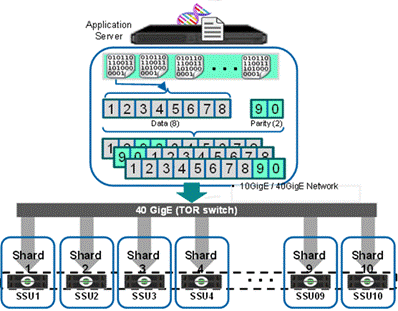
The ClusterStor A200 system supports network erasure coding to provide data and disaster protection. Multiple network erasure coding schemas (called “Data Layouts”) can be concurrently defined and utilized in a single A200 system to deliver separation of data across SSUs if desired.
Seagate’s network erasure coding splits the data parity shards across multiple SSUs which enables data to be available even if multiple SSUs or individual drives fail concurrently. In addition, SSU network erasure coding extends the number of drives that can participate in data reconstruction across SSUs, allowing for massive parallelism and increased reconstruction speed. Increased reconstruction speed in turn shortens the failed drive data rebuild time, leading to an increase in data durability as the system scales.
As shown in the figure, the initial supported ClusterStor A200 erasure coding schema is 8+2, meaning that objects are sharded into eight data shards and 2 parity shards and written across any 10 networked SSUs in the storage pool. An A200 configuration containing ten or more SSUs maintains full data read availability even in the event of two concurrent SSU failures or multiple concurrent drive failures. Note that to maintain full system availability and durability for both reads and writes, a minimum configuration of twelve (12) SSUs is required. Seagate also supports a smaller six (6) SSU A200 configuration with deprecated availability and reliability specifications. |
| ||

|
|
|
|
ClusterStor HSM Gateway |
A200 Base Rack |
|
ClusterStor |
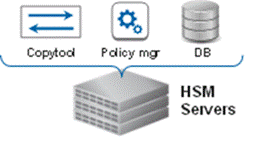
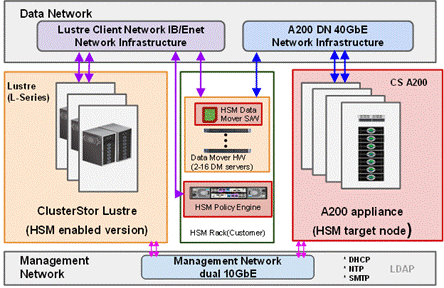
ClusterStor HSM for Lustre is a combination of Seagate-supplied Robinhood Policy Engine and copytool (data mover) software components and customer or partner-supplied servers. | |
|
RobinHood Policy Engine |
RobinHood is an open source policy engine that maintains a replica of Lustre filesystem metadata in a (typically mySQL) database that can be used to specify Lustre HSM actions based on policies defined by storage administrators. Examples of such policies include migration rules for copying Lustre files to the A200 and stubbing rules for freeing up Lustre filesystem capacity. Robinhood provides an overall view of filesystem contents through its web UI and command line tools and implements advanced features for Lustre filesystems (list/purge files per OST or pool, read MDT changelogs). Seagate provides an enhanced and optimized RobinHood to run with Seagate’s Lustre and A200 configurations, and Seagate includes the enhanced RobinHood software as part of the ClusterStor HSM package. A single RobinHood server (customer or partner-supplied) is required per Lustre MDT. | |
|
Copytool (Data Movers) |
Copytool is data transfer software that copies files between the Lustre parallel file system and the A200 Active archive under the direction of the RobinHood policy engine. Seagate has customized the copytool software to communicate with the A200 Clovis API and Seagate includes the updated copytool software as part of the ClusterStor HSM package. Customers can deploy between two and sixteen copytool servers (customer or partner-supplied) to deliver the level of performance required by their workload. | |
|
Typical A200 Tiering Solution Configuration
|
| |
|
ClusterStor A200 Architecture Components
|
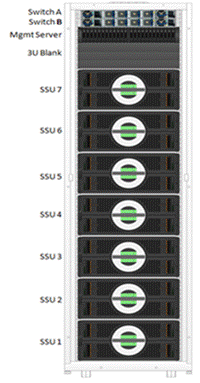
The ClusterStor A200 is a pre-configured rack-based storage solution that delivers predictable performance and eliminates single points of failure. The A200 base rack consists of up to seven SSUs, a highly available ClusterStor management unit (SMU) and redundant 10/40GbE switches. The figure to the right shows the components of the ClusterStor A200 base system. Each of the key components and capabilities is described in more detail in the sections below. | |
|
Hardware Infrastructure & Availability |
The ClusterStor A200 infrastructure components, including the switches, power units, fans, etc. are designed to be completely redundant and hot swappable to supply the highest level of system availability possible. | |
|
A200 ClusterStor Manager
|
The A200 ClusterStor Manager is a comprehensive system management application that is part of the ClusterStor A200 distributed management framework and is responsible for pulling everything together as a single managed system view, including advanced performance monitoring capabilities. ClusterStor Manager consolidates management of the ClusterStor A200 storage infrastructure, network erasure coding data protection layer, and HSM management and monitoring into a single, easy-to-use administrator interface. Initial installation, creation of data layouts, ongoing monitoring and management, expansion and software upgrades are accessed via a single pane of glass. This brings unprecedented system visibility to the storage management system administrator. There is only one CLusterStor Manager per A200 system. | |
|
A200 Scalable Storage Unit (SSU)
|
The ClusterStor A200 SSU is the storage sub-system for the A200 active archive. The A200 SSU s based on the Seagate designed, developed and manufactured industry leading enterprise 5U84 3.5 inch drive platform, featuring: ● 82 SATA and 2 SAS disks per enclosure ● Enterprise level Reliability, Availability and Serviceability ● Platinum certified PSUs ● Adaptive cooling technology
Each 5U84 A200 contains a single embedded storage controller, eighty two 8TB SMR drives, two metadata drives, dual 10GigE network ports, and provides 524 usable TB per tray (up to over 4.1 usable PB per rack) when configured with 8TB drives. The result is an easy to deploy, easy to use, and easy to manage solution. There is no need to guess at how to scale; each SSU is a balanced performance building block delivering a predictable level of performance and storage capacity.
Additional SSUs and expansion racks can seamlessly be added as needed to provide linear capacity and performance scalability. Overall system performance is directly proportional to the number of SSUs to satisfy their performance and/or data capacity needs.
Individual SSUs can be added non-disruptively to ClusterStor A200 at any time to increase total available capacity. When new capacity is added, the A200 rebalances the data across the storage domain in the background, increasing overall system availability, durability and performance.
Overall system performance is directly proportional to the number of SSUs due to ClusterStor’s efficient internal optimization that yields industry leading linear performance scalability. End users simply add SSUs to satisfy their performance and/or data capacity needs. | |
|
Seagate Pre-configured Rack-Based Solutions |
Seagate delivers a pre-configured and factory tested high availability rack-scale solution. Pre- configured solutions provide a fully integrated high performance storage system with comprehensive end to end management and monitoring that simplifies deployment, expansion and support. | |
|
Base Rack |
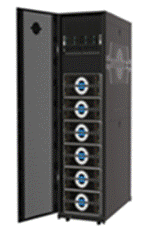
The Seagate provided Base Rack includes top of rack (TOR) switches, a ClusterStor Management Unit and from one to seven SSUs. Base racks are the only racks that contain the SMU. | |
|
Expansion Racks |
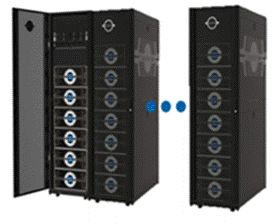
The ClusterStor A200 further expands using expansion racks. Each expansion rack contains a pair of redundant, top of rack management switches and up to seven SSUs. With the addition of each SSU (or addition of expansion rack(s) containing SSUs), the ClusterStor A200 increases performance and capacity. | |
|
Adding A200 Storage Capacity | ||
|
|
| |
|
STEP A : Start with Base Rack |
STEP B: Add additional Expansion Racks | |
Technical Specifications
|
A200 Serviceability | |||||||
|
| |||||||
|
SSU Serviceability
|
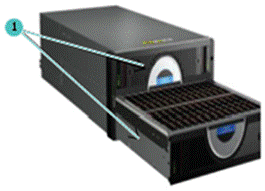
A200 SSU - Two Drawers each containing 42 drive bays The Seagate ClusterStor A200 SSU enclosure is pre-integrated into the Seagate provided rack and offers a high density design, with no single point of failure. At the front of the enclosure there are two drawers, each containing 42 drive bays, supporting 3.5-inch dual-ported SATA drives housed within carriers. Each drawer can be easily accessed from the front of the enclosure, eliminating the need to remove the SSU from the rack. Drives are hot-swappable, enabling the system to remain fully operational within normal thermal specifications for several minutes when a drive is replaced. The platform offers fully redundant power and cooling. The enclosure is designed to maximize the reliability of the High Density Drive (HDD), with vibration dampening and temperature monitoring technology throughout the system. The front panel includes an operator control panel located on the front bezel, which is used to indicate the shelf number where the enclosure is located in a rack and the general health of the enclosure. The rear of the enclosure houses a single Embedded Server Module (ESM), two power supplies, and five cooling modules. The SSU minimizes energy use through advances in Seagate technology including individual drive power control, advanced adaptive cooling technology, and Platinum Certified PSUs that are 92% efficient at 50% load. Additionally, the SSU is designed to meet and exceed stringent worldwide requirements for recycling and environmental friendliness. | ||||||
|
ClusterStor Manager (CSM) |
ClusterStor Manager (CSM) is a browser-based tool that provides a unified system management view, presenting all necessary information from the different sources of information on the platform including hardware, Lustre and storage. CSM supports the Chrome, Firefox, and Internet Explorer browsers and provides functions for use in system configuration, deployment, and day to day end-user operations. CSM also provides the ClusterStor CLI (CSCLI), which includes a robust set of CLI commands, enabling many system actions and functions. The ClusterStor Installer guides the administrator through the automated deployment of all ClusterStor software, configuration and setup of the cluster, including verification tests prior to customer shipment. Once delivered and post-configured at the customer site, CSM provides a browser-based or command line interface feature set that monitors and manages the entire storage cluster and provides assistance with diagnosing operational issues. This browser-based tool is accessible through a direct connection between the customer’s IP network and the ClusterStor Management Server nodes. CSM is fully routable and can be accessed over the Internet if the customer network is configured to support this. | ||||||
|
ClusterStor Serviceability
|
All systems logs are consolidated across the entire cluster into the central management server; this includes logs from every layer of the system from disk drive data through reporting information to Lustre error messages. This enables administrators to easily identify anomalies in the ClusterStor operation and proactively service the system to avoid downtime/performance impacts. The hardware incorporates a modular design that enables commonly failing components to be field serviceable. The most commonly anticipated failure items are disk drives, controller/server modules, power supplies and cooling modules--all of which can be easily serviced without downtime. SSU disk drives are located in a pull out drawer and are released by the press of a button. LED indicators help service personnel identify the correct disk to be repaired. The maintenance operation to remove a failed disk drive and install a replacement drive in an SSU typically take no more than two minutes to complete. After a disk drive is replaced, the system uses a discovery process to identify the new drive and include this new hardware in the available storage inventory. HDD replacement on the SMU metadata storage is identical to the SSU disk drive replacement procedure. The controllers identified as critical to the system are individually serviceable, with a failed module being easily replaced even while data is still being served by the system. | ||||||
|
Warranty Information |
● Hardware Warranty – 12 month limited hardware warranty included with original hardware purchase – Provides return to base hardware repair / replacement / credit via standard process on confirmed failures
· Software Warranty – Ninety (90) days limited software warranty included with original hardware purchase – Delivers remote support on the standard base software version and file system that shipped with your system for the first 90-Days | ||||||
|
Extended Software and Hardware Support |
Tiered offering with all options available from 1 through 5 year extended support.
| ||||||
|
ClusterStor A200 Specifications – General Information (1) and (2) |
System Capacity (raw) |
Up to 4.59PB Raw (3.63 PB Usable) per rack Up to 2 ˄128 objects |
|
System Performance |
Up to 10 GB/s bandwidth performance per rack (req´s dual 40GbE connections to each rack TOR switch) | |
|
SSU Storage |
Seagate 5U84 Storage enclosure, 84 drives, Integrated Storage Server, 10GbE Internal Rack network connections. | |
|
SSU´s per rack |
Up to 7 per rack (base or expansion) | |
|
Maximum Object Size |
Unlimited (up to the size of the available storage) | |
|
Client Software |
Seagate HSM Data Mover | |
|
Network Requirements |
External system management interface (base rack only) |
2 x 1 GbE |
|
External data Interface |
4 x 40GbE (2x from each rack TOR switch) | |
|
External switch infrastructure |
40 GbE switch pair in a HA configuration with LACP support, VLAN support | |
|
A200 Disk Drives |
Data Store |
Seagate 8TB SMR SATA (Lamar) drives (82 per SSU) |
|
Metadata Store |
Seagate 6 GbE/s 6TB SAS drives (2 per SSU) | |
|
Dimensions |
Height |
1,991 mm (78.4 in) |
|
Width |
600 mm (23.62 in) | |
|
Depth |
1,200 mm (47.24 in) | |
|
Weight |
1,194Kg (2,26 lbs.) (preliminary data) | |
|
System Availability |
Data Availability |
Four “nines” (99.99%) with 12 SSU configuration (req´s HA switch infrastructure and dual connections to each TOR switch) |
|
Data Durability |
Eleven “nines” (99.999%) with 12 SSU configuration | |
|
Hot Swappable Components |
Disk Drives, Power Supplies and Power Cooling Modules | |
|
Power Cooling Modules |
Dual fans per SSU | |
|
Power Consumption |
Base Storage Rack Configuration (7SSUs) |
8.25 Kilowatts Peak (preliminary data) |
|
Expansion Storage Rack |
8.00 Kilowatts Peak (preliminary data) | |
|
Single SSU |
1.10 Kilowatts Peal (preliminary data) | |
|
Heat Dissipation |
Base Storage Rack Configuration (7 SSUs) |
28,150 BTU/hr |
|
ClusterStor HSM Specifications – General Information | ||
|
Supported Target Systems |
ClusterStor L – Series or third party Lustre 2.5 x system | |
|
Supported Archives |
CS a200 archive | |
|
HSM PE/DB appliance |
2U24 storage appliance including Seagate ClusterStor HSM SW (RobinHood) | |
|
HSM Data Mover software |
Seagate –Supplied Data mover “copytool” software Requires Customer Supplied Linux Server Min 2 servers required, maximum supported 16 | |
|
Network Requirements | ||
|
HSM PE/DB appliance |
2x 1GbE management interface 1x 40GbE / FDR IB (connected to CS9000) | |
|
Customer Supplied Linux Server (for HSM Data Mover) |
1x 40GbE (connected to A200) and 1x IB/40GbE (connected to CS9000) | |
|
Performance | ||
|
IO Throughout |
Up to 1.5 GB/s per HSM Data Mover | |
|
Update tracking method |
Lustre Robin Hood Changelog | |
|
Power Consumption | ||
|
HSM PE/DB appliance |
700W peak (preliminary data) | |
|
Heat Dissipation | ||
|
HSM PE/DB appliance |
2,388 BTU/hr | |
|
Environment-friendly Products and Approach |
End-of-life Management and Recycling |
Hewlett Packard Enterprise offers end-of-life product return, trade-in, and recycling programs, in many geographic areas, for our products. Products returned to Hewlett Packard Enterprise will be recycled, recovered or disposed of in a responsible manner. The EU WEEE Directive (2012/19/EU) requires manufacturers to provide treatment information for each product type for use by treatment facilities. This information (product disassembly instructions) is posted on the Hewlett Packard Enterprise web site: http://www.hpe.com/RECYCLE These instructions may be used by recyclers and other WEEE treatment facilities as well as Hewlett Packard Enterprise OEM customers who integrate and re-sell Hewlett Packard Enterprise equipment. |
Summary of Changes
|
Date |
Version History |
Action |
Description of Change | ||||||||||||||||||
|
11-Jul-2017 |
Version 1 |
Created |
Create QuickSpecs for Seagate ClusterStor A200 Archive | ||||||||||||||||||
| |||||||||||||||||||||