














Seagate ClusterStor 1500: технические характеристики и документация
В архивеOverview
|
ClusterStor 1500 Best ROI, Departmental Workflow Acceleration and Value
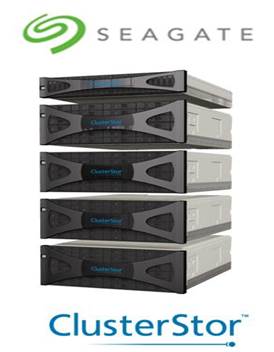
Overview The Seagate ClusterStor 1500 departmental high performance storage solution features modular, factory integrated scale-out storage building blocks, the Lustre® parallel file system and a comprehensive management platform that eliminates the guesswork associated with creating your own high performance computing (HPC) storage solution for data intensive commercial technical computing applications and High Performance Data Analytics (HPDA) workloads.
|
Standard Features
|
Benefits |
|
The ClusterStor 1500 is designed to address department level commercial, industrial, scientific and academic computing workloads, focused on data intensive simulation and modeling applications, requiring superior low latency I/O with high performance throughput scale, along with high reliability, availability, manageability and serviceability.
The ClusterStor 1500 excels in user environments requiring high availability, sustained performance supporting dozens to hundreds of client compute nodes, as well as low latency parallel file system access to significant data sets with usable data storage capacity ranging from sixty tera-bytes (TB) to over seven peta-bytes (PB) and production proven linear scalability from 1.25GB/s up to 105GB/s sustained read and write performance throughput. ClusterStor 1500 Architectural Elements ClusterStor 1500 provides a factory integrated, pre-installed and pre-configured deployment of the Lustre file system, designed to deliver sustained high performance throughput, with integrated high availability and resiliency features, end-to-end system management, and the ability to expand existing systems using modular building blocks. Lustre is open-source client/server based software that uses a distributed architecture and is designed for compute and I/O-intensive, performance-sensitive applications. The Lustre architecture is used for many different types and sizes of Linux clusters, but it is best known for powering many of the Top 500 HPC clusters in the world.
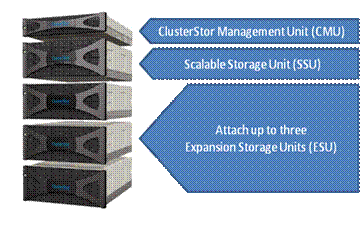
ClusterStor 1500 Scale-Out Storage Building Blocks: • ClusterStor Management Unit (CMU) • Scalable Storage Unit (SSU) • Expansion Storage Unit (ESU) The ClusterStor 1500 CMU and SSU building blocks connect to the customer provided Lustre Client Network (LCN), using two multi-protocol high speed network ports, which support FDR InfiniBand or 40Gbit/sec Ethernet (GbE). Supported configurations provide high throughput balanced I/O connectivity to the customer's Lustre Clients. InfiniBand topologies support Lustre Client nodes with QDR and/or FDR InfiniBand. Ethernet topologies support Lustre Client nodes with 10GbE and/or 40GbE.
Lustre Metadata Server (MDS) Nodes within the ClusterStor Management Unit (CMU) Each ClusterStor 1500 system includes the ClusterStor Management Unit (CMU), which is two rack units (2U) high and contains two embedded storage processing servers and internal disk storage. The CMU is designed to provide Lustre management functions such as Metadata Server (MDS), metadata storage and administrative functions for the ClusterStor solution. Specifically, the two MDS nodes within the CMU manage all metadata associated with the Lustre file system and respond to Lustre client requests to access file system data. The two MDS nodes manage the file system namespace (file and directory names), permissions, file layout information, and network request handling. The MDS nodes redundantly store all file system metadata in the Metadata Target (MDT), which is hosted on the CMU internal disk storage. Within the high availability CMU, the two MDS nodes run in a primary/secondary active-passive configuration on the two embedded storage processing servers that are connected to the shared and redundant MDT storage, which is implemented as a dedicated RAID 10 volume. Each MDS is only active on one server node at a time. In the event the primary MDS node fails, the failover process ensures that the secondary MDS node is activated, takes control of the MDT, and takes over all MDS functions. Also hosted within the high availability CMU are redundant Lustre Management Server (MGS) nodes and redundant ClusterStor Management Server nodes. These are deployed in the same primary/secondary active-passive configuration as the MDS nodes, and work together to provide seamlessly integrated end-to-end management of the ClusterStor high performance storage solution. Lustre Object Storage Server (OSS) Nodes within the ClusterStor Scalable Storage Unit (SSU) The basic building block of the modular ClusterStor system is the Scalable Storage Unit (SSU). The ClusterStor 1500 SSU is four rack units (4U) high and contains two embedded storage processing servers and internal disk storage. The SSU is designed to provide Lustre Object Storage Server (OSS) and Lustre Object Storage Target (OST) functions (note additional Lustre OSTs may be attached to a SSU using up to three Expansion Storage Units, described in the next section). Each Lustre OST uses Lustre MDRAID for data protection and integrity, consisting of RAID 6 (8+2) data plus parity blocks, and one integrated spare drive.
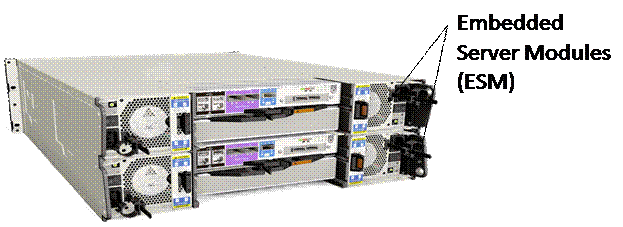
Within the SSU, one Lustre OSS node is contained and hosted within each of the two ClusterStor Embedded Server Module (ESM), shown in figure two. Overall, the ClusterStor 1500 SSU contains and hosts two Lustre OSS nodes and two Lustre OSTs. Additional Lustre OSTs may be added to a ClusterStor 1500 SSU with the attachment of up to three Expansion Storage Units. The ESM is a dedicated x86 hardware server module that utilizes the Storage Bridge Bay (SBB) industry standard form factor, enabling it to plug directly into the modular ClusterStor 1500 SSU 4U enclosure. The ESM combines the attributes of a standard server, a RAID controller and a JBOD, all packaged in one modular design capable of running standard operating systems. Up to two ESMs can be installed in a single SSU enclosure to provide embedded server and storage application functions.
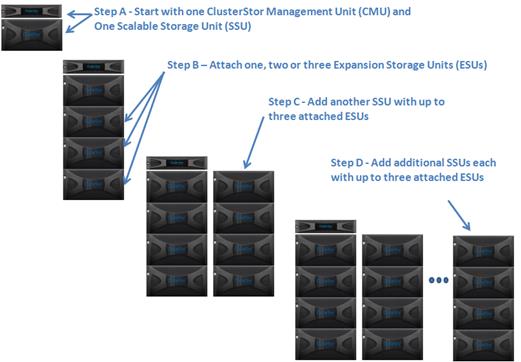
Additional Lustre OSTs - Up to Three Attached ClusterStor Expansion Storage Units (ESU) Each ClusterStor 1500 SSU may attach to up to three ClusterStor 1500 Expansion Storage Units (ESU) building blocks to add more storage capacity and file system performance throughput. The combination of one ClusterStor 1500 SSU and three attached ClusterStor 1500 ESUs provides two Lustre OSS nodes and a total of eight Lustre OSTs. Regarding high availability failover, the two OSS nodes are deployed in an active-active configuration. Each OSS node acts as the primary server for half of the attached OSTs and secondary server for the other half of the OSTs within the SSU and attached ESUs. Upon the failure of one OSS node, the remaining active OSS node takes control of all OSTs within the SSU and attached ESUs.
ClusterStor 1500 Solution with Multiple SSUs and Attached ESUs The ClusterStor 1500 always includes one CMU within the solution and may include multiple SSUs. Each SSU may attach to up to three ESUs, however, all SSUs much have the same number of attached SSUs throughout the configuration. Overall, the ClusterStor 1500 expands performance and storage capacity with the number of SSUs and attached ESUs. See the Installation Guide for details on supported configurations including multiple ClusterStor 1500 SSUs and attached ESUs.
ClusterStor Manager (CSM) ClusterStor Manager (CSM) is a browser-based tool that provides a unified system management view, presenting all of the necessary information from the different sources of information on the platform including: hardware, Lustre file system and storage. CSM supports the Chrome, Firefox, and Internet Explorer browsers and provides functions for use in system configuration, deployment, and day to day end-user operations. CSM also provides the ClusterStor CLI (CSCLI), which includes a robust set of CLI commands enabling many system actions and functions. The ClusterStor Installer guides the administrator through the automated deployment of all ClusterStor software, configuration and setup of the cluster. Once delivered and post-configured at the customer site, CSM provides a browser-based or command line interface feature set that monitors and manages the entire storage cluster and provides assistance with diagnosing operational issues. This browser-based tool is accessible through a direct connection between the customer's IP network and the ClusterStor Management Server nodes. CSM is fully routable and can be accessed over the Internet if the customer network is configured to support this.
ClusterStor Reliability The ClusterStor 1500 system utilizes a distributed processing model. The entire design of the ClusterStor solution is focused on enterprise class design with no single point of failure and truly integrated high availability. The ClusterStor 1500 system includes General Enclosure Management (GEM) which constantly monitors environmental conditions on the system and reports when normal operating conditions are above or below a standard threshold. Besides the ability to monitor the system environmental conditions, GEM can actively control system behavior. For instance, GEM can force a system shutdown if the ambient room temperature exceeds a preset temperature threshold, thereby protecting temperature sensitive components within the system. Higher-level software on the CMU nodes and the ESM nodes are used to initiate failover when a component fails. All hardware components have redundant power connections, power supplies and fans to eliminate component loss due to power or hardware failure. Data and management functions are routed over dual communications interfaces to insure that access to the management of the system and data access are not suspended for any type of failure. Dual ESMs are used to provide multiple paths to the storage components and dual data ports on each drive may access disk drive.
ClusterStor Serviceability All systems logs are consolidated across the entire cluster into the central management server, this includes logs from every layer of the system from disk drive data through reporting information to Lustre error messages. This enables administrators to easily identify anomalies in the ClusterStor operation and proactively service the system to avoid downtime/performance impacts. The hardware incorporates a modular design that enables commonly failing components to be field serviceable. The most commonly anticipated failure items are disk drives, controllers/server modules, power supplies and cooling modules, all of which can be easily serviced without downtime. After a disk drive is replaced, the system uses a discovery process to identify the new drive and include this new hardware in the available storage inventory. HDD replacement on the CMU metadata storage is identical to the SSU disk drive replacement procedure. The controllers themselves, identified as critical to the system are individually serviceable, with a failed module being easily replaced even while data is still being served and all OSTs being accessed thru its partner ESM. |
Additional Features
|
Key Features |
Modular Design Compact footprint suitable for use in customer provided 19 inch industry standard racks Built with scale-out building blocks called Scalable Storage Units (SSU) designed to address midrange commercial, industrial, scientific and academic computing, focused on data intensive simulation and modeling applications, requiring superior low latency I/O with high performance throughput scale, along with high reliability, availability, manageability and serviceability
High Performance Parallel File Access Lustre is the most popular parallel file system for computationally intensive Linux clusters and ClusterStor 1500 makes it easy to deploy and use. The Lustre file system is an open-source file system with a vibrant community. It is purpose designed to enable high performance parallel file access for parallel compute clusters at scale. Lustre provides a single file system that is distributed across all available object server targets. In turn each file is striped across the file system enabling all disk drives to participate in read and write I/O requests simultaneously.
ClusterStor Manager ClusterStor Manager, a comprehensive system management application, is included with every system. ClusterStor Manager is web browser based, part of ClusterStor's distributed management framework and is responsible for pulling everything together as a singly managed system. ClusterStor Manager consolidates management of the storage infrastructure, RAID data protection layer, operating system, and the file system into a single, easy-to-use, administrator interface bringing unprecedented system visibility to the system administrator. |
|
| |
|
Cost Effective |
ClusterStor 1500 delivers affordable, midrange file system performance, scalability and efficiency due to unmatched integration of high availability scale-out storage building blocks which internally concentrate storage processing power in a compact footprint suitable for use in customer provided 19 inch industry standard racks. |
|
| |
|
Scale-Out Performance |
ClusterStor 1500 hardware and integrated Lustre file system architecture enables scale-out performance from over 1 GB/sec to over 100 GB/sec and capacity from 80 TB up to 10.5 PB of raw data storage capacity. |
|
| |
|
Flexibility |
Configurations can scale-out performance linearly, and capacity can be added with up to three Expansion Storage Units attached to each Scalable Storage Unit. Adding Scalable Storage Units adds further scale-out performance and file system processing capability. |
Configuration Information - Factory Integrated Models
|
Qualified Servers with configurations
| |||||||||||||||||||||||||||||||||||||||||||||||||||||||||||||||||||||||||||||
|
Warranty Information |
Hardware Warranty
Software Warranty
| ||||||||||||||||||||||||||||||||||||||||||||||||||||||||||||||||||||||||||||
|
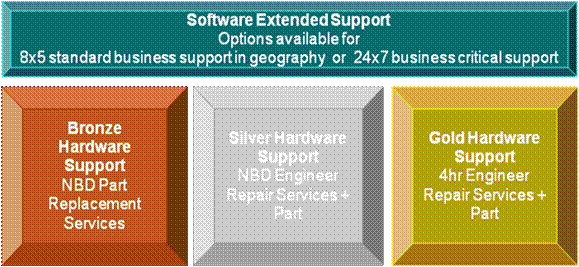
Extended Software and Hardware Support |
Tiered offering with all options available from 1 through 5 year extended support.
| ||||||||||||||||||||||||||||||||||||||||||||||||||||||||||||||||||||||||||||
Summary of Changes
|
Date |
Version History |
Action |
Description of Change: |
|
18-Sept-2015 |
From version 1 to 2 |
Changed |
Remove support section |
|
17- Aug-2015 |
Version 1 |
Created |
Create QS for the Cluster Store 15000 |
|
© Copyright 2015 Hewlett-Packard Development Company, L.P. |