
























Сегодня покупают
← Вернуться назад
Нужна помощь с конфигурацией?
Пришлите SKU, спецификацию или список требований. Специалист Apltech проверит совместимость компонентов и найдёт актуальные артикулы
Получить консультацию →

HPE Aruba VAN SDN Controller Software: технические характеристики и документация

В архиве
Aruba VAN SDN Controller Software

Overview

Aruba VAN SDN Controller Software


Models

Aruba VAN SDN Controller Base Software with 50-node E-LTU

J9863AAE


Key features

  • Enterprise-class platform for the delivery of a broad range of network innovations
  • Compliant with OpenFlow 1.0 and 1.3 protocols
  • Support for over 50 OpenFlow-enabled Hewlett Packard Enterprise (HPE) switch models
  • Open APIs to enable third-party SDN application development
  • Extensible, scalable, resilient controller architecture
  • Ease of deployment with OVA-based controller reducing time and cost of installation

Product overview

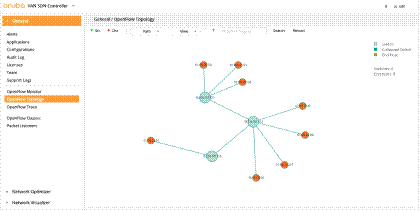
Aruba Virtual Application Networks (VAN) SDN Controller Software provides a unified control point in an SDN-enabled network, simplifying management, provisioning, and orchestration. This enables delivery of a new generation of application-based network services and provides open application programming interfaces (APIs) that allow developers to create innovative solutions to dynamically link business requirements to network infrastructure via either custom Java programs or general-purpose RESTful control interfaces. The Aruba VAN SDN Controller is designed to operate in campus, data center, or service provider environments.

 The VAN SDN Controller is the building block of the Aruba Open SDN Ecosystem (including the Aruba SDN App Store and SDN Software Development Kit), allowing third party developers to deliver innovative solutions to dynamically link business requirements to network infrastructure. VAN SDN Controller software directly provisions physical and virtual switches under its control via the industry-standard OpenFlow protocol, as well as Netconf and SNMP. Network ports, links, and topologies are all directly visible, enabling centralized policy administration and more effective path selection based on a dynamic, global view of the network. This dramatically simplifies the orchestration of multi-tenant environments and the enforcement of network policy for both mobile clients and servers.


Features and Benefits

Virtual machine deployment option
Enables customers to quickly deploy the VAN SDN controller with minimal effort.

Proactive flow processing
Enables highly scalable, centrally orchestrated SDN networks. With this approach, a central application manages the provisioning of endpoints, such as servers or virtual machines in a data center, or fixed endpoints in a campus network.

Reactive flow processing
Enables dynamic monitoring of new flows or endpoints, such as individual user or server sessions. These environments require careful characterization to ensure that all levels of the network infrastructure have the capacity to respond to large numbers of sub-second events.

Graphical user interface (GUI)
Facilitates controller administration and API documentation.

Northbound APIs
• Leverages the controllers extensible RESTful HTTPS interface.
• Provides an abstract representation of the underlying OpenFlow network and allow external applications running above the controller to exert deliberative, business-level control over the network.
• Provides the services necessary to support a full management platform such as HPE Intelligent Management Center (IMC).

Native APIs
Allows Java applications to run within the controller as a collection of OSGi bundles that enable high-performance event and packet processing. These network-level applications are extremely powerful, allowing the personality of the controller to be extended and customized for specific environments. They leverage a three-tier architecture with strict API guidelines for interfacing with external entities, other Java modules, and the controller database.

Scale-out architecture
• Uses scalable, resilient database frameworks, allowing expansion beyond a single standalone controller to a high-availability cluster.
• Based on open-source in-memory database systems, including Hazelcast (for strict consistency), Cassandra (for eventual consistency), and a PostgreSQL relational database.
• Persistent data can be shared among multiple controllers to deliver a scale-out approach to the control of large or demanding networks.

High availability
Provides a "2n+1" active consistency model, which allows three controllers to manage individual subsets of the network while sharing a common network view. The failure of one control component generates a rapid response by the cluster to provide continued network operations.

Controller security
Delivers security at multiple levels. HTTPS is used for the REST API, and the authentication of users and applications is performed by way of the Keystone identity service. Controller-to-switch communications are secured through the Transport Layer Security (TLS) encryption protocol, as specified in the OpenFlow standard.

Link service module
• Utilizes specialized messages to discover physical links between switches in the control domain and monitors port state changes and notifies applications of link event changes.
• Identifies multi-hop links where non-OpenFlow devices separate controlled network segments.

Topology service module
Enhanced SDN network topology view enables the user to search for hosts, switches, or users on the graphical network representation.

Node manager service module
• Monitors ARP, DHCP, and IP packets from edge ports.
• Allows the module to provide a cache of MAC and IP addresses for each end point, which provides identification of devices or users attached to the network.

Path service module
• Utilizes information from the node and topology services to program an end-to-end unidirectional L2 path through the control domain for new network flows.
• Drops unknown source addresses and supports flooding for unknown destinations.
• Can be disabled for normal packet processing, or replaced with a more sophisticated program as desired by the application programmer.

Path diagnostic service
Validates network paths and generates protocol-specific test packets (ICMP, DHCP, UDP, TCP, etc.) that can be inserted into the network and observed at various switches along the path. This provides network administrators with traceroute functionality.

OpenFlow control interface
Uses a generalized approach in the controllers southbound interface to processing OpenFlow 1.0 and 1.3 messages. This provides an efficient and intuitive mechanism for monitoring and programming various network components and for processing new flow messages. Packets are translated into a set of rich data types by the controller, which allows Java applications to easily consume or create messages or packets. Netconf and SNMP southbound drivers are also available.

Flexible packet processing
Enables a hybrid of both OpenFlow and normal packet processing with the Aruba VAN SDN architecture. Access control lists can be provisioned centrally, for example, while L2 or L3 forwarding decisions can be made using standard network protocols. This allows SDN concepts to be applied incrementally to the network, starting with the application of network policy and extending to exception-based forwarding, adding value without replacing traditional switching or routing.


Warranty and Support

Limited electronic and business-hours telephone support is available from Hewlett Packard Enterprise. To reach our support centers, refer to http://www.hpe.com/networking/ contact-support. For details on the duration of support provided with your product purchase, refer to http://www.hpe.com/networking/warrantysummary


Software Releases

To find software for your product, refer to www.hpe.com/networking/support. For details on the software releases available with your product purchase, refer to http://www.hpe.com/networking/warrantysummary


Technical Specifications


Aruba VAN SDN Controller Base Software with 50-node E-LTU (J9863AAE)

Platform required

Ubuntu Server: PostgreSQL 9.1 or higher OpenJDK 8 JVM

Keystone Icehouse or higher Virtual Appliance:

Includes all packages

System requirements, recommended

Server:

2.2 GHz Intel® Xeon® or Intel® Core™ 2 8-core processor or equivalent 16 GB RAM memory

64 GB storage

1000 Mbps NIC

Recommended software

Server:

Ubuntu 14.04 LTS 64-bit

Notes

Performance
Maximum OpenFlow devices: 4,000
Maximum OpenFlow ports: 50,000
Maximum new flows per second (cbench): 2.3 million (single controller)
Maximum new flows per second (cbench): 6.5 million (3 controller team)

Services

Refer to the Hewlett Packard Enterprise website at http://www.hpe.com/networking/services for details on the service-level descriptions and product numbers. For details about services and response times in your area, please contact your local Hewlett Packard Enterprise sales office.

Accessories


Aruba VAN SDN Controller Software accessories

Aruba VAN SDN Controller Base Software with 50-node E-LTU (J9863AAE)


Aruba VAN SDN Controller Base Software with 50-node License E-LTU

J9863AAE

Aruba VAN SDN Controller Additional 50-node E-LTU

J9864AAE

Aruba VAN SDN Controller High Availability E-LTU

J9865AAE


Summary of Changes

Date

Version History

Action

Description of Change

10-Mar-2017

From Version 4 to 5

Changed

Document name and content updated with Aruba information

29-Apr-2016

From Version 3 to 4

Changed

SKU descriptions updated

31-Mar-2016

From Version 2 to 3

Changed

Overview and Technical Specifications updated

24-Apr-2015

From Version 1 to 2

Changed

Overview section and Technical Specifications were updated


Sign up for updates


© Copyright 2017 Hewlett Packard Enterprise Development LP. The information contained herein is subject to change without notice. The only warranties for Hewlett Packard Enterprise products and services are set forth in the express warranty statements accompanying such products and services. Nothing herein should be construed as constituting an additional warranty. Hewlett Packard Enterprise shall not be liable for technical or editorial errors or omissions contained herein.

To learn more, visit http://www.hpe.com/networking

c04111355 - 14711 - Worldwide - V5 - 10-March-2017