


HPE Big Switch Networks Big Cloud Fabric Series: технические характеристики и документация
В архивеOverview
|
Big Switch Networks Big Cloud Fabric Series |
|
Next generation data center switching |
|
|
|
|
|
|
|
Product overview |
|
At Hewlett Packard Enterprise, we help customers use technology to slash the time it takes to turn ideas into value. In turn, we transform industries, markets and lives. Open networking solutions from HPE free you from vendor lock-in. We also give you the ability to scale your cloud data center network to meet your business requirements, while using the resources that best suit your needs and lowering your costs. Big Cloud Fabric together with HPE Altoline strengthen HPE's growing commitment to open network. Big Cloud FabricTM is the next-generation data center switching fabric delivering operational velocity, network automation and visibility for software-defined data centers and cloud native applications, while staying within flat IT budgets. Using hyperscale-inspired networking principles, software controls and leaf/spine CLOS fabric delivered on open networking hardware, Big Cloud Fabric leverages software-defined networking (SDN) to make networks intelligent, agile and flexible. Big switch networks Big Switch's mission is to disrupt the status quo of networking with order of magnitude improvements in network intelligence, agility, and flexibility by delivering Next-Generation Data Center Networking. We do this by delivering all the design philosophies of hyperscale networking in a single solution, applicable for data centers of any size. The Big Cloud Fabric Benefits:
|
|
|

|
Big Cloud Fabric Overview |
|
||
|
Big Cloud Fabric (BCF) is the industry's first data center fabric built using SDN controller software and open networking (white-box or brite-box) hardware switches. Embracing hyper-scale data center design principles, the BCF solution delivers:
Applications can now take advantage of high east-west bisectional bandwidth, secure multi-tenancy, and workload elasticity natively provided by BCF. Customers benefit from unprecedented application agility due to automation, massive operational simplification due to SDN, and dramatic cost reduction due to hardware (HW)/software (SW) disaggregation.
BCF supports both physical and virtual (multi-hypervisor) workloads and choice of orchestration software.1 It provides L2 switching, L3 routing, and L4-7 service insertion and chaining while ensuring high bisectional bandwidth. The scalable fabric is fully resilient with no single point of failure and supports headless mode operations. |
|||
|
|
|||
|
|
|||
|
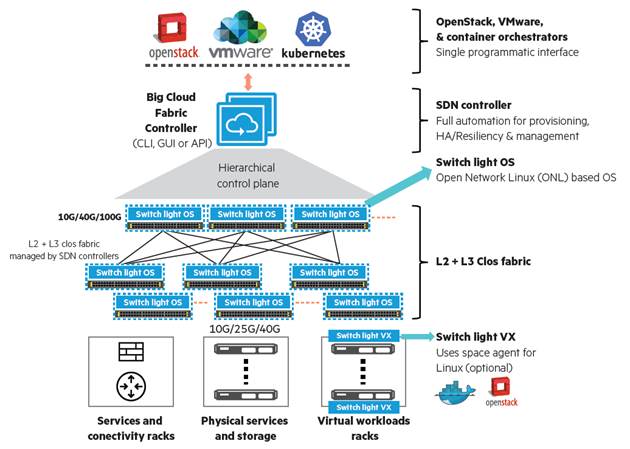
Figure 1: Big Cloud Fabric (Leaf-Spine Clos Architecture) |
|||
|
|
|||
|
Architecture: SDN Software Meets open networking Hardware |
|
||
|
Software Defined Networking (SDN) fabric architecture refers to a separation of the network's data and control plane, followed by a centralization of the control plane functionality. In practice, it implies that the network's policy plane, management plane and much of control plane are externalized from the hardware device itself, using an SDN controller, with few on-device off-load functions for scale and resiliency. The network state is centralized but hierarchically implemented, instead of being fully distributed on a box-by-box basis across access and aggregation switches. Controller-based designs not only bring agility via centralized programmability and automation, but they also streamline fabric designs (e.g. leaf-spine L2/L3 Clos) that are otherwise cumbersome to implement and fragile to operate in a box-by-box design. The BCF architecture consists of a physical switching fabric, which is based on a leaf-spine Clos architecture. Optionally, the fabric architecture can be extended to virtual switches residing in the hypervisor. Leaf and spine switches running Switch LightTM Operating System form the individual nodes of this physical fabric. Switch Light Virtual running within the hypervisor extends the fabric to the virtual switches. Intelligence in the fabric is hierarchically placed: most of it in the BCF Controller (where configuration, automation and troubleshooting occur), and some of it off-loaded to Switch Light for resiliency and scale-out. |
|||
|
|
|||
|
Big Cloud Fabric System Components |
|
||
|
|
|||
|
|
|||
|
Deployment solutions |
|
||
|
BCF is designed from the ground up to satisfy the requirements of physical, virtual or combination of physical and virtual workloads. It supports a wide variety of data center use cases, including:
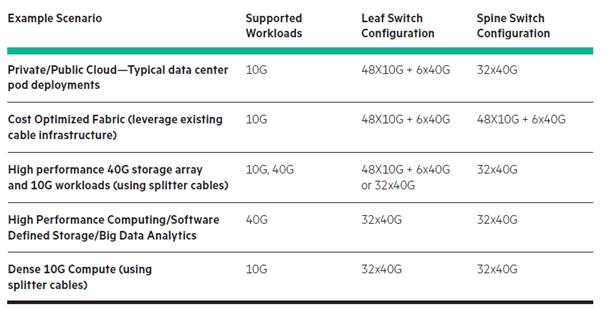
The BCF fabric can be designed to support the above listed deployment scenarios using a combination of open networking Ethernet switch options. A few examples are listed in the table shown in Table 1. |
|||
|
|
|||
|
Table 1: Example BCF Deployment Scenarios |
|||
|
|
|||
|
|
|||
|
Big Cloud Fabric Benefits |
|
||
|
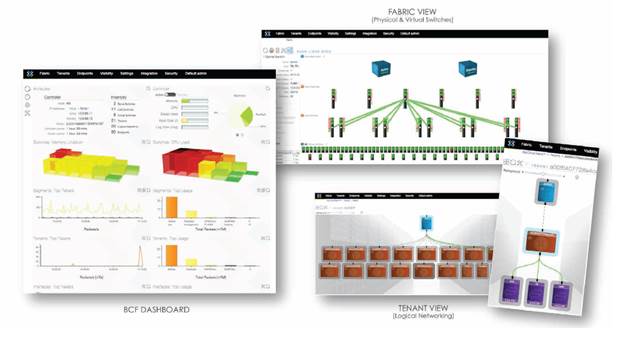
Centralized Controller Reduces Management Consoles By Over 60:1 With configuration, automation and most troubleshooting done via the BCF Controller, the number of management consoles involved in provisioning new physical capacity or new logical apps goes down dramatically. For example, in a 32 rack pod with dual leaf switches and four spine switches, a traditional box-by-box network design would have 68 switch management consoles. The Big Cloud Fabric design has only one-the controller console-that performs the same functions. The result is massive time savings, reduced error rates and simpler automation designs. As a powerful management tool, the controller console exposes a web-based GUI, a traditional networking-style CLI and REST APIs.
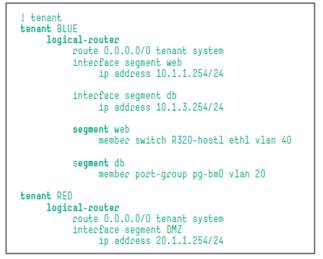
Streamlined Configuration, Enabling Rapid Innovation In the BCF design, configuration in the CLI, GUI or REST API is based on the concept of logical tenants. Each tenant has administrative control over a logical L2/L3/policy design that connects the edge ports under the tenant's control. The Big Cloud Fabric controller has the intelligence to translate the logical design into optimized entries in the forwarding tables of the spine, leaf and vleaf.
Open Networking Switch Hardware Reduces CAPEX Costs By Over 50% By adding up hardware, software, maintenance and optics/cables, a complete picture of the hard costs over three years shows that the savings are dramatic.
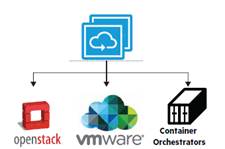
Built-in Orchestration Support Streamlines DC Operations BCF Controller natively supports integration with various Cloud Management Platforms (CMPs)-VMware (vSphere, NSX Manager, vSAN, & VIO), and OpenStack, and Container orchestrators-through a single programmatic interface. This is tremendously simpler and scalable compared to box-by-box networking which demands an exponentially larger number of programmatic interactions with CMPs. Data center admins benefit from streamlined application deployment workflows, enhanced analytics and simplified troubleshooting across physical and virtual environments.
SDN Fabric Enables Deep Visibility and Resilience for OpenStack Networks The BCF OpenStack Neutron plugin for L2/L3 networking provides resiliency necessary for production-grade OpenStack deployments-including support for distributed L3 routing and distributes NAT (Floating IP). The BCF Controller acts as the single pane for provisioning, troubleshooting, visibility and analytics of the entire physical and virtual network environment. This enables data center operators to deploy applications rapidly, simplifies operational workflows and provides immediate root-cause analysis when application performance issues arise.
Network/Security/Audit Workflow Integration BCF Controller exposes a series of REST APIs used to integrate with application template and audit systems, starting with OpenStack. By integrating network L2/L3/policy provisioning with OpenStack HEAT templates in Horizon GUI, the time to deploy new applications is reduced dramatically as security reviews are done once (on a template) rather than many times (on every application). Connectivity edit and audit functions allow for self service modifications and rapid audit-friendly reporting, ensuring efficient reviews for complex applications that go beyond the basic templates. Scale-out (Elastic) Fabric BCF's flexible, scale-out design allows users to start at the size and scale that satisfies their immediate needs while future proofing their growth needs. By providing a choice of hardware and software solutions across the layers of the networking stack and pay-as-you-grow economics, starting small scale and growing the fabric gradually instead of locking into a fully integrated proprietary solution, provides a path to a modern data center network. Once new switches (physical or virtual) are added, the controller adds those switches to the fabric and extends the current configuration hence reducing any error that may happen otherwise. Customers take advantage of one time configuration of the fabric. |
|||
|
|
|||
|
Figure 2: BCF Supports Integration with CMPs |
|||
|
|
|||
|
|
|||
|
Figure 3: BCF Graphical User Interface (GUI) |
|||
|
|
|||
|
DC-grade Resilience BCF provides DC grade resiliency that allows the fabric to operate in the face of link or node failures as well as in the rare situation when the controller pair is unavailable (headless mode). Swapping a switch (in case of HW failure or switch repurpose) is similar to changing a line card in a modular chassis. After re-cabling and power up, the switch boots up by downloading the right image, configuration and forwarding tables. Additionally, the BCF Controller coordinates and orchestrates entire fabric upgrade ensuring minimum fabric down time. These functionalities further enhance fabric resiliency and simplify operations. |
|||
|
|
|||
|
Using BCF: A 3-Tier Application Example |
|
||
|
BCF supports a multi-tenant model, which is easily customizable for the specific requirements of different organizations and applications. This model increases the speed of application provisioning, simplifies configuration, and helps with analytics and troubleshooting. Some of the important terminology used to describe the functionality include:
Tenant-A logical grouping of L2 and/or L3 networks and services.
|
|||
|
|
|
||
|
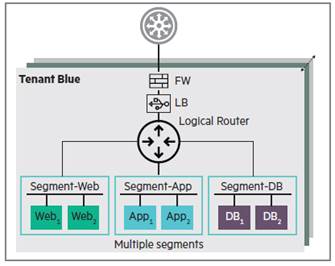
Figure 4: BCF Logical Topology |
Figure 5: Application Centric Configuration |
||
|
|
|||
|
Tenant Workflow In the most common scenario, end consumers or tenants of the data center infrastructure deal with a logical network topology that defines the connectivity and policy requirements of applications. As an illustrative example, the canonical 3-tier application in Figure 4, shows various workload nodes of a tenant named “BLUE”. Typically, a tenant provisions these workloads using orchestration software such as OpenStack, VMware vSphere, or BCF Controller GUI/CLI directly. As part of that provisioning workflow, the BCF Controller seamlessly handles enabling the logical topology onto the physical and virtual switches.
Mapping Logical to Physical The BLUE Tenant has three logical network segments, each of the three segments represents the broadcast domain for the 3-tiers-Web, App and Database. Let's say in this example, Web1,2 and App1,2 are virtualized workloads but DB1,2 is comprised of physical workloads. Following the rules defined by the data center administrator, the orchestration system provisions requested workloads across different physical nodes within the data center. As an example, the logical topology shown in Figure 4 could be mapped on the pod network. The BCF Controller handles the task of providing optimal connectivity, between these loads dispersed across the pod, while ensuring tenant separation and security. In order to simplify the example, we only show racks that host virtualized and physical workloads in the figure below, but similar concepts apply for implementing tenant connectivity to external router and chaining shared services. An illustrative sample set of entries in various forwarding tables highlight some of the salient features of BCF described in earlier sections.
|
|||
|
|
|||
|
Big Cloud Fabric features |
|
||
|
|
|||
|
Feature |
Description/Benefit |
||
|
Zero Touch Fabric (ZTF) |
ZTF enables complete control and management of physical switches within BCF without manually interacting with the switches. It tremendously simplifies day-to-day network operations: |
||
|
|||
|
|||
|
|||
|
|
|
||
|
Fabric LAG |
Fabric LAG combines the underlying LAG functionality in switching ASICs with the centralized visibility of the SDN controller to create a highly resilient and efficiently balanced fabric. Compared to spanning tree protocols or even traditional MLAG/ECMP based approaches to multi-path fabric formation, Fabric LAG technology enables significantly reduced convergence time on topology changes and dramatically reduced configuration complexity. |
||
|
|
|
||
|
Fabric Sync |
Fabric Sync intelligently synchronizes Controller Information Base (CIB) with fabric node's Forwarding Information Base (FIB) using the OpenFlow protocol. During a topology change, only delta updates are synced across impacted switches. Fabric Sync ensures strong CIB-FIB consistency, as it is the single point of control for maintaining all forwarding and associated policy tables. |
||
|
|
|
||
|
Resilient Headless Mode |
In situations when both controllers are unreachable, fabric nodes are considered to be running in Headless mode. In this mode, all provisioned services continue to function as programmed prior to entering the Headless mode. Additionally, multiple levels of redundancy enable a highly resilient and self-healing fabric even during headless mode. |
||
|
|
|
||
|
Centrally-managed Fabric |
Big Cloud Fabric Controller provides single-pane-of-glass for entire fabric. |
||
|
|
|
||
|
(GUI, CLI & REST APIs) |
|
||
|
|||
|
Single-pane-of-glass fabric management enhances operational simplicity by providing a centralized dashboard for fabric management as well as quick and easy access to troubleshooting, analytics and telemetry information. Additionally, it provides simplified workflow for network operators and administrators. |
|||
|
|
|
||
|
Fabric Analytics |
Fabric Analytics is the set of features that provides Advanced Multi-node Troubleshooting, Analytics & Telemetry in the Big Cloud Fabric solution. |
||
|
|
|
||
|
API-first Fabric |
Big Cloud Fabric Controller is highly programmable due to its “API-first” design principle and can be implemented as a closed loop feedback system. For example, security applications can dynamically detect threats and program the BCF controller for mitigation. The BCF GUI and CLI utilize the underlying REST APIs-hence are by definition consistent and hardened. |
||
|
|
|
||
|
Tenant-aware Fabric |
Big Cloud Fabric provides built-in multi-tenancy via tenant-aware configurations, tenant separation and fine-grain inter-tenant access control. Configuration in the CLI, GUI or REST API is based on the concept of logical tenants. |
||
|
|
|
||
|
Service-aware Fabric |
Big Cloud Fabric supports L3 virtual and physical service insertion and service chaining. Services can be shared across tenants or dedicated to a specific tenant. |
||
|
|
|
||
|
L2 Features |
|
||
|
|
|
||
|
L3 Features |
|
||
|
|
|
||
|
QoS |
|
||
|
|
|
||
|
High Availability |
|
||
|
|
|
||
|
Security |
|
||
|
|
|
||
|
OpenStack Integration |
|
||
|
|
|
||
|
VMware vCenter Integration |
Provides Fabric Automation and Visibility including: |
||
|
|||
|
|
|
||
|
VMware NSX-v Support |
Close the overlay/underlay gap for visibility and troubleshooting. Features include: |
||
|
|||
|
|
|
||
|
VMware vSAN Support |
|
||
|
|
|
||
|
Container Support2 |
|
||
|
|
|
||
|
Multi-Orchestration Support |
Support Multiple Virtual PODs (vPODs) on single BCF Fabric |
||
|
|
|
||
|
|
|
||
|
Inter-Pod Connectivity |
|
||
|
|
|
||
|
MIBs |
Documented in a separate MIB's document |
||
|
|
|
||
|
Industry Standards |
|
||
|
|
|
||
|
Support for Open Networking Ethernet Switch |
Support Broadcom Trident-II, Trident-II+ & Tomahawk ASICs for 10G, 25G, 40G and 100G switch from HPE Altoline. The following models are supported: HPE Altoline 6921, Altoline 6941 and Altoline 6960. |
||
|
For the complete list of supported switch and configurations as well as optics/cables, included in the Big Cloud Fabric Hardware Compatibility List (HCL), please https://www.hpe.com/us/en/networking/data-center.html. |
|||
|
|
|
||
|
Fabric Management |
|
||
|
|
|||
Configuration
|
Build To Order: BTO is a standalone unit with no integration. BTO products ship standalone are not part of a CTO or Rack-Shippable solution. | |||
|
|
|||
|
Hardware Controller Appliance |
| ||
|
|
| ||
|
BSN BCF Appl HWB HPE Prp Need Sup |
JL553A | ||
|
See Configuration NOTE: 1, 5 | ||
|
|
| ||
|
PDU Cable NA/MEX/TW/JP |
JL553A#B2B | ||
|
| ||
|
|
| ||
|
PDU Cable ROW |
JL553A#B2C | ||
|
| ||
|
|
| ||
|
High Volt Switch to Wall Power Cord |
JL553A#B2E | ||
|
| ||
|
|
| ||
|
No Power Cord |
JL553A#AC3 | ||
|
| ||
|
|
| ||
|
BSN BCF Appl HWBL HPE Pp Need Sup |
JL554A | ||
|
See Configuration NOTE: 2, 5 | ||
|
|
| ||
|
PDU Cable NA/MEX/TW/JP |
JL554A#B2B | ||
|
| ||
|
|
| ||
|
PDU Cable ROW |
JL554A#B2C | ||
|
| ||
|
|
| ||
|
High Volt Switch to Wall Power Cord |
JL554A#B2E | ||
|
| ||
|
|
| ||
|
No Power Cord |
JL554A#AC3 | ||
|
| ||
|
|
| ||
|
Virtual Controller Appliance |
| ||
|
|
| ||
|
BSN BCF Cntrl VM SW 3Rk 1y 24x7 E-LTU |
JL507AAE | ||
|
See Configuration NOTE: 3 | ||
|
|
| ||
|
BSN BCF Cntrlr VM SW 3Rk Prp Nd Sp E-LTU |
JL508AAE | ||
|
See Configuration NOTE: 4 | ||
|
|
| ||
|
Configuration Rules: |
| ||
|
|
|
| |
|
Note 1 |
OCA Blue NOTE: If Managing > Six (6) but < Thirty Two (32) Leaf Switches, use this HWB Hardware Appliance | ||
|
|
| ||
|
Note 2 |
OCA Blue NOTE: If Managing > Thirty Two (32) Leaf Switches OR Using P+V (with Virtual Switch), use this HWBL Hardware Appliance | ||
|
|
| ||
|
Note 3 |
OCA Blue NOTE: If Managing < Six (6) Leaf Switches in P Configuration (without Virtual Switch), use this Virtual Controller | ||
|
|
| ||
|
Note 4 |
OCA Blue NOTE: If Managing < Six (6) Leaf Switches in P Configuration (without Virtual Switch), use this Virtual Controller | ||
|
|
| ||
|
Note 5 |
Localization (Wall Power Cord) required on orders without #B2B, #B2C (PDU Power Cord) or #B2E. (See Localization Menu) | ||
|
|
| ||
|
Remarks: |
| ||
|
|
OCA Blue NOTE: Attention Sales, Partners/Distributors: All BOMs containing Big Switch Networks SKUs must be registered before a quote can be generated or an order can be placed. Please request confirmation via the regional email nodes listed here before proceeding. APJ: APJ-BSN-deal-registration apj-bsn-deal-registration@hpe.com EMEA: EMEA-BSN-deal-registration emea-bsn-deal-registration@hpe.com America: AMS-BSN-deal-registration ams-bsn-deal-registration@hpe.com | ||
|
|
|
| |
|
Switch Licenses |
| ||
|
|
| ||
|
SWITCH LICENSES FOR BCF |
| ||
|
System (std 0 // max 999) User Selection (min 0 // max 999) |
| ||
|
|
| ||
|
BSN BCF Swch SW 1800G BW 1y 24x7 E-LTU |
JL498AAE | ||
|
Big Switch Networks BCF Switch Software for Max 1800G BW 1yr Subscription 24x7 Support E-LTU |
| ||
|
|
| ||
|
BSN BCF Swch SW 1800G BW 3y 24x7 E-LTU |
JL499AAE | ||
|
| ||
|
|
| ||
|
BSN BCF Swch SW 1800G BW 5yr 24x7 E-LTU |
JL500AAE | ||
|
| ||
|
|
| ||
|
BSN BCF Swch SW 3200G BW 1y 24x7 E-LTU |
JL501AAE | ||
|
| ||
|
|
| ||
|
BSN BCF Swch SW 3200G BW 3y 24x7 E-LTU |
JL502AAE | ||
|
| ||
|
|
| ||
|
BSN BCF Swch SW 3200G BW 5y 24x7 E-LTU |
JL503AAE | ||
|
| ||
|
|
| ||
|
Remarks: |
| ||
|
|
OCA Blue NOTE: Each Switch Software Subscription SKU contains a per switch price for the period defined by the SKU; includes support.
If the switch has a bandwidth <= 1800G, then select one of the following: JL498AAE - BSN BCF Swch SW 1800G BW 1y 24x7 E-LTU JL499AAE - BSN BCF Swch SW 1800G BW 3y 24x7 E-LTU JL500AAE - BSN BCF Swch SW 1800G BW 5yr 24x7 E-LTU
If the switch has a bandwidth > 1800G but <= 3200G, then select one of the following: JL501AAE - BSN BCF Swch SW 3200G BW 1y 24x7 E-LTU JL502AAE - BSN BCF Swch SW 3200G BW 3y 24x7 E-LTU JL503AAE - BCF Swch SW 3200G BW 5y 24x7 E-LTU |
| |
|
|
| ||
|
|
| ||
|
VSWITCH LICENSES FOR BCF |
| ||
|
For JL554A System (std 0 // max 999) User Selection (min 0 // max 999) per Hardware Controller Appliance | |||
|
|
| ||
|
BSN BCF vSwch SW 1y 24x7 E-LTU |
JL504AAE | ||
|
| ||
|
|
| ||
|
BSN BCF vSwch SW 3y 24x7 E-LTU |
JL505AAE | ||
|
| ||
|
|
| ||
|
BSN BCF vSwch SW 5y 24x7 E-LTU |
JL506AAE | ||
|
| ||
|
|
| ||
|
Remarks: |
| ||
|
|
OCA Blue NOTE: Each vSwitch Software Subscription SKU contains a per switch price for the period defined by the SKU; includes support.
Select this license if use case is P + V |
| |
|
|
| ||
|
Support |
| ||
|
|
| ||
|
Support for VM Controller |
| ||
|
For JL508AAE System (std 0 // max 1) User Selection (min 1 // max 1) per Virtual Controller Appliance |
| ||
|
|
| ||
|
BSN BCF Cntrlr VM SW 1y 24x7 E-LTU |
JL509AAE | ||
|
| ||
|
|
| ||
|
BSN BCF Cntrlr VM SW 3y 24x7 E-LTU |
JL510AAE | ||
|
| ||
|
|
| ||
|
BSN BCF Cntrlr VM SW 5y 24x7 E-LTU |
JL511AAE | ||
|
| ||
|
|
| ||
|
Support for HWB Hardware Appliance |
| ||
|
For JL553A System (std 0 // max 1) User Selection (min 1 // max 1) per Hardware Controller Appliance |
| ||
|
|
| ||
|
BSN BCF Cntrl Appl HWB 1y 24x7 Sup E-LTU |
JL543AAE | ||
|
| ||
|
|
| ||
|
BSN BCF Cntrl Appl HWB 3y 24x7 Sup E-LTU |
JL544AAE | ||
|
| ||
|
|
| ||
|
BSN BCF Cntrl Appl HWB 5y 24x7 Sup E-LTU |
JL545AAE | ||
|
| ||
|
|
| ||
|
Support for HWBL Hardware Appliance |
| ||
|
For JL554A System (std 0 // max 1) User Selection (min 1 // max 1) per Hardware Controller Appliance |
| ||
|
|
| ||
|
BSN BCF Cntrl Apl HWBL 1y 24x7 Sup E-LTU |
JL546AAE | ||
|
| ||
|
|
| ||
|
BSN BCF Cntrl Apl HWBL 3y 24x7 Sup E-LTU |
JL547AAE | ||
|
| ||
|
|
| ||
|
BSN BCF Cntrl Apl HWBL 5y 24x7 Sup E-LTU |
JL548AAE | ||
|
| ||
|
|
| ||
|
Services |
| ||
|
|
| ||
|
Training and Professional Services |
| ||
|
System (std 0 // max 99) User Selection (min 0 // max 99) |
| ||
|
|
| ||
|
BSN BCF 3d SW Instl Cntrl + 6 Swch E-LTU |
JL512AAE | ||
|
| ||
|
|
| ||
|
BSN BCF Archt Ovrvw 3d Adv Trning E-LTU |
JL513AAE | ||
|
| ||
|
|
| ||
|
|
| ||
|
|
| ||
Technical Specifications
|
BCF Controller Appliance Specification | ||
|
| ||
|
The BCF Controller can be deployed either as a physical appliance (production or lab deployment) or as a virtual machine appliance (for limited scale production or lab deployment). Physical appliance is also available in NEBS form factor.
BCF Controller-Physical Appliance Specification The BCF controller is available as enterprise-class, 2-sockets, 1U rack-mount physical appliance designed to deliver the right combination of performance, redundancy and value in a dense chassis. It comes in two versions-Standard and Large. | ||
|
| ||
|
Feature |
Technical Specification | |
|
Controller |
HWB HPE DL360 Gen9 JL553A (Standard) |
HWBL HPE DL360 Gen9 JL554A (Large) |
|
|
|
|
|
Processor |
Intel® Xeon® Processor E5-2620 v4 20M Cache, 2.10 GHz |
Intel® Xeon® Processor E5-2650 v4 30M Cache, 2.20 GHz |
|
# of Cores 8 |
# of Cores 12 | |
|
# of Threads 16 |
# of Threads 24 | |
|
Processor Base Frequency 2.10 GHz Max Turbo Frequency 3.00 GHz Cache 20 MB SmartCache |
Processor Base Frequency 2.20 GHz Max Turbo Frequency 2.90 GHz Cache 30 MB SmartCache | |
|
Bus Speed 8 GT/s QPI |
Bus Speed 9.6 GT/s QPI | |
|
# of QPI Links 2 TDP 85 W |
# of QPI Links 2 TDP 105 W | |
|
VID Voltage Range 0 |
VID Voltage Range 0 | |
|
|
| |
|
Form Factor |
1U Rack Server | |
|
SFF Drives: 3.44 x 17.54 x 26.75 in (8.73 x 44.55 x 67.94 cm) | ||
|
|
| |
|
Memory |
4 x HPE 16GB (1x16GB) Single Rank x4 DDR4-2400 CAS-17-17-17 Registered Memory Kit | |
|
|
| |
|
Hard Drive |
2 x HP 1TB 6G SATA 7.2K rpm SFF (2.5-inch) SC Midline 1yr Warranty Hard Drive | |
|
|
| |
|
Networking |
HPE Ethernet 10Gb 2-port 560SFP+ Adapter HP H240ar FIO Smart HBA | |
|
|
| |
|
Power |
2 x Hot Plug Power Supplies 500W | |
|
|
| |
|
Additional Features |
Fan fault tolerance; ECC memory, interactive LCD screen; ENERGY STAR® compliant | |
|
|
| |
|
Temperature-Continuous Operation |
10°C to 35°C (50°F to 95°F) | |
|
|
| |
|
Temperature-Storage |
-30°C to 60°C (-40°F to 149°F) with a maximum temperature gradation of 20°C per hour | |
|
|
| |
|
Relative Humidity-Continuous |
8% to 90% with 24°C (72.5°F) maximum dew point | |
|
|
| |
|
Relative Humidity-Storage |
5% to 95% at a maximum wet bulb temperature of 38.7°C (101.7°F) | |
|
|
| |
|
Altitude-Continuous |
3050m (10,000ft) | |
|
|
| |
|
Altitude-Storage |
9144m (30,000ft) | |
|
|
| |
|
NOTE: For NEBS appliance details please contact the HPE Networking Sales +1-888-269-4073 | ||
|
| ||
|
| ||
|
VM Appliance Specification | ||
|
The Big Cloud Fabric Controller is available as a Virtual Machine appliance for the following environments (for limited scale production or lab deployment). | ||
|
| ||
|
Environment |
Lab Only |
Production |
|
Linux KVM |
Ubuntu 14.04 |
|
|
|
|
|
|
Vmware ESXi |
Version 6.0 |
|
|
|
|
|
|
Red Hat RHEL |
RHEL 7.2 |
RHEL 7.2 |
|
|
|
|
|
vCPU |
10 vCPU |
12 vCPU |
|
|
|
|
|
vMemory |
56 GB of Virtual Memory, |
56 GB of Virtual Memory, |
|
|
|
|
|
HDD |
300GB HDD |
300GB HDD |
|
|
|
|
|
vNIC |
4 vNIC |
4 vNIC |
|
| ||
|
NOTE: The above table explicitly indicates the Major/Minor/Maintenance versions tested and supported by Big Cloud Fabric. Versions other than the ones listed above will not be supported. | ||
|
| ||
|
NOTE: A VM's performance depends on many other factors in the hypervisor setup, and as such, we recommend using hardware appliance for production deployment greater than two racks. | ||
|
| ||
|
| ||
|
Supported Workloads & Orchestration Systems |
||
|
The Big Cloud Fabric Controller is available as a Virtual Machine appliance for the following environments (for limited scale production or lab deployment). |
||
|
|
||
|
Feature |
Technical Specification |
|
|
Physical Workloads |
Bare-metal server workloads |
|
|
|
|
|
|
Virtual Workloads |
VMware Integration with vSphere 6.0. For OpenStack see table below. Support any virtual workload on BCF P Fabric without integration. |
|
|
|
|
|
|
Cloud Orchestration |
OpenStack (Neutron ML2 driver, Neutron L3 Plugin) VMware VIO |
|
|
|
|
|
|
|
||
|
Open Stack Integration |
||
|
|
||
|
Hypervisor |
OpenStack - MITa kA (beta) |
OpenStack - Liberty |
|
KVM |
Ubuntu 14.04 |
Ubuntu 14.04 (Mirantis OpenStack-Fuel 8.0) |
|
CentOS 7.2 (Packstack) |
CentOS 7.2 (Packstack) |
|
|
RHEL 7.2 (RHOSP 9) |
RHEL 7.2 (RHOSP 8) |
|
Summary of Changes
|
Date |
Version History |
Action |
Description of Change |
|
04-Sep-2014 |
From Version 2 to 3 |
Changed |
Configuration section updated |
|
11-Aug-2017 |
From Version 1 to 2 |
Changed |
Images fixed |
|
07-Aug-2017 |
Version 1 |
Created |
Document creation |
| ||||||||||||||||||