


Arista Modular Switches: технические характеристики и документация
В архивеOverview
|
Arista Modular Switching Solutions |
|
|
|
|
|
|
|
Product overview |
|
The Arista Modular Switches offer an ideal platform for building high performance data center networks. Designed for large virtualized and cloud networks Arista Modular Switches are high performance universal spine switches. They combine 100GbE density with Internet scale table sizes and comprehensive L2 and L3 features. Advanced Arista Extensible Operating System (EOS) features for network monitoring, precision timing, VXLAN network virtualization are combined with extensive hardware resources with a rich choice of systems and line cards to support lasting investment protection. |
|
|
|
Cloud Optimized Performance True line rate non-blocking switching to enable dramatically faster and simpler network designs for data centers that lowers network capital and operational expenses. Deep buffer virtual output queue (VOQ) architecture that reduces head-of-line (HOL) blocking and under congested scenarios.
Designed for High Availability and Manageability Arista EOS advanced features provides control, and visibility with single point of management. Networked applications for workload mobility, smart systems rollback and upgrades and workflow telemetry.
Virtualization and Provisioning Supports evolving virtualized data centers and tight integration with orchestration tools and encapsulation technologies such as VXLAN. Supports LANZ for microburst detection, VM Tracer, Zero Touch Provisioning (ZTP), sFlow (RFC3176) and Advanced Event Monitoring for increased flexibility.
Low Total Cost of Ownership Designed to be efficient with power per port as low as 25 W per 100GbE port which combined with front to rear cooling optimizes the data center environment to produce a reliable, dense and power efficient modular switch. |
|
|
|
Overview (Arista 7300 Series) | ||
|
| ||
|
The Arista 7300 Series modular switches are part of the Arista portfolio of data center switches. The 7300 Series with 7300X Series line cards increase flexibility and scalability for data center switches supporting both leaf and spine and SplineTM applications for collapsed end of row and aggregation. The 7300X systems share a common architecture with the Arista 7050X and 7250X Series and oï¬er a choice of three modular systems, a 4-slot, 8-slot and 16 slot that support advanced features for network monitoring, precision timing and network virtualization to deliver scalable high performance for software defined cloud networking.
Increased adoption of 10 Gigabit Ethernet servers and applications requiring higher bandwidth is driving rapid adoption of 10 and 40 Gigabit Ethernet switching. The 7300 Series support a choice of high density line cards in combination with wire speed layer 2/3/4 performance that provides a flexible combination of 100M, 1G, 10G and 40G switching to design large leaf and spine networks for scale-out of east-west traï¬c patterns with low latency and power eï¬ciency. With reversible front-to-rear or rear-to-front airflow, redundant and hot swappable supervisor, power, fabric and cooling modules the system is purpose built for data centers. The 7300 Series is energy eï¬cient with typical power consumption of under 3 watts per 10GbE port for a fully loaded chassis. All of these attributes make the Arista 7300 Series an ideal platform for building reliable, low latency, resilient and scalable data center networks. Combined with Arista EOS the 7300 Series delivers advanced features for big data, cloud, virtualized and traditional designs. | ||
|
|
| |
|
| ||
|
Arista 7300X Series Modular Data Center Switches | ||
|
|
| |
|
Product Highlights |
| |
|
|
| |
|
Performance
High Availability
Cloud Networking Ready
Advanced Provisioning & Monitoring
|
Resilient Control Plane
Data Center Class Design
Arista Extensible Operating System
| |
|
|
| |
|
Arista EOS All Arista products including the 7300 Series runs the same Arista EOS software binary image simplifying network administration with a single standard across all switches. Arista EOS is a modular switch operating system with a unique state sharing architecture that cleanly separates switch state from protocol processing and application logic. Built on top of a standard Linux kernel, all EOS processes run in their own protected memory space and exchange state through an in-memory database. This multi-process state sharing architecture provides the foundation for in-service-software updates and self-healing resiliency together with stateful switchover without the loss of data plane forwarding.
Arista EOS enables advanced monitoring and automation capabilities such as Zero Touch Provisioning, LANZ, VM Tracer and Linux based tools to be run natively on the switch.
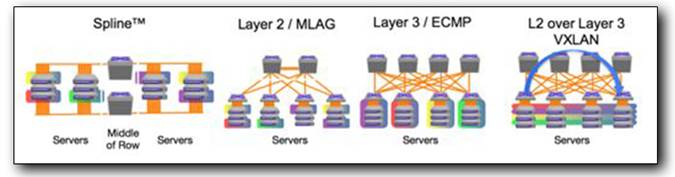
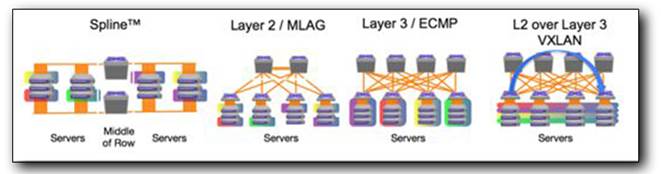
Scaling Data Center Performance The Arista 7300X Series delivers wire speed switching at later 2 and layer 3 to enable dramatically faster and simpler network designs for data centers that lowers network capital and operational expenses. When used in conjunction with Arista 1G and 10G leaf switches and Arista's Multi-Chassis Link Aggregation (MLAG) technology, a pair of 7300X Switches can support over 12,000 Servers with a leaf and spine active/active L2 network topology. A combination of 16 7300X in a spine at Layer 3 scales the network up to over 32K 10G Servers in a fully non-blocking, low-latency, two-stage network that provides predictable and consistent application performance. The flexibility of the L2 and L3 multi-path design options combined with support for open standards provides maximum flexibility, scalability and network wide virtualization. Arista EOS advanced features provides control, and visibility with single point of management. | ||
|
| ||
|
Arista Leaf-Spine Two-Tier and Spline One-Tier Network Architectures | ||
|
Software Defined Cloud Networks Arista Software Defined Cloud Networking (SDCN), combines the principles that have made cloud computing the unstoppable force that it is: automation, self service provisioning, and linear scaling of both performance and economics coupled with the trend in Software Defined Networking that delivers: network virtualization, custom programmability, simplified architectures, and lower capital expenditure. This combination creates a best-in-class software foundation for maximizing the value of the network to both the enterprise and service provider data center. A new architecture for the most mission-critical location within the IT infrastructure that simplifies management and provisioning, speeds up service delivery, lowers costs and creates opportunities for competitive diï¬erentiation, while putting control and visibility back in the hands of the network and systems administrators.
The Four Pillars of Arista's Software Defined Cloud Networking:
Dynamic Buï¬er Allocation In cut-through mode, the Arista 7300X series switches forward packets with a latency of less than 2 usec. Upon congestion, the packets are buï¬ered in shared packet memory that has a total size of 12 Mbytes. Unlike other architectures that have fixed per-port packet memory, the 7300X Series use Dynamic Buï¬er Allocation (DBA) to allocate up to 6MB of packet memory to a single port for lossless forwarding.
Maximum Flexibility for Scale Out Network Designs Scale out network designs enable solutions to start small and evolve over time. A simple two-way design can grow as wide as 64-way without significant changes to the architecture. The 7300X Series include enhancements that allow for flexible scale-out designs:
Enhanced Features for High Performance Networks The Arista 7300X Series delivers a suite of advanced traï¬c control and monitoring features to improve the agility of modern high performance environments, with solutions for data monitoring, precise timing and next-generation virtualization.
Smart System Upgrade Smart System Upgrade is a network application designed to address one of the most complicated and challenging tasks facing data center administrators - network infrastructure maintenance. Changes to the underlying network infrastructure can aï¬ect large numbers of devices and cause significant outages. SSU provides a fully customizable suite of features that tightly couples data center infrastructure to technology partners allowing for intelligent insertion and removal, programmable updates to software releases and open integration with application and infrastructure elements.
Precise Data Analysis Arista Latency Analyzer (LANZ) is an integrated feature of EOS. LANZ provides precise real-time monitoring of micro-burst and congestion events before they impact applications, with the ability to identify the sources and capture aï¬ected traï¬c for analysis.
Virtualization Supporting next-generation virtualized data centers requires tight integration with orchestration tools and emerging encapsulation technologies such as VXLAN. The 7300 Series builds on the valuable tools already provided by the Arista VM Tracer suite to integrate directly into encapsulated environments. Oï¬ering a wire-speed gateway between VXLAN and traditional L2/3 environments, the 7300 Series makes integration of non-VXLAN aware devices including servers, firewalls and load-balancers seamless and provides the ability to leverage VXLAN as a standards based L2 extension technology for non-MPLS environments.
Advanced Event Management (AEM) Simplifying the overall operations, AEM provides the tools to customize alerts and actions. AEM is a powerful and flexible set of tools to automate tasks and customize the behavior of EOS and the operation of the overall data center switching infrastructure. AEM allows operators to fully utilize the intelligence within EOS to respond to real-time events, automate routine tasks, and automate actions based on changing network conditions.
Unified Forwarding Table Cloud network scalability is directly impacted by the size of a switches forwarding tables. In many systems a 'one size fits all' approach is adopted using discrete fixed size tables for each of the common types of forwarding entry. The Arista 7300X leverages a common Unified Forwarding Table for the L2 MAC, L3 Routing, L3 Host and IP Multicast forwarding entries, which can be partitioned per entry type. The ideal size of each partition varies depending on the network deployment scenario. The flexibility of the UFT coupled with the range of pre-defined configuration profiles available on the 7300X ensures optimal resource allocation for all network topologies and network virtualization technologies. Algorithmic Longest Prefix Match (ALPM) allows for the shared UFT to be expanded to contain up to 128K longest prefix match (LPM) route entries.
Designed for High Availability and Manageability The Arista 7300 Series are designed for continuous operations with system wide monitoring of both hardware and software components, simple serviceability and provisioning to prevent single points of failure. The hardware supports high-availability with hot-swap of all components with redundant supervisors, power supplies, fabric and cooling modules. Fabric redundancy provides deterministic degradation and integrated reversible fan systems for dynamic temperature control combined with N+1 redundancy. Each of the 7300 Series oï¬ers power redundancy that supports both power source and power supply redundancy. The Arista EOS software enabled stateful failover (*) between the dual redundant supervisors as well as self-healing stateful fault containment (SFC), stateful fault repair (SFR) and live patching through in-service-software updates to help ensure continuous service. The Arista 7300 lowers total cost of ownership as it is designed to be eï¬cient with power per port as low as 3W per 10GbE port which combined with reversible cooling to for both leaf and spine data center deployment produces the most reliable, dense and power eï¬cient modular switch.
7300X Architecture The 7300X Series architecture is designed around an internal clos with line cards and fabric modules fully interconnected to deliver a low latency fully non-blocking system. Each line card has self-contained switch modules and interconnect via the vertical fabric modules for over 40 Tbps of switching capacity. Dual redundant supervisor modules provide centralized control plane and management functionality.
| ||
|
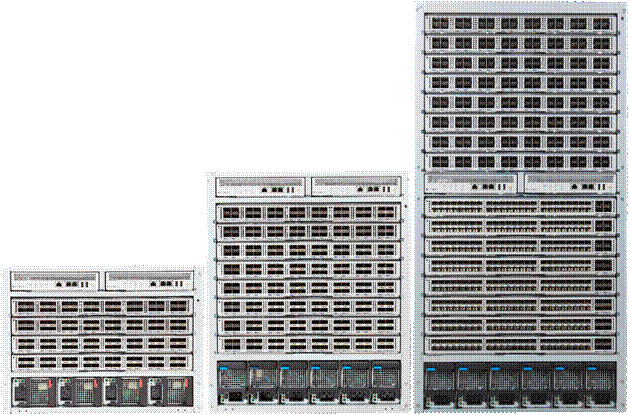
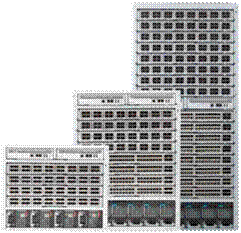
7300 Chassis - 16-slot, 8-slot and 4-slot The Arista 7300 chassis provides room for two supervisor modules, four, eight or 16 line card modules, multiple power supply modules, and four fabric modules. The 7304 chassis fits into 8 rack units while the 7308 chassis fits into 13U and the 7316 chassis fits in 21 RU of a standard data center rack. Supervisor and line card modules plug in from the front, as do power supply modules, while the fabric and fan modules are inserted from the rear. The midplane is completely passive and provides control plane connectivity to each of the fabric and line card modules. The system is optimized for data center deployments with front-to-rear and rear to front airflow options |
Arista 7300X Series Chassis | |
|
| ||
|
Line Card Modules Wire-speed line cards deliver up to 1.92 Billion packets per second of forwarding with a single stage architecture that delivers provides fair access to all ports. Line cards contains up to 24MB of packet memory that ensures up to 6MB for any single port for lossless forwarding. Each line card connects to all fabric modules in a non-blocking full mesh and leverages flow based dynamic load balancing to improve the fabric eï¬ciency by reducing the probability of hash polarization. The Arista 7300 Series can be populated with any combination of line cards. For environments requiring the highest performance combined with scalability a range of both copper and fiber options is available addressing dense 1G/10G and 10G/40G with full support for industry standard connections and comprehensive layer 2 and 3 features for flexible deployment choice. | ||
|
| ||
|
|
32 port QSFP+ 40G line card for 10G/40G
| |
|
|
48 port SFP+ for 1/10GbE and 4 port 40GbE QSFP+
| |
|
|
48 port 10GBASE-T for 100M/1G/10GbE and 4 port 40GbE QSFP+
| |
|
|
| |
|
7300 Supervisor Module The supervisor modules for the 7300 series run Arista Extensible Operating System (EOS) and handle all control plane and management functions of the system. One supervisor module is needed to run the system and a second can be added for stateful 1+1 redundancy. Each supervisor module takes up only a half slot resulting in very eï¬cient use of space and a higher density design. The quad-core x86 CPU with 16GB of DRAM and an optional SSD provides the control plane performance needed to run an advanced data center switch scaling to over 2,000 physical ports and thousands of virtual ports. A pulse per second clock input port enables synchronizing with an external source to improve the accuracy of network timing and monitoring tools.
|
Arista 7300X Series Supervisor | |
|
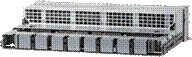
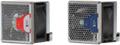
7300 Fabric and Fan Module At the heart of the 7300 series is the fabric. It interconnects all line cards in a non-blocking architecture irrespective of the traï¬c pattern providing a full 2.56 Tbps of forwarding to each line card module. Each line card module connects to the fabric with multiple links and flows are spread across these paths to eï¬ciently utilize the available fabric capacity. The fabric modules are always active-active, providing high availability and can be hot-swapped with graceful performance degradation. The fabric modules for the three chassis are diï¬erent based on the size of the chassis and each accommodate a set of individual hot-swap fan modules. The fan modules support forward and reverse airflow and provide redundant cooling. Each fan module can be independently replaced without any impact of the system.
|
Arista 7300X Series Fabric/Fan and Fans | |
|
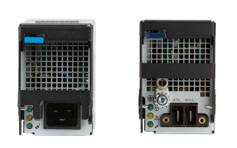
7300 Power Supply Module The 7300 series switches are equipped with a choice of reversible airflow direction 3000W AC or 2700W DC power supplies. The power supplies provide load sharing, support grid redundancy and are hot-swappable to eliminate downtime when replacing power supplies. A maximum of 4 power supplies are used on the 7304, up to 6 power supplies on the 7308 and up 8 power supplies on the 7316, with 6 on the front and an additional 2 on the rear. The AC power supplies are platinum climate saver rated and have an eï¬ciency of over 93% with single stage conversion to the internal DC voltage. The DC power supplies require inputs at-48V DC to deliver up to 2700W. The 7300 Series uses multiple small power supplies which allows for incremental provisioning and smaller input circuits. Variable power supply fan speeds ensure power supply eï¬ciency is optimized and reduces noise in data center environments.
|
Arista 7300X Series Power Supplies | |
|
| ||
|
| ||
|
* Not currently supported in EOS | ||
|
| ||



|
Overview (Arista 7320X Series) | |
|
| |
|
The Arista 7320X Series modular switches deliver over 50Tbps of switching with up to 256 wire speed 100GbE ports. The 7320X Series are part of the Arista portfolio of data center switches and increase availability, flexibility and scalability supporting both leaf and spine and SplineTM applications. The 7320X systems share feature consistency and a common architecture with the Arista 7300X, 7060X and 7260X Series in two modular systems, a 4-slot and 8-slot, that support comprehensive features for network monitoring, precision timing and network virtualization to deliver scalable high performance for software defined cloud networking.
Increased adoption of high performance servers and applications requiring higher bandwidth is driving adoption of 25 Gigabit Ethernet switching in combination with 100Gigabit Ethernet. The 7320X Series support high density 100GbE in combination with wire speed layer 2/3/4 performance. Each 100GbE interface supports a choice of 10GbE, 25GbE, 40GbE, 50GbE and 100GbE speeds allowing customers to seamlessly transition data centers from existing 10GbE and 40GbE architectures to 25GbE and 100GbE in open leaf and spine networks with the capacity that meets the need for scale-out of virtualized networks, with east-west traï¬c patterns.
With front-to-rear airflow, redundant and hot swappable supervisor, power, fabric and cooling modules the system is purpose built for data centers. The 7320X Series is energy eï¬cient with typical power consumption of under 17 Watts per 100GbE port for a fully loaded system. These attributes make the Arista 7320X Series an ideal platform for building reliable, low latency, resilient and scalable data center networks. Combined with Arista EOS the 7320X Series delivers advanced features for cloud, big data, virtualized and traditional designs. | |
|
| |
|
| |
|
Arista 7320X Series 100GbE Modular Data Center Switches | |
|
|
|
|
Product Highlights |
|
|
|
|
|
Performance
High Availability
Cloud Networking Ready
Advanced Provisioning & Monitoring
|
Resilient Control Plane
Data Center Class Design
Arista Extensible Operating System
|
|
Arista EOS All Arista products including the 7320X Series runs the same Arista EOS software binary image simplifying network administration with a single standard across all switches. Arista EOS is a modular switch operating system with a unique state sharing architecture that cleanly separates switch state from protocol processing and application logic. Built on top of a standard Linux kernel, all EOS processes run in their own protected memory space and exchange state through an in-memory database. This multi-process state sharing architecture provides the foundation for in-service-software updates and self-healing resiliency together with stateful switchover without the loss of data plane forwarding. Arista EOS enables advanced monitoring and automation capabilities such as Zero Touch Provisioning, LANZ, VM Tracer and Linux based tools to be run natively on the switch.
Scaling Data Center Performance The Arista 7320X Series delivers wire speed switching at later 2 and layer 3 to enable dramatically faster and simpler network designs for data centers that lowers network capital and operational expenses. When used in conjunction with Arista 1G, 10G and 40G leaf switches and Arista's Multi-Chassis Link Aggregation (MLAG) technology, a pair of 7320X Switches can support over 48,000 Servers with a leaf and spine active/active L2 network topology. A spine of 16 7320X at Layer 3 scales the network up to over 100K 10G Servers in a fully non- blocking, low-latency, two-stage network that provides predictable and consistent application performance. The flexibility of the L2 and L3 multi-path design options combined with support for open standards provides maximum flexibility, scalability and network wide virtualization. Arista EOS advanced features provides control, and visibility with single point of management.
| |
|
| |
|
Arista Leaf-Spine Two-Tier and Spline One-Tier Network Architectures | |
|
| |
|
Software Driven Cloud Networks Arista Software Driven Cloud Networking (SDCN), combines the principles that have made cloud computing the unstoppable force that it is: automation, self service provisioning, and linear scaling of both performance and economics coupled with the trend in Software Defined Networking that delivers: network virtualization, custom programmability, simplified architectures, and lower capital expenditure. This combination creates a best-in-class software foundation for maximizing the value of the network to both the enterprise and service provider data center. A new architecture for the most mission-critical location within the IT infrastructure that simplifies management and provisioning, speeds up service delivery, lowers costs and creates opportunities for competitive diï¬erentiation, while putting control and visibility back in the hands of the network and systems administrators.
The Four Pillars of Arista's Software Defined Cloud Networking:
Dynamic Buï¬er Allocation In cut-through mode, the Arista 7320X series switches forward packets with a latency of less than 2 usec. Upon congestion, the packets are buï¬ered in shared packet memory that has a total size of 16 Mbytes. Unlike other architectures that have fixed per-port packet memory, the 7320X Series use Dynamic Buï¬er Allocation (DBA) to allocate packet memory to a single port for lossless forwarding.
Maximum Flexibility for Scale Out Network Designs Scale out network designs enable solutions to start small and evolve over time. A simple two-way design can grow as wide as 64-way without significant changes to the architecture. The 7300X Series include enhancements that allow for flexible scale-out designs:
Enhanced Features for High Performance Networks The Arista 7320X Series delivers a suite of advanced traï¬c control and monitoring features to improve the agility of modern high performance environments, with solutions for data monitoring, precise timing and next-generation virtualization.
Smart System Upgrade Smart System Upgrade (SSU) is a network application designed to address one of the most complicated and challenging tasks facing data center administrators - network infrastructure maintenance. Changes to the underlying network infrastructure can aï¬ect large numbers of devices and cause significant outages. SSU provides a fully customizable suite of features that tightly couples data center infrastructure to technology partners allowing for intelligent insertion and removal, programmable updates to software releases and open integration with application and infrastructure elements. Precise Data Analysis Arista Latency Analyzer (LANZ) is an integrated feature of EOS. LANZ provides precise real-time monitoring of micro-burst and congestion events before they impact applications, with the ability to identify the sources and capture aï¬ected traï¬c for analysis. Virtualization Supporting next-generation virtualized data centers requires tight integration with orchestration tools and emerging encapsulation technologies such as VXLAN. The 7320X Series builds on the valuable tools already provided by the Arista VM Tracer suite to integrate directly into encapsulated environments. Oï¬ering a wire-speed gateway between VXLAN and traditional L2/3 environments, the 7320X Series makes integration of non-VXLAN aware devices including servers, firewalls and load-balancers seamless and provides the ability to leverage VXLAN as a standards based L2 extension technology for non-MPLS environments. Advanced Event Management (AEM) Simplifying the overall operations, AEM provides the tools to customize alerts and actions. AEM is a powerful and flexible set of tools to automate tasks and customize the behavior of EOS and the operation of the overall data center switching infrastructure. AEM allows operators to fully utilize the intelligence within EOS to respond to real-time events, automate routine tasks, and automate actions based on changing network conditions. Unified Forwarding Table Cloud network scalability is directly impacted by the size of a switches forwarding tables. In many systems a 'one size fits all' approach is adopted using discrete fixed size tables for each of the common types of forwarding entry. The Arista 7320X leverages a common Unified Forwarding Table (UFT) for the L2 MAC, L3 Routing, L3 Host and IP Multicast forwarding entries, which can be partitioned per entry type. The ideal size of each partition varies depending on the network deployment scenario. The flexibility of the UFT coupled with the range of pre-defined configuration profiles available on the 7320X ensures optimal resource allocation for all network topologies and network virtualization technologies. Algorithmic Longest Prefix Match (ALPM) allows for the shared UFT to be expanded to contain up to 128K longest prefix match (LPM) route entries.
Designed for High Availability and Manageability The Arista 7320X Series are designed for continuous operations with system wide monitoring of both hardware and software components, simple serviceability and provisioning to prevent single points of failure. The hardware supports high-availability with hot-swap of all components with redundant supervisors, power supplies, fabric and cooling modules. Fabric redundancy provides deterministic degradation and integrated fan systems for dynamic temperature control combined with N+1 redundancy. Each of the 7320X Series oï¬ers power redundancy that supports both power-source and power-supply redundancy. The Arista EOS software enabled stateful failover (*) between the dual redundant supervisors as well as self-healing stateful fault containment (SFC), stateful fault repair (SFR) and live patching through in-service-software updates to help ensure continuous service. The Arista 7320X lowers total cost of ownership as it is designed to be eï¬cient with power per port as low as 17W per 100GbE port which combined with front to rear cooling produces the most reliable, dense and power eï¬cient modular switch.
CloudVision CloudVision is a network-wide approach for workload orchestration and workflow automation as a turnkey solution for Cloud Networking. CloudVision extends the EOS publish subscribe architectural approach across the network for state, topology, monitoring and visibility. This enables enterprises to move to cloud-class automation without needing any significant internal development.
7320X Architecture The 7320X Series architecture is designed around an internal clos with line cards and fabric modules fully interconnected to deliver a low latency fully non-blocking system. Each line card has self-contained switch modules and interconnect via the vertical fabric modules for over 50 Tbps of switching capacity. Dual redundant supervisor modules provide centralized control plane and management functionality. | |
|
| |
|
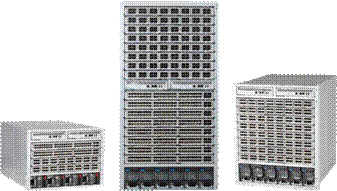
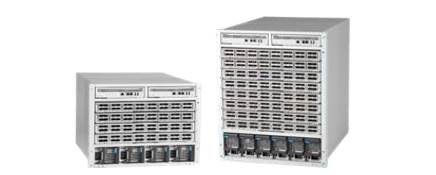
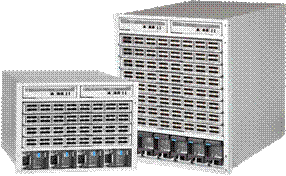
7300 Chassis - 8-slot and 4-slot The Arista 7300 chassis provides room for two supervisor modules, four or eight line card modules, multiple power supply modules, and four fabric modules. The 7304 chassis fits into 8 rack units while the 7308 chassis fits into 13U of a standard data center rack. Supervisor and line card modules plug in from the front, as do power supply modules, while the fabric and fan modules are inserted from the rear. The midplane is completely passive with orthogonal connectors that provide direct connectivity between each of the fabric and line card modules. The system is optimized for data center deployments with front-to-rear airflow and can be installed in both standard 4-post and 2-post rack or cabinets without special modifications. |
Arista 7300X Series Chassis |
|
|
|
|
System Cooling The Arista 7320X Series supports front to rear cooling that is optimized for modern data center and co-location facilities. Cool air is drawn into the system through the front over the line cards, supervisor modules and power supplies. Warm air is exhausted at the rear through the fabric modules by fan modules that are integrated into the fabric cards. The system controls the fans speeds to dynamically adjust to the ambient air temperature and internal temperature sensors built into all system elements to ensure optimum cooling.
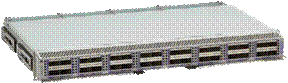
Line Card Modules The 7320X Series line cards deliver up to 4.7 Billion packets per second of forwarding with a single stage architecture that provides fair access to all ports. Each line card contains up to 32MB of packet memory that ensures up to 4MB for any single port for lossless forwarding. Line cards connect to all fabric modules in a non-blocking full mesh and leverage flow based load balancing to improve fabric eï¬ciency. Fabric and line card connections are optimized to allow individual flows of up to 100 Gigabit per second The Arista 7320X Series can be populated with up to eight high density 100GbE line cards. For environments requiring the highest performance combined with interface flexibility the 7320X line cards support five speed choices on each port. Each port can be configured for quad 10GbE or 25GbE, dual 50GbE or single 40GbE and 100GbE. Speed changes and breakout modes are enabled independently of the other ports on the line card. Additionally a wide range of both copper and fiber optics for all speeds are available with full support for industry standard connections. Each 7320X line card supports wire speed layer 2 and 3 forwarding and support for a wide range of L2 and L3 features. | |
|
|
|
|
Arista 7320X Series 32 port 100GbE Line Card |
32 port QSFP100 100GbE line card for 10G/25G/40G/50G/100G
|
|
|
|
|
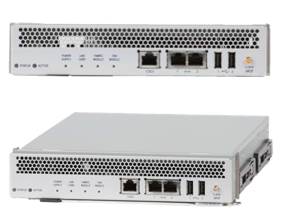
Supervisor Module The supervisor module for the 7300X and 7320X series runs Arista Extensible Operating System (EOS) and handles all control plane and management functions of the system. One supervisor module is needed to run the system and a second can be added for 1+1 redundancy. Each supervisor module takes up only a half slot resulting in very eï¬cient use of space and a higher density design. The quad-core x86 CPU with 16GB of DRAM and an optional solid state drive (SSD) provides the control plane performance needed to run an advanced data center switch scaling to over 2,000 physical ports and thousands of virtual ports. Supervisor modules have dedicated connections to all fabric modules and line cards for communication and monitoring. A pulse per second clock input port enables synchronizing with an external source to improve the accuracy of network timing and monitoring tools. The supervisor module features an auxiliary console port, 2 Ethernet management interfaces and a pair of USB ports for attaching external storage to install images, copy logs or support external connections. A series of status LEDs provide summary information for the system, power supplies, line cards, fabrics and fan modules. |
Arista 7300X Series Supervisor Module |
|
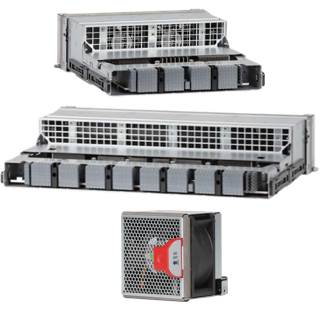
Fabric and Fan Module At the heart of the 7320X series is the fabric. It interconnects all line cards in a non-blocking architecture irrespective of the traï¬c pattern providing a full 6.4 Tbps of forwarding to each line card slot. Each line card connects to the fabric with multiple links and flows are spread across these paths to eï¬ciently utilize the available fabric capacity. The four fabric modules are always active-active, providing high availability and can be hot-swapped with graceful performance degradation. The fabric modules for the two chassis are diï¬erent based on the size of the chassis and each accommodates a set of individual hot-swap high speed fan modules which provides redundancy for cooling. Each high speed fan module can be independently replaced without any impact of the system. The high speed fan modules are common to many of the 7000 Series 2RU switches providing simpler maintenance and sparing across modular and fixed products. |
Arista 7320X Series Fabric and Fan Modules |
|
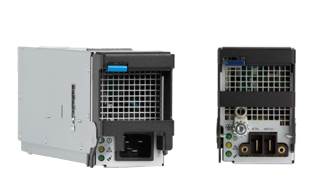
Power Supply Modules The 7320 series switches are equipped with a choice of 3000W AC or 2700W DC power supplies. The power supplies provide load sharing, support grid redundancy and are hot-swappable to eliminate downtime when replacing power supplies. A maximum of 4 power supplies are used on the 7304 and up to 6 power supplies on the 7308. System are fully redundant with just two power supplies depending on the configuration and adding more power supplies provides increased power capacity. The AC power supplies are Titanium climate saver rated and have an eï¬ciency of over 94% across typical loading with a single stage conversion to the internal DC voltage. The DC power supplies require inputs at -48V DC to deliver up to 2700W. The 7320X Series uses multiple small power supplies which allows for incremental provisioning and smaller input circuits. Variable power supply fan speeds ensure power supply eï¬ciency is optimized and reduces noise in data center environments. |
Arista 7320X Series AC and DC Power Supplies |
|
| |
|
Overview (Arista 7500 Series) | |
|
| |
|
Designed for large virtualized data centers and cloud networks the Arista 7500 Series modular switches are the industry's highest performance data center switches, available in a compact 7RU (4-slot) or 11RU (8-slot) they combine scalable L2 and L3 resources with advanced features for network monitoring, precision timing, network virtualization to deliver scalable and deterministic network performance for mission critical data centers, enterprise and HPC environments.
The Arista 7500E is the second generation of the 7500 Series and delivers seamless upgrades ensuring investment protection of first generation fabrics, line cards and common equipment while setting a new standard for performance, density, reliability, and power eï¬ciency. The Arista 7500E Series oï¬ers over 30Tbps of total capacity for 1,152 ports of 10GbE or 288 ports of 40GbE and support for 96 ports of wire-speed 100GbE with a broad choice of interface types that support flexible combinations of 10G, 40G and 100G modes on a single port.
With front-to-rear airflow, redundant and hot swappable supervisor, power, fabric and cooling modules the system is purpose built for data centers. The 7500E Series is energy eï¬cient with typical power consumption of under 4 watts per port for a fully loaded chassis. All of these attributes make the Arista 7500E an ideal platform for building reliable, low latency, resilient and highly scalable data center networks. | |
|
| |
|
Arista 7500E Series Modular Data Center Switches | |
|
|
|
|
Product Highlights |
|
|
|
|
|
Performance
High Hardware Availability
Virtualization and Provisioning
|
Scalable Architecture
Resilient Control Plane
Data Center Class Design
Arista Extensible Operating System
|
|
|
|
|
Arista EOS All Arista products including the 7500E Series runs the same Arista EOS software, binary image simplifying network administration with a single standard across all switches. Arista EOS is a modular switch operating system with a unique state sharing architecture that cleanly separates switch state from protocol processing and application logic. Built on top of a standard Linux kernel, all EOS processes run in their own protected memory space and exchange state through an in-memory database. This multi-process state sharing architecture provides the foundation for in-service-software updates and self-healing resiliency together with stateful switchover without the loss of data plane forwarding. Arista EOS enables advanced monitoring and automation capabilities such as Zero Touch Provisioning, LANZ, VM Tracer and Linux based tools to be run natively on the switch.
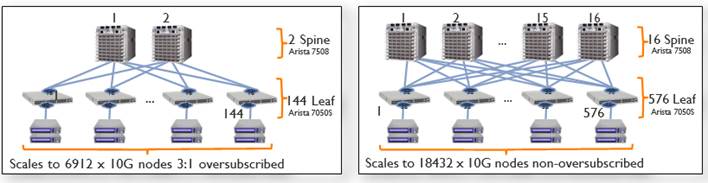
Scaling Data Center Performance The Arista 7500E delivers true line rate non-blocking switching capacity to enable dramatically faster and simpler network designs for data centers that lowers network capital and operational expenses. When used in conjunction with Arista 7050 or 7150 10G leaf switches and Arista's Multi-Chassis Link Aggregation (MLAG) technology, a pair of 7508E Switches can support over 6,000 Servers with a leaf and spine active/active L2 network topology. A combination of 16 Arista 7508E switches in a spine at Layer 3 scales the network up to over 18,000 10G Servers in a fully non-blocking, low-latency, two-stage network that provides predictable and consistent application performance. The flexibility of the L2 and L3 multi-path design options combined with support for open standards provides maximum flexibility, scalability and network wide virtualization. Arista EOS advanced features provides control, and visibility with single point of management
| |
|
| |
|
Arista Leaf-Spine Two-Tier Network Architecture | |
|
| |
|
Software Defined Cloud Networks Arista Software Defined Cloud Networking (SDCN), combines the principles that have made cloud computing the unstoppable force that it is: automation, self service provisioning, and linear scaling of both performance and economics coupled with the trend in Software Defined Networking that delivers: network virtualization, custom programmability, simplified architectures, and lower capital expenditure. This combination creates a best-in-class software foundation for maximizing the value of the network to both the enterprise and service provider data center. A new architecture for the most mission-critical location within the IT infrastructure that simplifies management and provisioning, speeds up service delivery, lowers costs and creates opportunities for competitive diï¬erentiation, while putting control and visibility back in the hands of the network and systems administrators.
The Four Pillars of Arista's Software Defined Cloud Networking:
Deterministic Network Performance The Arista 7500 Series uses a deep buï¬er virtual output queue (VOQ) architecture that eliminates head-of-line (HOL) blocking and virtually eliminates packet drops even in the most congested network scenarios. An advanced traï¬c scheduler fairly allocates bandwidth between all virtual output queues while accurately following queue disciplines including weighted fair queueing, fixed priority, or hybrid schemes including 802.1Qaz ETS. As a result, the Arista 7500 can handle the most demanding data center requirements with ease, including mixed traï¬c loads of real-time, multicast, and storage traï¬c while still delivering low latency.
Maximum Flexibility
Enhanced Features for High Performance Networks The Arista 7500E delivers a suite of advanced traï¬c control and monitoring features to improve the agility of modern high performance environments, with solutions for data monitoring, precise timing and next-generation virtualization.
Precise Data Analysis Arista Latency Analyzer (LANZ) and Precision Data Analyzer (DANZ) are integrated features of EOS. DANZ provides a solution to monitoring and visibility challenges at 10/40/100Gbps giving IT operations the ability to proactively deliver feedback on congestion events, filter, replicate, aggregate and capture traï¬c without aï¬ecting production performance. LANZ provides precise real-time monitoring of micro-burst and congestion events before they impact applications, with the ability to identify the sources and capture aï¬ected traï¬c for analysis. Precision Timing (IEEE 1588) Arista's hardware derived Precision Time Protocol solution provides a robust mechanism for accurate in-band time distribution in high performance environments. The system clock can be synchronized using the Supervisor module clock input port with a PPS source or IEEE 1588 PTP.
Virtualization Supporting next-generation virtualized data centers requires tight integration with orchestration tools and emerging encapsulation technologies such as VXLAN. The 7500E builds on the valuable tools already provided by the Arista VM Tracer suite to integrate directly into encapsulated environments. Oï¬ering a wire-speed gateway between VXLAN and traditional L2/3 environments, the 7500E makes integration of non-VXLAN aware devices including servers, firewalls and load-balancers seamless and provides the ability to leverage VXLAN as a standards based L2 extension technology for non-MPLS environments.
Arista Event Management (AEM) Simplifying the overall operations, AEM provides the tools to customize alerts and actions. AEM is a powerful and flexible set of tools to automate tasks and customize the behavior of EOS and the operation of the overall data center switching infrastructure. AEM allows operators to fully utilize the intelligence within EOS to respond to real-time events, automate routine tasks, and automate actions based on changing network conditions.
| |
|
Line Card Modules Wire-speed line cards deliver up to 14.4 Billion packets per second of forwarding with a distributed virtual output queue architecture and lossless fabric that eliminates head-of-line blocking and provides fairness across all ports. Line cards contains up to 18GB of packet memory for approximately 40msec of traï¬c buï¬er per ingress port and virtually eliminating packet drops in congestion scenarios. Line cards connects to all fabric modules in a non-blocking full mesh. The Arista 7508 and 7504 chassis can be populated with any combination of line cards. For environments requiring the highest performance combined with scalability a range of speed and interface options is available addressing dense 1/10G, 40G and 100G with full support for industry standard connections and comprehensive layer 2 and 3 features for flexible deployment choice. Embedded optics combined with MPO interfaces provide a multi-speed port (MXP) capability that increases system density with a choice of 10G/40G/100G interfaces. MXP ports support a mix and match option of 12 x 10G, 3 x 40G or 1x 100G per port. With support for up to 400m over multi-mode fiber MXP ports provide high density and seamless migration from 10G to 100G without replacing transceivers or lowering system density. Line cards with CFP2 and QSFP support industry standard 100G optics for both single and multi-mode fiber for distances up to 40km. |
12 port 100GbE QSFP line card for broad interface choice and high density
|
|
12 port 10GbE SR10MXP line card with embedded optics
| |
|
6 port 100GbE CFP2 line card for flexible range of 100G, 40G and 10G ports
| |
|
36 port QSFP+ 40G line card for 10G/40G
| |
|
48 port SFP+ for 1/10GbE and 2 port 100GbE SR10 MXP line card
| |
|
48 port SFP+ line card for wire-speed 1/10GbE and consistent features
| |
|
48 port 10GBASE-T line card for 100M/1/10GbE and consistent features
| |
|
Designed for High Availability and Manageability The Arista 7500E Series are designed for continuous operations with system wide monitoring of both hardware and software components, simple serviceability and provisioning to prevent single points of failure. The hardware supports high-availability with hot- swap of all components with redundant supervisors, power supplies, fabric and cooling modules. Fabric N+1 redundancy provides zero loss of performance with deterministic degradation and integrated fan systems provide dynamic temperature control combined with N+1 redundancy. The 7500E oï¬ers 2+2 power redundancy that supports both power source and power supply redundancy. The Arista EOS software supports stateful failover between the dual redundant supervisors as well as self-healing stateful fault containment (SFC), stateful fault repair (SFR) and live patching through in-service-software updates to help ensure continuous service. The Arista 7500E lowers total cost of ownership as it is designed to be eï¬cient with power per port as low as 4W per 10GbE port which combined with front to rear cooling to optimize the data center environment produces the most reliable, dense and power eï¬cient modular switch. | |
|
|
|
|
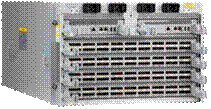
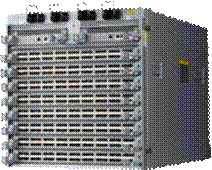
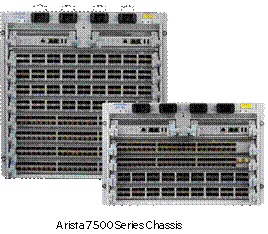
7500 Chassis - 8-slot and 4-slot The 7500 chassis provides room for two supervisor modules, four or eight line card modules, four power supply modules, and six fabric modules. The 7504 chassis fits into 7 rack units while the 7508 chassis fits into 11U of a standard data center rack. Supervisor and line card modules plug in from the front, while the fabric and power supply modules are inserted from the rear. The midplane is completely passive and provides control plane connectivity to each of the fabric and line card modules. The system design is optimized for data center deployments with front- to-rear airflow. |
|
|
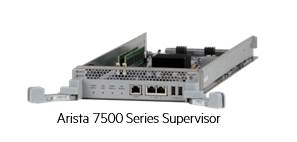
7500E Supervisor Module The supervisor modules for the 7500 series run Arista Extensible Operating System (EOS) and handle all control plane and management functions of the system. One supervisor module is needed to run the system and a second can be added for stateful 1+1 redundancy. Each supervisor module takes up only a half slot resulting in very eï¬cient use of space and a higher density design. The quad-core x86 CPU with 16GB of DRAM and an optional SSD provides the control plane performance needed to run an advanced data center switch scaling to over 1,000 physical ports and thousands of virtual ports. A pulse per second clock input port enables synchronizing with an external source to improve the accuracy of monitoring tools.
|
|
|
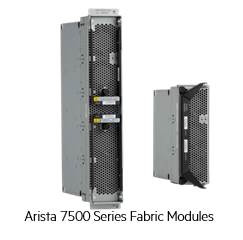
7500E Fabric Module At the heart of the 7500E series is the fabric. It interconnects all line cards in a non- blocking architecture irrespective of the traï¬c pattern providing a full 5.12 Tbps per fabric module. Each line card module connects to the fabric with multiple links and data packets are spread across the links to fully utilize the fabric capacity. Unlike hash-based selection of fabric links, the 7500E architecture provides 100% eï¬cient connectivity from any port to any other port with no drops. The fabric modules are always active-active, provide N+1 redundancy and can be hot- swapped with zero performance degradation. The Fabric Modules for the 7508E and the 7504E are diï¬erent based on the size of the chassis and both integrate a fan assembly for flexible and redundant cooling.
|
|
|
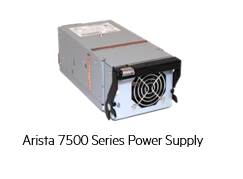
7500E Power Supply Module The 7500E series switches are equipped with four 2900W AC power supplies. The power supplies are 2+2 grid redundant and hot-swappable. The power supplies are gold climate saver rated and have an eï¬ciency of over 90% with single stage conversion to the internal 12V DC voltage. |
|
|
| |







|
Overview (Arista 7500R Series) | |||
|
| |||
|
The Arista 7500R Series of purpose built modular switches deliver the industry's highest performance with 115Tbps of system throughput to meet the needs of the largest scale data centers. They combine scalable L2 and L3 resources and high density with advanced features for network monitoring, precision timing and network virtualization to deliver scalable and deterministic network performance while simplifying designs and reducing Opex.
The 7500R can be deployed in a wide range of open networking solutions including large scale layer 2 and layer 3 cloud designs, overlay networks, virtualized or traditional enterprise data center networks. Deep packet buï¬ers and large routing tables allow for internet peering applications and provides complete deployment flexibility.
Available in a compact system design, as a choice of 12, 8 and 4 slot, the Arista 7500R is the next generation of the 7500 Series and delivers seamless upgrades ensuring investment protection of fabric modules, line cards and supervisor modules while setting a new standard for performance, density, reliability, and power eï¬ciency. The 7500R can support up to 432 ports of wire speed 100GbE and 40GbE and oï¬ers over 115 Tbps of total capacity with a broad choice of line cards. Every 100GbE interface supports a choice of 5 speeds including 25GbE and 50GbE providing unparalleled flexibility and the ability to seamlessly transition data centers to the next generation of Ethernet performance.
All components are hot swappable, with redundant supervisor, power, fabric and cooling modules with front-to-rear airflow. The system is purpose built for data centers and is energy eï¬cient with typical power consumption of under 25 watts per 100GbE port for a fully configured chassis. These attributes make the Arista 7500R an ideal platform for building reliable and highly scalable data center networks. | |||
|
| |||
|
Arista 7500R Series Modular Data Center Switches | |||
|
|
| ||
|
Product Highlights |
| ||
|
|
| ||
|
Performance
High Hardware Availability
Virtualization and Provisioning
|
Scalable Architecture
Resilient Control Plane
Data Center Class Design
Arista Extensible Operating System
| ||
|
|
| ||
|
Arista EOS All Arista products including the 7500R Series runs the same Arista EOS software, binary image simplifying network administration with a single standard across all switches. Arista EOS is a modular switch operating system with a unique state sharing architecture that cleanly separates switch state from protocol processing and application logic. Built on top of a standard Linux kernel, all EOS processes run in their own protected memory space and exchange state through an in-memory database. This multi-process state sharing architecture provides the foundation for in-service-software updates and self-healing resiliency together with stateful switchover without the loss of data plane forwarding. Arista EOS enables advanced monitoring and automation capabilities such as Zero Touch Provisioning, LANZ, VM Tracer and Linux based tools to be run natively on the switch.
Software Defined Cloud Networks Arista Software Defined Cloud Networking (SDCN), combines the principles that have made cloud computing the unstoppable force that it is: automation, self service provisioning, and linear scaling of both performance and economics coupled with the trend in Software Defined Networking that delivers: network virtualization, custom programmability, simplified architectures, and lower capital expenditure. This combination creates a best-in-class software foundation for maximizing the value of the network to both the enterprise and service provider data center. A new architecture for the most mission-critical location within the IT infrastructure that simplifies management and provisioning, speeds up service delivery, lowers costs and creates opportunities for competitive diï¬erentiation, while putting control and visibility back in the hands of the network and systems administrators.
The Four Pillars of Arista's Software Defined Cloud Networking: Universal Cloud Network
Cloud Control
Network Wide Virtualization
Network Applications and Automated Management
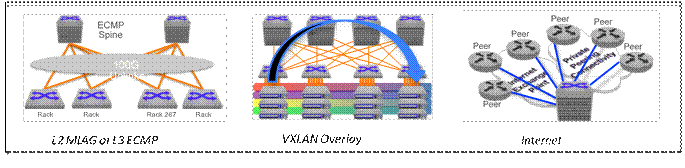
Scaling Data Center Performance The Arista 7500R Series deliver non-blocking switching capacity that enables dramatically faster and simpler network designs for data centers and lower both capital and operational expenses. A wide range of modular systems with a single consistent EOS allows for flexible selections at all tiers of the network and deployment scenarios including layer 2 MLAG, layer 3 ECMP, VXLAN Overlay and Internet Peering. Arista's Multi-Chassis Link Aggregation (MLAG) technology supports a leaf and spine active/active L2 network topology. An Equal Cost Multi-Path (ECMP) design at Layer 3 scales the network in a fully non-blocking, low-latency, two-stage network that provides predictable and consistent application performance. The flexibility of the L2 and L3 multi-path design options combined with support for open standards provides maximum flexibility, scalability and network wide virtualization that scales to hundreds of thousands of hosts in a single two-tier design. Both designs support overlay networks via VXLAN and can integrate with standards-based overlay controller solutions. The Arista 7500R Series FlexRoute engine provides the flexible scalability to support deployment as a routing platform with Internet scale routing. Arista FlexRoute along with EOS NetDB enables innovation not natively available in merchant chipsets. Arista EOS provides operational savings through visibility, automation and improved network operations. | |||
|
| |||
|
Arista Flexible Network Architectures | |||
|
| |||
|
Enhanced Features for High Performance Cloud Networks The Arista 7500R delivers a suite of advanced traï¬c control and monitoring features to improve the agility of modern high performance environments, with solutions for automation, data monitoring, precise timing and next-generation virtualization. Automating the data center enables customers to dynamically provision computing resources in the most eï¬cient manner while also meeting business needs by maintaining service level agreements (SLAs). Arista EOS automates complex IT workflows and simplifies network operations while reducing or even eliminating downtime. Arista EOS rich automation capabilities not only reduce the human error element in network operations but also enable IT operators to make the network work the way they want. Arista oï¬ers solutions for a variety of approaches to cloud-like network automation. Addressing the needs of the largest public cloud environments as well as applying those lessons learned in the turnkey CloudVision automation oï¬ering.
CloudVision CloudVision is a network-wide approach for workload orchestration and workflow automation as a turnkey solution for Cloud Networking. CloudVision extends the EOS publish subscribe architectural approach across the network for state, topology, monitoring and visibility. This enables enterprises to move to cloud-class automation without needing any significant internal development.
Arista Event Management (AEM) Advanced Event Management (AEM), a sub-system of Arista EOS, is a powerful and flexible tool to automate tasks and customize the behavior of EOS and the operation of the overall data center switching infrastructure. Simplifying the overall operations, AEM provides the tools to customize alerts and actions. AEM allows operators to fully utilize the intelligence within EOS to respond to real-time events, automate routine tasks, and automate actions based on changing network conditions. Precise Data Analysis Arista Latency Analyzer (LANZ) and Precision Data Analyzer (DANZ) are integrated features of EOS. DANZ provides a solution to monitoring and visibility challenges at 10/40/100Gbps giving IT operations the ability to proactively deliver feedback on congestion events, filter, replicate, aggregate and capture traï¬c without aï¬ecting production performance. LANZ provides precise real-time monitoring of micro-burst and congestion events before they impact applications, with the ability to identify the sources and capture aï¬ected traï¬c for analysis. Precision Timing (IEEE 1588) Arista's hardware derived Precision Time Protocol solution provides a robust mechanism for accurate in-band time distribution in high performance environments. The system clock can be synchronized using the Supervisor module clock input port with a PPS source or IEEE 1588 PTP. Virtualization Supporting next-generation virtualized data centers requires tight integration with orchestration tools and emerging encapsulation technologies such as VXLAN. The 7500R builds on the valuable tools already provided by the Arista VM Tracer suite to integrate directly into encapsulated environments. Oï¬ering a wire-speed gateway between VXLAN and traditional L2/3 environments, the 7500R makes integration of non-VXLAN aware devices including servers, firewalls and load-balancers seamless and provides the ability to leverage VXLAN as a standards based L2 extension technology for non-MPLS environments. Maximum Network Design Flexibility
System Overview The 7500R Series oï¬ers complete investment protection with the Arista 7500E Series with seamless upgrade paths for key components and a common system architecture that ensures long term investment protection. The following 7500R chassis options are available:
The 7500R modular chassis can accommodate any combination of the 7500E line cards or the following 7500R line cards providing a rich choice of density and speed:
The Arista 7500R lowers total cost of ownership as it is designed to be eï¬cient with power per port as low as 25W per 100GbE port which combined with front to rear cooling to optimize the data center environment produces the most reliable, dense and power eï¬cient modular switch.
7500R Deterministic Network Performance The Arista 7500 Series uses a deep buï¬er virtual output queue (VOQ) architecture that eliminates head-of-line (HOL) blocking and virtually eliminates packet drops even in the most congested network scenarios. An advanced traï¬c scheduler fairly allocates bandwidth between all virtual output queues while accurately following queue disciplines including weighted fair queueing, fixed priority, or hybrid schemes. As a result, the Arista 7500 can handle the most demanding data center requirements with ease, including mixed traï¬c loads of real-time, multicast, and storage traï¬c while still delivering low latency.
7500R High Availability The Arista 7500R Series are designed for continuous operations with system wide monitoring of both hardware and software components, simple serviceability and provisioning to prevent single points of failure. The hardware supports high-availability with hot- swap of all components with redundant supervisors, power supplies, fabric and cooling modules. Fabric N+1 redundancy provides zero loss of performance with deterministic degradation and integrated fan systems provide dynamic temperature control combined with N +1 redundancy. The 7500R Series oï¬er power redundancy that supports both power source and power supply redundancy. The Arista EOS software supports stateful failover between the dual redundant supervisors as well as self-healing stateful fault containment (SFC), stateful fault repair (SFR) and live patching through in-service-software updates to help ensure continuous service.
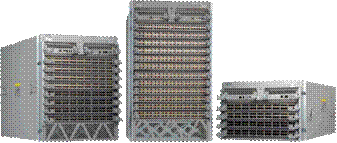
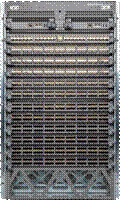
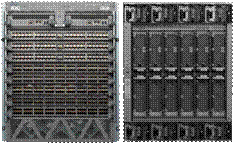
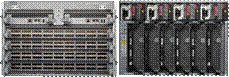
7500R Series Chassis - 12-slot, 8-slot and 4-slot The 7500R Series chassis provides room for two supervisor modules, four, eight or twelve line card modules, grid redundant power supply modules, and six fabric modules. Supervisor and line card modules plug in from the front, while the fabric modules are inserted from the rear. The midplane is completely passive and provides control plane connectivity to each of the fabric and line card modules. The system design is optimized for data center deployments with front-to-rear airflow. | |||
|
|
|
| |
|
Arista 7500R Series Chassis - 7512R (front), 7508R (front and rear) and 7504R (front and rear) | |||
|
| |||
|
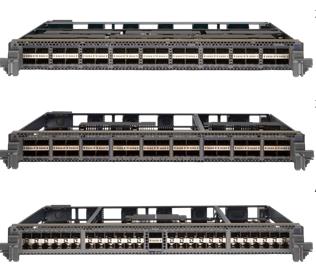
Line Card Modules Wire-speed line cards deliver up to 51 Billion packets per second of forwarding with a distributed virtual output queue architecture and lossless fabric that eliminates head-of-line blocking and provides fairness across all ports. Line cards contain up to 24GB of packet memory for approximately 50msec of traï¬c buï¬er per ingress port and virtually eliminating packet drops in congestion scenarios. Line cards connect to all fabric modules in a non-blocking full mesh. The Arista 7500R systems can be populated with any combination of line cards. For environments requiring the highest performance combined with scalability a range of speed and interface options is available with full support for industry standard connections and comprehensive layer 2 and 3 features for flexible deployment choice. Line cards support industry standard optics for both single and multi-mode fiber along with flexibility for multi-rate configurations. All line cards support 100GbE, with built-in support for quad 10GbE or 25GbE, dual 50GbE or single 40GbE and 100GbE to ensure future proofing for next generation network architectures. Speed changes and breakout modes are enabled independently of the other ports on the line card. 40GbE ports allow high density 10GbE and the 10GbE SFP+ ports support 1GbE mode oï¬ering comprehensive investment protection for both existing and new network designs. | |||
|
| |||
|
|
36 port 100GbE QSFP line card for broad interface choice and highest density
36 port 40GbE QSFP+ line card for 10G/40G and 100GbE
48 port SFP+ for 1/10GbE and 2 port 100GbE QSFP line card
| ||
|
Supervisor Module The supervisor modules for the 7500R series run Arista Extensible Operating System (EOS) and handle all control plane and management functions of the system. One supervisor module is needed to run the system and a second can be added for stateful 1+1 redundancy. Each supervisor module takes up only a half slot resulting in very eï¬cient use of space and a higher density design. The multi-core x86 CPU with 32GB of DRAM and an optional SSD provides the control plane performance needed to run an advanced data center switch scaling to over 1,700 physical ports and thousands of virtual ports. A pulse per second clock input port enables synchronizing with an external source to improve the accuracy of monitoring tools.
Fabric Module At the heart of the 7500R series is the fabric. It interconnects all line cards in a non-blocking architecture irrespective of the traï¬c. Each line card module connects to the fabric with multiple links and data packets are spread across the links to fully utilize the fabric capacity. Unlike hash-based selection of fabric links, the 7500R architecture provides 100% eï¬cient connectivity from any port to any other port with no drops. The fabric modules are always active-active, provide N+1 redundancy and can be hot-swapped with zero performance degradation. The Fabric Modules for the 12-slot, 8-slot and the 4-slot 7500 Series are diï¬erent based on the size of the chassis and both integrate a fan assembly for flexible and redundant cooling.
Power Supply Modules The 7500R series switches are equipped with redundant and hot-swappable AC or DC power supplies with an internal variable speed fan. The 3000W AC power supplies are Titanium climate saver rated and have an eï¬ciency of over 94% with single stage conversion to the internal 12V DC voltage. 3000W DC power supplies use -40 to -72V direct current inputs. | |||
|
| |||
|
Features and Benefits (Arista 7300 Series) | |
|
| |
|
Layer 2 Features
- 64 ports/channel - 1024 groups per system
- 64 ports per MLAG
Layer 3 Features
Advanced Monitoring and Provisioning
|
- Openflow 1.0 * - Arista DirectFlow * - eAPI - OpenStack Neutron Support
Virtualization Support
Security Features
|
|
* Not currently supported in EOS | |
|
Quality of Service (QoS) Features
Network Management
Extensibility
- Bash shell access and scripting - RPM support - Custom kernel modules
- Python - C++
Standards Compliance
|
SNMP MIBs
See EOS release notes for latest supported MIBs |
|
* Not currently supported in EOS | |
|
Features and Benefits (Arista 7320X Series) | |
|
| |
|
Layer 2 Features
- 64 ports/channel - 1024 groups per system
- 64 ports per MLAG
Layer 3 Features
Advanced Monitoring and Provisioning
- Configurable Congestion Notification (CLI, Syslog) - Streaming Events (GPB Encoded) - Capture/Mirror of congested traï¬c |
- Port Mirroring 4 to 128 (4 active sessions per ASIC) - L2/3/4 Filtering on Mirror Sessions - Mirror to EOS/SSD*
- CLI Scheduler - Event Manager - Event Monitor - Linux tools
- Openflow 1.0 * - Arista DirectFlow * - eAPI - OpenStack Neutron Support
Virtualization Support
- VMware vSphere support - VM Auto Discovery - VM Adaptive Segmentation - VM Host View
Security Features
|
|
* Not currently supported in EOS | |
|
Quality of Service (QoS) Features
Network Management
Extensibility
- Bash shell access and scripting - RPM support - Custom kernel modules
- Python - C++
Standards Compliance
|
SNMP MIBs
See EOS release notes for latest supported MIBs
|
|
* Not currently supported in EOS | |
|
Features and Benefits (Arista 7500 Series) | |
|
| |
|
Layer 2 Features
- 64 Ports / Channel - 256 groups per system (1152 groups *)
- Uses IEEE 802.3ad LACP - 128 ports per MLAG
Layer 3 Features
Advanced Monitoring and Provisioning
- Configurable Congestion Notification (CLI, Syslog) - Streaming Events (GPB Encoded) - Capture/Mirror of congested traï¬c *
- Port Mirroring (16 sessions) - Enhanced Remote Port Mirroring * - SPAN/TAP M:N Aggregation - L2/3/4 Filtering * |
- CLI Scheduler - Event Manager - Event Monitor - Linux tools
Virtualization Support
- VMware vSphere support - VM Auto Discovery - VM Adaptive Segmentation - VM Host View
Security Features
Quality of Service (QoS) Features
|
|
* Not currently supported in EOS | |
|
Network Management
Extensibility
- Bash shell access and scripting - RPM support - Custom kernel modules
- eAPI - OpenStack Neutron Support
- Python - C++ - eAPI - OpenStack Neutron Support
Line card Features
Fabric Features
|
Standards Compliance
SNMP MIBs
See EOS release notes for latest supported MIBs * Not currently supported in EOS
|
|
Features and Benefits (Arista 7500R Series) | |
|
| |
|
Layer 2 Features
- 64 Ports / Channel - 256 groups per system (1152 groups *)
- Uses IEEE 802.3ad LACP - 128 ports per MLAG
Layer 3 Features
Multicast
Advanced Monitoring and Provisioning
- Configurable Congestion Notification (CLI, Syslog) * - Streaming Events (GPB Encoded) * - Capture/Mirror of congested traï¬c *
|
- Port Mirroring (16 sessions) - Enhanced Remote Port Mirroring - SPAN/TAP M:N Aggregation * - L2/3/4 Filtering *
- CLI Scheduler - Event Manager - Event Monitor - Linux tools
Virtualization Support
Security Features
Quality of Service (QoS) Features
|
|
| |
|
| |
|
Network Management
High Availability
Extensibility
- Bash shell access and scripting - RPM support - Custom kernel modules
- eAPI - OpenStack Neutron Support - Programmatic access to system state - Python - Chef - Puppet - C++ - eAPI - OpenStack Neutron Plug-in support
Line card Features
|
Fabric Features
Standards Compliance
SNMP MIBs
See EOS release notes for latest supported MIBs |
|
|
|
|
* Not currently supported in EOS |
|
|
|
|
Configuration
|
Ordering Information (Arista 7300) | ||||||||||||||||||||||||||||||||||||||||||||||||||||||||||||||||||||||||||||||||||||||||||||||||||||||||||||||||||||||||||
|
| ||||||||||||||||||||||||||||||||||||||||||||||||||||||||||||||||||||||||||||||||||||||||||||||||||||||||||||||||||||||||||
| ||||||||||||||||||||||||||||||||||||||||||||||||||||||||||||||||||||||||||||||||||||||||||||||||||||||||||||||||||||||||||
|
| ||||||||||||||||||||||||||||||||||||||||||||||||||||||||||||||||||||||||||||||||||||||||||||||||||||||||||||||||||||||||||
|
| ||||||||||||||||||||||||||||||||||||||||||||||||||||||||||||||||||||||||||||||||||||||||||||||||||||||||||||||||||||||||||
|
Ordering Information (Arista 7320X) | ||||||||||||||||||||||||||||||||||||||||||||||||||||||||||||||||
|
| ||||||||||||||||||||||||||||||||||||||||||||||||||||||||||||||||
| ||||||||||||||||||||||||||||||||||||||||||||||||||||||||||||||||
|
| ||||||||||||||||||||||||||||||||||||||||||||||||||||||||||||||||
|
| ||||||||||||||||||||||||||||||||||||||||||||||||||||||||||||||||
|
Ordering Information (Arista 7500E) | ||||||||||||||||||||||||||||||||||||||||||||||||||||||||||||||
|
| ||||||||||||||||||||||||||||||||||||||||||||||||||||||||||||||
| ||||||||||||||||||||||||||||||||||||||||||||||||||||||||||||||
|
| ||||||||||||||||||||||||||||||||||||||||||||||||||||||||||||||
|
| ||||||||||||||||||||||||||||||||||||||||||||||||||||||||||||||
|
Ordering Information (Arista 7500R) | ||||||||||||||||||||||||||||||||||||||||||||||||||||||||||||||||||||||||||||||||||||||
|
| ||||||||||||||||||||||||||||||||||||||||||||||||||||||||||||||||||||||||||||||||||||||
| ||||||||||||||||||||||||||||||||||||||||||||||||||||||||||||||||||||||||||||||||||||||
|
| ||||||||||||||||||||||||||||||||||||||||||||||||||||||||||||||||||||||||||||||||||||||
|
| ||||||||||||||||||||||||||||||||||||||||||||||||||||||||||||||||||||||||||||||||||||||
|
Warranty The Arista 7500R Series switches come with a one-year limited hardware warranty, which covers parts, repair, or replacement with a 10 business day turn-around after the unit is received.
| ||||||||||||||||||||||||||||||||||||||||||||||||||||||||||||||||||||||||||||||||||||||
|
Service and Support Support services including next business day and 4-hour advance hardware replacement are available. For service depot locations, please see: http://www.arista.com/en/service | ||||||||||||||||||||||||||||||||||||||||||||||||||||||||||||||||||||||||||||||||||||||
|
| ||||||||||||||||||||||||||||||||||||||||||||||||||||||||||||||||||||||||||||||||||||||
Technical Specifications
|
Technical Specifications (Arista 7300 Series) |
|||||||||||||||||||||||||||||||||||||||||||||||||||||||||||||||||||||||||||||||||||||||||||||||||||||||||||||||||||||||||||||||||||||||||||||||
|
|
|||||||||||||||||||||||||||||||||||||||||||||||||||||||||||||||||||||||||||||||||||||||||||||||||||||||||||||||||||||||||||||||||||||||||||||||
|
* Typical power consumption measured at 25C ambient with 50% load on all ports |
|||||||||||||||||||||||||||||||||||||||||||||||||||||||||||||||||||||||||||||||||||||||||||||||||||||||||||||||||||||||||||||||||||||||||||||||
|
|
|||||||||||||||||||||||||||||||||||||||||||||||||||||||||||||||||||||||||||||||||||||||||||||||||||||||||||||||||||||||||||||||||||||||||||||||
|
Physical Characteristics (Arista 7300 Series) |
|||||||||||||||||||||||||||||||||||||||||||||||||||||||||||||||||||||||||||||||||||||||||||||||||||||||||||||||||||||||||||||||||||||||||||||||
|
|
|||||||||||||||||||||||||||||||||||||||||||||||||||||||||||||||||||||||||||||||||||||||||||||||||||||||||||||||||||||||||||||||||||||||||||||||
|
|
|||||||||||||||||||||||||||||||||||||||||||||||||||||||||||||||||||||||||||||||||||||||||||||||||||||||||||||||||||||||||||||||||||||||||||||||
|
Technical Specifications (Arista 7320X Series) | ||||||||||||||||||||||||||||||||||||||||||||||||||||||||||||||||||||||||||||||||||||||||||||||||||||||||||||||||||||||||||||||||||||||||||||||||
|
| ||||||||||||||||||||||||||||||||||||||||||||||||||||||||||||||||||||||||||||||||||||||||||||||||||||||||||||||||||||||||||||||||||||||||||||||||
|
* Typical power consumption measured at 25C ambient with 50% load on all ports | ||||||||||||||||||||||||||||||||||||||||||||||||||||||||||||||||||||||||||||||||||||||||||||||||||||||||||||||||||||||||||||||||||||||||||||||||
|
* Line card stated power is measured with optics and value shown with optics removed. | ||||||||||||||||||||||||||||||||||||||||||||||||||||||||||||||||||||||||||||||||||||||||||||||||||||||||||||||||||||||||||||||||||||||||||||||||
|
| ||||||||||||||||||||||||||||||||||||||||||||||||||||||||||||||||||||||||||||||||||||||||||||||||||||||||||||||||||||||||||||||||||||||||||||||||
|
Physical Characteristics (Arista 7320X Series) | ||||||||||||||||||||||||||||||||||||||||||||||||||||||||||||||||||||||||||||||||||||||||||||||||||||||||||||||||||||||||||||||||||||||||||||||||
|
| ||||||||||||||||||||||||||||||||||||||||||||||||||||||||||||||||||||||||||||||||||||||||||||||||||||||||||||||||||||||||||||||||||||||||||||||||
|
| ||||||||||||||||||||||||||||||||||||||||||||||||||||||||||||||||||||||||||||||||||||||||||||||||||||||||||||||||||||||||||||||||||||||||||||||||
|
| ||||||||||||||||||||||||||||||||||||||||||||||||||||||||||||||||||||||||||||||||||||||||||||||||||||||||||||||||||||||||||||||||||||||||||||||||
|
Technical Specifications (Arista 7500E Series) | ||||||||||||||||||||||||||||||||||||||||||||||||||||||||||||||||||||||||||||||||||||||||||||||||||||||||||||||||||||||||||||||||||||||||||||||||||||||||||||||||||||||||||||||||||||||||||||||||||||||||||||||||||||||||||||||||||||||||||||||||||||||||||||||||||||||||||||||||||||||||||||||||||||||||||||||||||||||||||||||||||||||||||
|
| ||||||||||||||||||||||||||||||||||||||||||||||||||||||||||||||||||||||||||||||||||||||||||||||||||||||||||||||||||||||||||||||||||||||||||||||||||||||||||||||||||||||||||||||||||||||||||||||||||||||||||||||||||||||||||||||||||||||||||||||||||||||||||||||||||||||||||||||||||||||||||||||||||||||||||||||||||||||||||||||||||||||||||
|
* Typical power consumption measured at 25C ambient with 50% load on all ports | ||||||||||||||||||||||||||||||||||||||||||||||||||||||||||||||||||||||||||||||||||||||||||||||||||||||||||||||||||||||||||||||||||||||||||||||||||||||||||||||||||||||||||||||||||||||||||||||||||||||||||||||||||||||||||||||||||||||||||||||||||||||||||||||||||||||||||||||||||||||||||||||||||||||||||||||||||||||||||||||||||||||||||
|
| ||||||||||||||||||||||||||||||||||||||||||||||||||||||||||||||||||||||||||||||||||||||||||||||||||||||||||||||||||||||||||||||||||||||||||||||||||||||||||||||||||||||||||||||||||||||||||||||||||||||||||||||||||||||||||||||||||||||||||||||||||||||||||||||||||||||||||||||||||||||||||||||||||||||||||||||||||||||||||||||||||||||||||
|
Physical Characteristics (Arista 7500E Series) | ||||||||||||||||||||||||||||||||||||||||||||||||||||||||||||||||||||||||||||||||||||||||||||||||||||||||||||||||||||||||||||||||||||||||||||||||||||||||||||||||||||||||||||||||||||||||||||||||||||||||||||||||||||||||||||||||||||||||||||||||||||||||||||||||||||||||||||||||||||||||||||||||||||||||||||||||||||||||||||||||||||||||||
|
* Not currently supported in EOS
| ||||||||||||||||||||||||||||||||||||||||||||||||||||||||||||||||||||||||||||||||||||||||||||||||||||||||||||||||||||||||||||||||||||||||||||||||||||||||||||||||||||||||||||||||||||||||||||||||||||||||||||||||||||||||||||||||||||||||||||||||||||||||||||||||||||||||||||||||||||||||||||||||||||||||||||||||||||||||||||||||||||||||||
|
| ||||||||||||||||||||||||||||||||||||||||||||||||||||||||||||||||||||||||||||||||||||||||||||||||||||||||||||||||||||||||||||||||||||||||||||||||||||||||||||||||||||||||||||||||||||||||||||||||||||||||||||||||||||||||||||||||||||||||||||||||||||||||||||||||||||||||||||||||||||||||||||||||||||||||||||||||||||||||||||||||||||||||||
|
| ||||||||||||||||||||||||||||||||||||||||||||||||||||||||||||||||||||||||||||||||||||||||||||||||||||||||||||||||||||||||||||||||||||||||||||||||||||||||||||||||||||||||||||||||||||||||||||||||||||||||||||||||||||||||||||||||||||||||||||||||||||||||||||||||||||||||||||||||||||||||||||||||||||||||||||||||||||||||||||||||||||||||||
|
Technical Specifications (Arista 7500R Series) | |||||||||||||||||||||||||||||||||||||||||||||||||||||||||||||||||||||||||||||||||||||||||||||||||||||||||||||||||||||||||||||||||||||||||||||||||||||||||||||||||||||||||||||||||||||||
|
| |||||||||||||||||||||||||||||||||||||||||||||||||||||||||||||||||||||||||||||||||||||||||||||||||||||||||||||||||||||||||||||||||||||||||||||||||||||||||||||||||||||||||||||||||||||||
|
* Typical power consumption measured at 25C ambient with 50% load on all ports 7500N Chassis are recommended for all new installations | |||||||||||||||||||||||||||||||||||||||||||||||||||||||||||||||||||||||||||||||||||||||||||||||||||||||||||||||||||||||||||||||||||||||||||||||||||||||||||||||||||||||||||||||||||||||
|
| |||||||||||||||||||||||||||||||||||||||||||||||||||||||||||||||||||||||||||||||||||||||||||||||||||||||||||||||||||||||||||||||||||||||||||||||||||||||||||||||||||||||||||||||||||||||
|
Physical Characteristics (Arista 7500R Series) | |||||||||||||||||||||||||||||||||||||||||||||||||||||||||||||||||||||||||||||||||||||||||||||||||||||||||||||||||||||||||||||||||||||||||||||||||||||||||||||||||||||||||||||||||||||||
|
* Not currently supported in EOS Note 1 - DCS-7508 rated to 35C with 7500R Series line cards
| |||||||||||||||||||||||||||||||||||||||||||||||||||||||||||||||||||||||||||||||||||||||||||||||||||||||||||||||||||||||||||||||||||||||||||||||||||||||||||||||||||||||||||||||||||||||
|
| |||||||||||||||||||||||||||||||||||||||||||||||||||||||||||||||||||||||||||||||||||||||||||||||||||||||||||||||||||||||||||||||||||||||||||||||||||||||||||||||||||||||||||||||||||||||
|
| |||||||||||||||||||||||||||||||||||||||||||||||||||||||||||||||||||||||||||||||||||||||||||||||||||||||||||||||||||||||||||||||||||||||||||||||||||||||||||||||||||||||||||||||||||||||
Summary of Changes
|
Date |
Version History |
Action |
Description of Change | ||||||||||||||||||
|
07-Nov-2016 |
Version 1 |
Created |
Document creation. | ||||||||||||||||||
| |||||||||||||||||||||



|
Headquarters |
Support support@arista.com 408-547-5502 866-476-0000 |
Sales sales@arista.com 408-547-5501 866-497-0000 | ||
|
|
|
| ||