

Arista 7500E Data Center Switch Series: технические характеристики и документация
В архивеOverview
|
Arista 7500E Data Center Switch Series |
|
||||
|
|
|||||
|
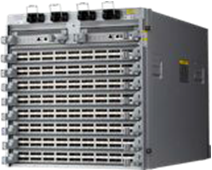
HPE and Arista share a common vision around the need to deliver secure hybrid IT solutions and experiences built on industry-leading software-defined infrastructure—helping customers to operate their workloads with speed and agility to grow their business. This partnership will provide our customers with proven networking solutions that are superior to legacy alternatives and that complement HPE compute, storage, virtualization, and cloud offerings. Designed for large virtualized data centers and cloud networks the Arista 7500 Series modular switches are the industry's highest performance data center switches, available in a compact 7RU (4-slot) or 11RU (8-slot) they combine scalable L2 and L3 resources with advanced features for network monitoring, precision timing, network virtualization to deliver scalable and deterministic network performance for mission critical data centers, enterprise and HPC environments. The Arista 7500E is the second generation of the 7500 Series and delivers seamless upgrades ensuring investment protection of first generation fabrics, line cards and common equipment while setting a new standard for performance, density, reliability, and power efficiency. The Arista 7500E Series offers over 30Tbps of total capacity for 1,152 ports of 10GbE or 288 ports of 40GbE and support for 96 ports of wire-speed 100GbE with a broad choice of interface types that support flexible combinations of 10G, 40G and 100G modes on a single port.
With front-to-rear airflow, redundant and hot swappable supervisor, power, fabric and cooling modules the system is purpose built for data centers. The 7500E Series is energy efficient with typical power consumption of under 4 watts per port for a fully loaded chassis. All of these attributes make the Arista 7500E an ideal platform for building reliable, low latency, resilient and highly scalable data center networks. |
|
||||
|
|
|
|
|||
|
|
|
||||
|
Arista 7500E Series Modular Data Center Switches |
|
||||
|
|
|
|
|||
|
Product Highlights |
|
|
|||
|
|
|
|
|||
|
Performance
High Hardware Availability
Virtualization and Provisioning
|
Scalable Architecture
Resilient Control Plane
Data Center Class Design
Arista Extensible Operating System
|
|
|||
|
|
|
|
|||
|
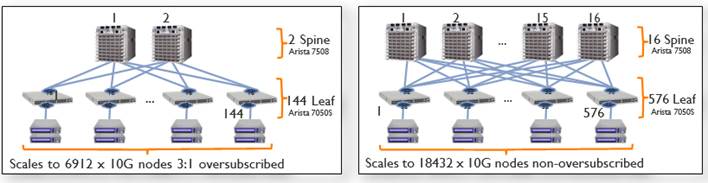
Arista EOS All Arista products including the 7500E Series runs the same Arista EOS software, binary image simplifying network administration with a single standard across all switches. Arista EOS is a modular switch operating system with a unique state sharing architecture that cleanly separates switch state from protocol processing and application logic. Built on top of a standard Linux kernel, all EOS processes run in their own protected memory space and exchange state through an in-memory database. This multi-process state sharing architecture provides the foundation for in-service-software updates and self-healing resiliency together with stateful switchover without the loss of data plane forwarding. Arista EOS enables advanced monitoring and automation capabilities such as Zero Touch Provisioning, LANZ, VM Tracer and Linux based tools to be run natively on the switch. Scaling Data Center Performance The Arista 7500E delivers true line rate non-blocking switching capacity to enable dramatically faster and simpler network designs for data centers that lowers network capital and operational expenses. When used in conjunction with Arista 7050 or 7150 10G leaf switches and Arista's Multi-Chassis Link Aggregation (MLAG) technology, a pair of 7508E Switches can support over 6,000 Servers with a leaf and spine active/active L2 network topology. A combination of 16 Arista 7508E switches in a spine at Layer 3 scales the network up to over 18,000 10G Servers in a fully non-blocking, low-latency, two-stage network that provides predictable and consistent application performance. The flexibility of the L2 and L3 multi-path design options combined with support for open standards provides maximum flexibility, scalability and network wide virtualization. Arista EOS advanced features provides control, and visibility with single point of management
|
|
||||
|
|
|
||||
|
Arista Leaf-Spine Two-Tier Network Architecture |
|
||||
|
|
|
||||
|
Software Defined Cloud Networks Arista Software Defined Cloud Networking (SDCN), combines the principles that have made cloud computing the unstoppable force that it is: automation, self service provisioning, and linear scaling of both performance and economics coupled with the trend in Software Defined Networking that delivers: network virtualization, custom programmability, simplified architectures, and lower capital expenditure. This combination creates a best-in-class software foundation for maximizing the value of the network to both the enterprise and service provider data center. A new architecture for the most mission-critical location within the IT infrastructure that simplifies management and provisioning, speeds up service delivery, lowers costs and creates opportunities for competitive differentiation, while putting control and visibility back in the hands of the network and systems administrators.
The Four Pillars of Arista's Software Defined Cloud Networking:
Deterministic Network Performance The Arista 7500 Series uses a deep buffer virtual output queue (VOQ) architecture that eliminates head-of-line (HOL) blocking and virtually eliminates packet drops even in the most congested network scenarios. An advanced traffic scheduler fairly allocates bandwidth between all virtual output queues while accurately following queue disciplines including weighted fair queueing, fixed priority, or hybrid schemes including 802.1Qaz ETS. As a result, the Arista 7500 can handle the most demanding data center requirements with ease, including mixed traffic loads of real-time, multicast, and storage traffic while still delivering low latency.
Maximum Flexibility
Enhanced Features for High Performance Networks The Arista 7500E delivers a suite of advanced traffic control and monitoring features to improve the agility of modern high performance environments, with solutions for data monitoring, precise timing and next-generation virtualization. Precise Data Analysis Arista Latency Analyzer (LANZ) and Precision Data Analyzer (DANZ) are integrated features of EOS. DANZ provides a solution to monitoring and visibility challenges at 10/40/100Gbps giving IT operations the ability to proactively deliver feedback on congestion events, filter, replicate, aggregate and capture traffic without affecting production performance. LANZ provides precise real-time monitoring of micro-burst and congestion events before they impact applications, with the ability to identify the sources and capture affected traffic for analysis. Precision Timing (IEEE 1588) Arista's hardware derived Precision Time Protocol solution provides a robust mechanism for accurate in-band time distribution in high performance environments. The system clock can be synchronized using the Supervisor module clock input port with a PPS source or IEEE 1588 PTP. Precision timing (IEEE 1588) Arista's hardware derived Precision Time Protocol solution provides a robust mechanism for accurate in-band time distribution in high-performance environments. The system clock can be synchronized using the supervisor module clock input port with a PPS source or IEEE 1588 PTP. Virtualization Supporting next-generation virtualized data centers requires tight integration with orchestration tools and emerging encapsulation technologies such as VXLAN. The 7500E builds on the valuable tools already provided by the Arista VM Tracer suite to integrate directly into encapsulated environments. Offering a wire-speed gateway between VXLAN and traditional L2/3 environments, the 7500E makes integration of non-VXLAN aware devices including servers, firewalls and load-balancers seamless and provides the ability to leverage VXLAN as a standards based L2 extension technology for non-MPLS environments.
Arista Event Management (AEM) Simplifying the overall operations, AEM provides the tools to customize alerts and actions. AEM is a powerful and flexible set of tools to automate tasks and customize the behavior of EOS and the operation of the overall data center switching infrastructure. AEM allows operators to fully utilize the intelligence within EOS to respond to real-time events, automate routine tasks, and automate actions based on changing network conditions.
|
|
||||
|
Line Card Modules Wire-speed line cards deliver up to 14.4 Billion packets per second of forwarding with a distributed virtual output queue architecture and lossless fabric that eliminates head-of-line blocking and provides fairness across all ports. Line cards contains up to 18GB of packet memory for approximately 40msec of traffic buffer per ingress port and virtually eliminating packet drops in congestion scenarios. Line cards connects to all fabric modules in a non-blocking full mesh. The Arista 7508 and 7504 chassis can be populated with any combination of line cards. For environments requiring the highest performance combined with scalability a range of speed and interface options is available addressing dense 1/10G, 40G and 100G with full support for industry standard connections and comprehensive layer 2 and 3 features for flexible deployment choice. Embedded optics combined with MPO interfaces provide a multi-speed port (MXP) capability that increases system density with a choice of 10G/40G/100G interfaces. MXP ports support a mix and match option of 12 x 10G, 3 x 40G or 1x 100G per port. With support for up to 400m over multi-mode fiber MXP ports provide high density and seamless migration from 10G to 100G without replacing transceivers or lowering system density. Line cards with CFP2 and QSFP support industry standard 100G optics for both single and multi-mode fiber for distances up to 40km. |
12 port 100GbE QSFP line card for broad interface choice and high density
|
|
|||
|
12 port 10GbE SR10MXP line card with embedded optics
|
|
||||
|
6 port 100GbE CFP2 line card for flexible range of 100G, 40G and 10G ports
|
|
||||
|
36 port QSFP+ 40G line card for 10G/40G
|
|
||||
|
48 port SFP+ for 1/10GbE and 2 port 100GbE SR10 MXP line card
|
|
||||
|
48 port SFP+ line card for wire-speed 1/10GbE and consistent features
|
|
||||
|
48 port 10GBASE-T line card for 100M/1/10GbE and consistent features
|
|
||||
|
Designed for High Availability and Manageability The Arista 7500E Series are designed for continuous operations with system wide monitoring of both hardware and software components, simple serviceability and provisioning to prevent single points of failure. The hardware supports high-availability with hot- swap of all components with redundant supervisors, power supplies, fabric and cooling modules. Fabric N+1 redundancy provides zero loss of performance with deterministic degradation and integrated fan systems provide dynamic temperature control combined with N+1 redundancy. The 7500E offers 2+2 power redundancy that supports both power source and power supply redundancy. The Arista EOS software supports stateful failover between the dual redundant supervisors as well as self-healing stateful fault containment (SFC), stateful fault repair (SFR) and live patching through in-service-software updates to help ensure continuous service. The Arista 7500E lowers total cost of ownership as it is designed to be efficient with power per port as low as 4W per 10GbE port which combined with front to rear cooling to optimize the data center environment produces the most reliable, dense and power efficient modular switch. |
|
||||
|
|
|
|
|||
|
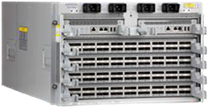
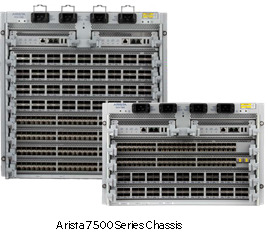
7500 Chassis - 8-slot and 4-slot The 7500 chassis provides room for two supervisor modules, four or eight line card modules, four power supply modules, and six fabric modules. The 7504 chassis fits into 7 rack units while the 7508 chassis fits into 11U of a standard data center rack. Supervisor and line card modules plug in from the front, while the fabric and power supply modules are inserted from the rear. The midplane is completely passive and provides control plane connectivity to each of the fabric and line card modules. The system design is optimized for data center deployments with front- to-rear airflow. |
|
|
|||
|
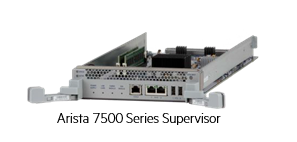
7500E Supervisor Module The supervisor modules for the 7500 series run Arista Extensible Operating System (EOS) and handle all control plane and management functions of the system. One supervisor module is needed to run the system and a second can be added for stateful 1+1 redundancy. Each supervisor module takes up only a half slot resulting in very efficient use of space and a higher density design. The quad-core x86 CPU with 16GB of DRAM and an optional SSD provides the control plane performance needed to run an advanced data center switch scaling to over 1,000 physical ports and thousands of virtual ports. A pulse per second clock input port enables synchronizing with an external source to improve the accuracy of monitoring tools.
|
|
|
|||
|
7500E Fabric Module At the heart of the 7500E series is the fabric. It interconnects all line cards in a non- blocking architecture irrespective of the traffic pattern providing a full 5.12 Tbps per fabric module. Each line card module connects to the fabric with multiple links and data packets are spread across the links to fully utilize the fabric capacity. Unlike hash-based selection of fabric links, the 7500E architecture provides 100% efficient connectivity from any port to any other port with no drops. The fabric modules are always active-active, provide N+1 redundancy and can be hot- swapped with zero performance degradation. The Fabric Modules for the 7508E and the 7504E are different based on the size of the chassis and both integrate a fan assembly for flexible and redundant cooling.
|
|
|
|||
|
7500E Power Supply Module The 7500E series switches are equipped with four 2900W AC power supplies. The power supplies are 2+2 grid redundant and hot-swappable. The power supplies are gold climate saver rated and have an efficiency of over 90% with single stage conversion to the internal 12V DC voltage. |
|
|
|||
|
|
|
||||







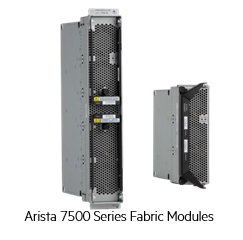
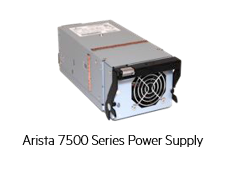
|
Features and Benefits | |
|
| |
|
Layer 2 Features
- 64 Ports / Channel - 256 groups per system (1152 groups *)
- Uses IEEE 802.3ad LACP - 128 ports per MLAG
Layer 3 Features
Advanced Monitoring and Provisioning
- Configurable Congestion Notification (CLI, Syslog) - Streaming Events (GPB Encoded) - Capture/Mirror of congested traffic*
- Port Mirroring (16 sessions) - Enhanced Remote Port Mirroring * - SPAN/TAP M:N Aggregation - L2/3/4 Filtering * |
- CLI Scheduler - Event Manager - Event Monitor - Linux tools
Virtualization Support
- VMware vSphere support - VM Auto Discovery - VM Adaptive Segmentation - VM Host View
Security Features
Quality of Service (QoS) Features
|
|
* Not currently supported in EOS | |
|
Network Management
Extensibility
- Bash shell access and scripting - RPM support - Custom kernel modules
- eAPI - OpenStack Neutron Support
- Python - C++ - eAPI - OpenStack Neutron Support
Line card Features
Fabric Features
|
Standards Compliance
SNMP MIBs
See EOS release notes for latest supported MIBs * Not currently supported in EOS
|
|
| |
Configuration
|
Ordering Information | ||
|
| ||
|
Description |
Arista SKU |
HPE SKU |
|
|
|
|
|
7504E chassis |
|
|
|
Arista 7504E 4x PSU 6x Fabric Supervisor SSD AC Bundle |
DCS-7504E-BND-D |
JH823A |
|
Arista 7504E 4-slot 4xPSU 6xFabricE 1xSupervisorE Bundle |
DCS-7504E-BND |
JH533A |
|
Arista 7504E Chassis Bundle with NEBS-compliant 7504N Chassis 4xDC PS 6xFabric-E 1xSupervisor-E |
DCS-7504EN-BND-DC |
JQ069A |
|
Arista 7504E Chassis Bundle with NEBS-compliant 7504N Chassis 4x3kW PS 6xFabric-E 1xSupervisor-E |
DCS-7504EN-BNd |
JQ070A |
|
|
|
|
|
7508E chassis |
|
|
|
Arista 7508E 4x PSU 6x Fabric Supervisor 2 SSD AC Bundle |
DCS-7508E-BND-D |
JH826A |
|
Arista 7508E 8-slot 4xPSU 6xFabricE 1xSupervisorE Bundle |
DCS-7508E-BND |
JH534A |
|
Arista 7508E Fabric E Module |
DCS-7508E-FM |
JL388A |
|
Arista 7508E Chassis Bundle with NEBS-compliant 7508N Chassis 6x3kW PS 6xFabric-E 1xSupervisor-E |
DCS-7508EN-BND |
JQ071A |
|
|
|
|
|
7500E supervisor, line card, and fabric modules |
|
|
|
Arista 7500E Series Supervisor Module |
DCS-7500E-SUP |
JH535A |
|
Arista 7500E Series 36QSFP+ Module |
DCS-7500E-36Q-LC |
JH536A |
|
Arista 7500E Series 48SFP+ Module |
DCS-7500E-48S-LC |
JH537A |
|
Arista 7500E Series 48XGT Module |
DCS-7500E-48T-LC |
JH538A |
|
Arista 7500E Series 48SFP+ 2SR10 MPO Module |
DCS-7500E-72S-LC |
JH539A |
|
Arista 7500E Series 12QSFP Module |
DCS-7500E-12CQ-LC |
JH540A |
|
Arista 7500E Series 12QSP+ MPO SR4 Module |
DCS-7500E-12CM-LC |
JH541A |
|
Arista 7500E Series 6CFP2 Module |
DCS-7500E-6C2-LC |
JH542A |
|
Arista 7504E Fabric E Module |
DCS-7504E-FM |
JL387A |
|
|
|
|
|
EOS licensing for modular switches |
|
|
|
Arista Expanded L3 Software Mod-1 E-LTU |
LIC-MOD-1-FLX |
JH543AAE |
|
Arista Expanded L3 Software Mod-2 E-LTU |
LIC-MOD-2-FLX |
JH544AAE |
|
Arista Enhanced Software Mod-1 E-LTU |
LIC-MOD-1-E |
JH545AAE |
|
Arista Enhanced Software Mod-2 E-LTU |
LIC-MOD-2-E |
JH546AAE |
|
Arista MACsec Software Mod-1 E-LTU |
LIC-MOD-1-MACSEC |
JH716AAE |
|
Arista Virtualization Software Mod-1 E-LTU |
LIC-MOD-1-V |
JH717AAE |
|
Arista Provisioning Software Mod-1 E-LTU |
LIC-MOD-1-Z |
JH718AAE |
|
Arista Virtualization Software Mod-2 E-LTU |
LIC-MOD-2-V |
JH719AAE |
|
Arista Provisioning Software Mod-2 E-LTU |
LIC-MOD-2-Z |
JH720AAE |
|
Arista FlexRoute L3 Lite Software Mod-1 E-LTU |
LIC-MOD-1-FLX-L |
JQ045AAE |
|
Arista FlexRoute L3 Lite Software Mod-2 E-LTU |
LIC-MOD-2-FLX-L |
JQ046AAE |
|
Arista FlexRoute L3 Lite Software Fix-2 E-LTU |
LIC-FIX-2-FLX-L |
JQ049AAE |
|
|
|
|
|
7500E Support |
|
|
|
Arista A-Care 7508E NBD Software 1 Month Support E-LTU |
SVC-7508E-1M-NB |
JH457AAE |
|
Arista A-Care 7508E 4H Software 1 Month Support E-LTU |
SVC-7508E-1M-4H |
JH458AAE |
|
Arista A-Care 7508E 2H Software 1 Month Support E-LTU |
SVC-7508E-1M-2H |
JH459AAE |
|
Arista A-Care 7504E NBD Software 1 Month Support E-LTU |
SVC-7504E-1M-NB |
JH460AAE |
|
Arista A-Care 7504E 4H Software 1 Month Support E-LTU |
SVC-7504E-1M-4H |
JH461AAE |
|
Arista A-Care 7504E 2H Software 1 Month Support E-LTU |
SVC-7504E-1M-2H |
JH462AAE |
|
Arista A-Care 7504E 1 Month Support for 7504N Chassis w/2H Software and Hardware Replacement E-LTU |
SVC-7504EN-1M-2H |
JQ062AAE |
|
Arista A-Care 7504E 1 Month Support for 7504N Chassis w/4H Software and Hardware Replacement E-LTU |
SVC-7504EN-1M-4H |
JQ063AAE |
|
Arista A-Care 7504E 1 Month Support for 7504N Chassis w/NBD Software and Hardware Replacement E-LTU |
SVC-7504EN-1M-NB |
JQ064AAE |
|
|
|
|
|
Warranty, service, and support
The Arista 7500SE switches come with a one-year limited hardware warranty that covers parts, repair, or replacement with a 10-business-day turnaround after the unit is received. All technical, hardware, and software support for Arista products is provided directly by Arista and not HPE. Consult the Arista Customer Support page for contact information: arista.com/en/support/customer-support. Services may be purchased from HPE or Arista to extend your support coverage and software upgrades. Support will be provided by Arista for these services. For details on Arista warranty and support, see: arista.com/assets/data/pdf/Warranty.pdf Services may be purchased from HPE or Arista to extend your support coverage and software upgrades. Support will be provided by Arista for these services. For details on Arista warranty and support, see: arista.com/assets/data/pdf/Warranty.pdf. | ||
|
|
| |
|
|
| |
Technical Specifications
|
Model comparison | ||||||||||||||||||||||||||||||||||||||||||||||||||||||||||||||||||||||||||||||||
|
| ||||||||||||||||||||||||||||||||||||||||||||||||||||||||||||||||||||||||||||||||
| ||||||||||||||||||||||||||||||||||||||||||||||||||||||||||||||||||||||||||||||||
|
| ||||||||||||||||||||||||||||||||||||||||||||||||||||||||||||||||||||||||||||||||
| ||||||||||||||||||||||||||||||||||||||||||||||||||||||||||||||||||||||||||||||||
|
| ||||||||||||||||||||||||||||||||||||||||||||||||||||||||||||||||||||||||||||||||
| ||||||||||||||||||||||||||||||||||||||||||||||||||||||||||||||||||||||||||||||||
|
| ||||||||||||||||||||||||||||||||||||||||||||||||||||||||||||||||||||||||||||||||
|
Physical Characteristics | ||||||||||||||||||||||||||||||||||||||||||||||||||||||||||||||||||||||||||||||||
|
| ||||||||||||||||||||||||||||||||||||||||||||||||||||||||||||||||||||||||||||||||
| ||||||||||||||||||||||||||||||||||||||||||||||||||||||||||||||||||||||||||||||||
|
| ||||||||||||||||||||||||||||||||||||||||||||||||||||||||||||||||||||||||||||||||
| ||||||||||||||||||||||||||||||||||||||||||||||||||||||||||||||||||||||||||||||||
|
| ||||||||||||||||||||||||||||||||||||||||||||||||||||||||||||||||||||||||||||||||
|
Supported Optics and Cables | ||||||||||||||||||||||||||||||||||||||||||||||||||||||||||||||||||||||||||||||||
|
| ||||||||||||||||||||||||||||||||||||||||||||||||||||||||||||||||||||||||||||||||
| ||||||||||||||||||||||||||||||||||||||||||||||||||||||||||||||||||||||||||||||||
|
| ||||||||||||||||||||||||||||||||||||||||||||||||||||||||||||||||||||||||||||||||
| ||||||||||||||||||||||||||||||||||||||||||||||||||||||||||||||||||||||||||||||||
|
* Not currently supported in EOS | ||||||||||||||||||||||||||||||||||||||||||||||||||||||||||||||||||||||||||||||||
|
| ||||||||||||||||||||||||||||||||||||||||||||||||||||||||||||||||||||||||||||||||
| ||||||||||||||||||||||||||||||||||||||||||||||||||||||||||||||||||||||||||||||||
|
| ||||||||||||||||||||||||||||||||||||||||||||||||||||||||||||||||||||||||||||||||
| ||||||||||||||||||||||||||||||||||||||||||||||||||||||||||||||||||||||||||||||||
|
| ||||||||||||||||||||||||||||||||||||||||||||||||||||||||||||||||||||||||||||||||
|
| ||||||||||||||||||||||||||||||||||||||||||||||||||||||||||||||||||||||||||||||||
Summary of Changes
|
Date |
Version History |
Action |
Description of Change | ||||||||||||||||||
|
02-Apr-2018 |
Version 7 |
Changed |
Configuration section updated | ||||||||||||||||||
|
05-Mar-2018 |
Version 6 |
Added |
SKUs added: JQ406A | ||||||||||||||||||
|
03-Dec-2017 |
Version 5 |
Added |
SKUs added: JH543AAE, JH544AAE, JH545AAE, JH546AAE, JH716AAE, JH717AAE, JH718AAE, JH719AAE, JH720AAE, JQ045AAE, JQ046AAE, JQ049AAE, JH457AAE, JH458AAE, JH459AAE, JH460AAE, JH461AAE, JH462AAE, JQ062AAE, JQ063AAE, JQ064AAE | ||||||||||||||||||
|
03-Jul-2017 |
Version 4 |
Added |
Models added: JQ069A, JQ070A, JQ071A | ||||||||||||||||||
|
05-Jun-2017 |
Version 3 |
Changed |
Technical Specifications updated | ||||||||||||||||||
|
07-Apr-2017 |
Version 2 |
Changed |
Format issues fixed | ||||||||||||||||||
|
06-Mar-2017 |
Version 1 |
Created |
Document creation. | ||||||||||||||||||
| |||||||||||||||||||||