







HPE Networking Instant On Switch 1840: технические характеристики и документация
|
Have feedback on QuickSpecs? We're listening | |
|
HPE Networking Instant On Switch Series 1840 QuickSpecs
Small businesses continue to face operational challenges in an evolving digital landscape a cost-effective, reliable, and secure networking solution must be designed to meet their needs.
With simplified management and enterprise-grade features, the Instant On 1840 helps streamline day-to-day network tasks, ensuring smooth operations. Its affordable price point makes it accessible for budget-conscious businesses seeking high performance without compromising security or reliability. In an environment where network uptime is critical, the Instant On 1840 provides fast, dependable connectivity to support interconnected devices and growing bandwidth demands. This switch enables SMBs to maximize their network investments, maintaining a competitive edge while managing limited resources effectively. |
|
|
HPE Networking Instant On Switch 1840 is an affordable, easy to deploy, smart-managed switch series for small businesses looking for a cost-effective ways to keep up with evolving network demands. These are entry-level switches offering Layer 2 switching capabilities, Gigabit connectivity along with flexible management modes - all at an affordable price point. |
|
|
|
|
|
Key Features |
|
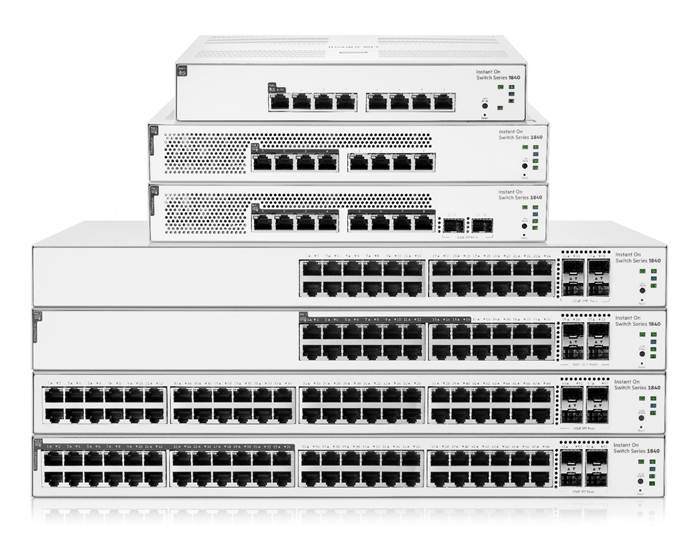
- Smart-managed Layer 2 Ethernet switch series ready to deploy in 8-, 24-, 48-port for non-PoE and Class 4 PoE models. - Up to 370W of PoE to power APs, IP Phones, surveillance cameras, door locks and other IoT devices - Two (2) and four (4) dedicated 1G SFP fiber ports on across models to eliminate traffic bottlenecks across your network. - Cost-effective PoE Support: with half of the ports capable of supporting PoE, these switches are ideal for cost-sensitive environments. - 8-port non-PoE switch that can be powered by an upstream Power over Ethernet (PoE) switch for environments where no line power is available. - Convenient mobile app and web-based GUI for set up, management and troubleshooting. - Compact and fan-less 8-port non-PoE and PoE models for acoustically sensitive environments |
|
|
|
Highlights |
|
Simplicity At Its Best Plug-and-play switches that work together with Instant On APs right out of the box Mobile app to easily setup, monitor and manage your network
Security You Can Count On - Protect your network from unauthorized access with Global Storm Control, TPM 2.0 (Trusted Platform module) based security and VLANs - Automatic denial-of-service (DOS) monitors and protects the network against malicious attacks
We've Got You Covered - No extra licensing or subscription fees - Industry-leading limited lifetime warranty and support
With a flexible management dashboard, Power over Ethernet (PoE) options, and energy-efficient features, these switches deliver a solid business network for small businesses with limited budget.
The HPE Networking Instant On Switch 1840 includes seven switches: three (3) 8-port, two (2) 24-port and two (2) 48-port models in PoE and non-PoE configurations. Besides powering up through a power adapter, the 8-port PD model can also be powered from an upstream PoE switch, offering greater flexibility for space-constrained environments by eliminating the need for additional power outlets and simplifying wiring infrastructure.
With PoE models, up to 30W PoE power delivery is available for Class 4 PoE devices like access points, surveillance cameras and VoIP phones. The 8-port, 24-port and 48-port PoE models come with the power budget of 65W, 195W and 370W respectively to support latest IoT devices.
Using either the Instant On mobile app or the cloud-based web portal, you can quickly set up, monitor and manage the 1830 Switch Series from anywhere at any time. |
|
|
|
Easy Set Up and Management The HPE Networking Instant On mobile app allows you to set up, manage, and monitor Instant On switches and access points directly from your phone. Within the app, you get guided step-by-step instructions to install Instant On devices to get your network up and running quickly - no technical expertise required. And cloud-based access allows you to access the network from anywhere, at any time. |
|
|
|
Better Together Instant On automatically detects and applies highest (critical) PoE priority to Instant On Access Points for uninterrupted power delivery and wireless network access. Wired and wireless voice traffic is prioritized with high QoS priority end-to-end for optimal voice performance. |
|
|
|
Optimized User Experience The HPE Networking Instant On mobile app provides common workflows for Instant On switches and access points making it easier to configure, monitor and manage your network remotely without the need for additional hardware like cloud keys or VPN. You can also update firmware on your Instant On devices directly from the cloud whenever you want, from wherever you are. |
|
|
|
Site Inventory And Topology View The site inventory view shows all Instant On switches and access points on a single interface, and the topology view provides an intuitive structure of all Instant On devices deployed on the network - allowing you to quickly identify non-functioning devices and troubleshoot accordingly. Network issues can be easily diagnosed with connectivity tests like Ping and Traceroute. |
|
|
|
Two-Factor Authentication (2FA) As the number of security breaches continues to rise, 2FA has become an essential tool to mitigate risk against compromised login credentials. Two-Factor Authentication (2FA), provides an additional layer of authentication, prevents attackers from remotely accessing the network, and secures sensitive customer information. |
|
|
|
Built-In Security Built-in security features protect your network from external threats by blocking malware attacks and keeping unauthorized users off the network. Network traffic can be filtered and access restricted based on MAC and IP address. |
|
|
|
No Hidden Fees All features are included in the price of the hardware - there are no recurring subscription or licensing fees. Expert-level support and industry-leading limited lifetime warranty are also included, along with chat support for the life of the product. |
|
|
|
Multi-Site Remote Management The cloud-hosted web interface and mobile app make it easy to remotely manage multiple sites, multiple networks, distributed and multi-tenant deployments. Each site is logically separated and has its own configuration, statistics, guest portal, and admin read/write privileges. Instant On allows you to create three admin accounts per site, offering the option to lock accounts from accidental deletion. |
|
|
|
Management Cloud-Based Management The cloud-hosted web interface and mobile app make it easy to manage networks with Instant On APs and switches.
Simple Local Web GUI Management For management of individual switches, the intuitive Web GUI makes management simple, even for non-technical users. Supports up to five (5) HTTP and HTTP Secure (HTTPS) sessions.
Secure Web-Management Sessions With HTTPS Encrypts and otherwise protects management sessions through HTTP Secure (HTTPS), which prevents snooping of sensitive management information. Regardless of whether the switch is managed from the local Web GUI or the cloud, data between the switch and the management interface is encrypted and secure.
Firmware Update Provides notification of the latest firmware with the ability to schedule update at a preferred time through Instant On mobile app and cloud-based web portal.
Configuration File Management Allows the user to back up and restore the configuration settings in case of a firmware upgrade or to apply them to other switches on the network.
DHCP Client Mode Allows the switch to be directly connected to a network, enabling plug-and-play operation. In the absence of a DHCP server on the network, the switch falls back to the default static address 192.168.1.1.
Locator LED Allows users to set the locator LED on a specific switch to either turn on, blink, or turn off; simplifying troubleshooting by making it easy to locate a particular switch within a rack of similar switches.
Comprehensive LED Display Provides an at-a-glance view of status, activity, speed, and full-duplex operation with per-port indicators.
Management VLAN ID Provides secure management access to the switch for administrators from within the specified VLAN.
Simple Network Time Protocol (SNTP) Allows automatic synchronization of the switch date and time for accurate tracking of system events and various schedules set by the administrator. |
|
|
|
Quality Of Service (Qos) Class of Service (CoS) Provides time-sensitive packets (like VoIP and video) with priority over other traffic based on DSCP or IEEE 802.1p classification; packets are mapped to four hardware queues for more effective throughput. |
|
|
|
Connectivity Auto MDI/MDI-X Adjusts automatically for straight-through or crossover cables on all 10/100/1000 ports.
Auto-negotiating capability Supports half/full-duplex auto-negotiating capability on every port that doubles the throughput of every port.
1G fiber connectivity Provides 1G fiber connections for uplinks and other connections across longer distances than copper cabling can support. SFP ports are in addition to available copper Ethernet ports, providing a higher total number of available ports. Two (2) SFP ports on the 8-port PoE switch and four (4) SFP ports available on 24- and 48-port models.
Ethernet Alliance PSE Class 4 PoE Certification Power Over Ethernet (PoE) functionality is supported on certain 1830 models, known as power source equipment (PSE) ports which provide power to connected devices.
With half of the ports supporting Class 4 PoE, these models provide up to 30 W per port, which allows support of class 4 PoE or IEEE 802.3at capable devices such as video IP phones, wireless access points, as well as any 15.4 W IEEE 802.3af compliant end device, mitigating the cost of additional electrical cabling and circuits that would otherwise be necessary.
Ethernet Alliance PD Class 3 PoE Certification Devices receiving power through PoE are referred to as powered devices (PDs).
The 8-port non-PoE Gigabit Ethernet model is a powered device that can be powered by an upstream Power over Ethernet (PoE) switch for environments where no line power is available, besides being powered up by an external power adapter. Port 1 supports Class 3 PoE with the capability of receiving IEEE 802.3af PoE power up to a maximum of 13W.
Auto-PoE power configuration The switch automatically assigns the required power to a port for a PD device based on Link Layer Discovery Protocol (LLDP).
PoE power allocation Support multiple methods (LLDP-MED automatic, class of PoE, or usage-based) to allocate PoE power for more efficient energy savings.
PoE Scheduling Allows user to configure a specific day/time of the week (e.g., business hours) for Instant On switches to supply power to connected devices (e.g., surveillance cameras, access points etc.).
Port Scheduling Allows user to configure up to three (3) schedules to enable or disable individual ports or PoE power delivery on certain switch ports by selecting a particular time of the day or a periodic occurrence. |
|
|
|
Switching Flow control Provides a flow-throttling mechanism propagated through the network to prevent packet loss at a congested node.
Spanning Tree Protocol (STP) Supports 802.1D STP, 802.1w Rapid Spanning Tree Protocol (RSTP) for faster convergence. Provides redundant links while preventing network loops.
BPDU filtering Drops BPDU packets when STP is enabled globally but disabled on a specific port.
Loop protection Allows loop detection in the network for switches that do not run spanning tree, or on which STP feature is disabled.
IGMP v1, v2 snooping IGMP snooping allows the switch to forward IPv4 multicast traffic intelligently. With IGMP snooping enabled, the switch forwards traffic only to ports that request the multicast traffic. This prevents the switch from broadcasting traffic to all ports and possibly affecting network performance.
Link aggregation Groups together multiple ports of up to 16 trunks with a maximum of eight (8) ports per trunk automatically using Link Aggregation Control Protocol (LACP), or manually, to form a high-bandwidth connection to the network backbone that helps prevent traffic bottlenecks.
Link Layer Discovery Protocol (LLDP) Advertises and receives management information from adjacent devices on a network, facilitating easy mapping by network management applications.
LLDP-MED (Media Endpoint Discovery) Defines a standard extension of LLDP that stores values for parameters such as QoS and VLAN for automatic configuration of network devices such as IP phones.
VLAN support Offers some of the benefits of both bridging and routing. VLANs partition the network into logical segments, which provide better administration, security, and multicast traffic management.
Port mirroring Enables traffic on a port or VLAN to be simultaneously sent to a network analyzer for monitoring.
Auto recovery Allows ports to be placed in a suspended state when defined error conditions are met. Features supported by Auto Recovery are BPDU Guard, Storm Control, Port Security, Loop Protection and Link Flap Prevention. |
|
|
|
Network Security TPM-based security Includes a Trusted Platform Module 2.0 (TPM) for secure hardware-based generation and storage of cryptographic keys used for secure connection to the Instant On Cloud Portal.
Automatic denial-of-service protection Manages high-volume traffic and prevents denial-of-service (DoS) attacks against the network.
Global Storm Control Protects against conditions where incoming packets flood the LAN, causing network performance degradation for unicast traffic with an unknown destination, and for broadcast and multicast traffic. |
|
|
|
Performance and Efficiency Energy Efficient Ethernet (EEE) Compliant with 802.3az standard requirements to save energy during periods of low data activity.
Auto-port shut down The switch saves power by automatically shutting down power to inactive ports. Power is restored on a port upon link detection.
Energy-efficient cooling Includes variable speed fans operating only at the speed necessary to maintain operating temperature to reduce excess noise and power consumption.
Fan-less operation Fan-less design for 8-port non-PoE, and PoE models as well as 24-port non-PoE model, making the switches ideal for silent operation environments. |
|
|
|
Features Accessed Through Local Web-Management Interface Quick start-up wizard Includes a quick start-up wizard which enable automatic configuring of the initial settings such as IP address, device information and system time.
Jumbo frame support Supports up to 9216 bytes frame size to improve the performance of large data transfers.
User account management Password strength checking and aging feature provides enhanced security to user account administration on the local web management interface. Password management further enhances the security so that only authorized users can access the switch's web interface.
Secure Sockets Layer (SSL) Encrypts all HTTP traffic and secures access to the local browser-based management of the switch.
SCP and TFTP file transfer Provides different mechanisms for secure file transfer through SCP (Secure Copy Protocol) or TFTP.
Dual image support Provide independent primary and secondary software images for backup while upgrading.
SNMPv1, v2c (read only) Facilitates remote management of the switch as the device can be discovered and monitored from an SNMP management station. |
|
|
|
Diagnostics Event logs Provides detailed information for problem identification and resolution.
Session logging Displays the active users connected to the switch, displaying client IP address, duration of the individual session.
Remote syslog Provides support for a single syslog server allowing the user to redirect and store events to a remote syslog server (supported on local web only).
Cable diagnostic tool Provides the mechanism to detect and report potential cabling issues, such as cable opens or cable shorts on copper links, in addition to providing distance to the fault and total length of cable (supported on local web only).
Ping IPv4 The switch supports ICMP for sending ping requests to IPv4 addresses.
Support file Includes summary information for the switch including the current switch configuration, statistics and buffered log messages (supported on local web only).
MAC address table Also known as the bridge table or the forwarding database, this table enables the switch to forward traffic through the appropriate port and supports up to 16K MAC address entries. |
|
|
|
Warranty, Service And Support HPE Networking Instant On Limited Lifetime Support provides 24X7 phone support for the first 90 days and chat support for the entire warranty period. Community support is included for the life of the product.
Refer to the Hewlett Packard Enterprise website at hpe.com/ networking/services for details on the service-level descriptions and product numbers. For details about services and response times in your area, please contact your local Hewlett Packard Enterprise sales office. |
|
|
|
BTO Models |
|
|
IOn 1840 |
|
|
Description |
SKU |
|
HPE Networking Instant On Switch 8p Gigabit 1p CL3 PD 1840 |
S5E25A |
|
HPE Networking Instant On Switch 8p Gigabit 1p CL3 PD 1840 PDU |
S5E25A#B2B |
|
HPE Networking Instant On Switch 8p Gigabit 1p CL3 PD 1840 PDU |
S5E25A#B2C |
|
HPE Networking Instant On Switch 8p Gigabit 1p CL3 PD 1840 220v |
S5E25A#B2E |
|
HPE Networking Instant On Switch 8p Gigabit 1p CL3 PD 1840 No Loc |
S5E25A#AC3 |
|
HPE Networking Instant On Switch 8p Gigabit 4p CL4 PoE 65W 1840 |
S5E26A |
|
HPE Networking Instant On Switch 8p Gigabit 4p CL4 PoE 65W 1840 PDU |
S5E26A#B2B |
|
HPE Networking Instant On Switch 8p Gigabit 4p CL4 PoE 65W 1840 PDU |
S5E26A#B2C |
|
HPE Networking Instant On Switch 8p Gigabit 4p CL4 PoE 65W 1840 220v |
S5E26A#B2E |
|
HPE Networking Instant On Switch 8p Gigabit 4p CL4 PoE 65W 1840 No Loc |
S5E26A#AC3 |
|
HPE Networking Instant On Switch 8p Gigabit CL4 PoE 2p SFP 124W 1840 |
S5E27A |
|
HPE Networking Instant On Switch 8p Gigabit CL4 PoE 2p SFP 124W 1840 PDU |
S5E27A#B2B |
|
HPE Networking Instant On Switch 8p Gigabit CL4 PoE 2p SFP 124W 1840 PDU |
S5E27A#B2C |
|
HPE Networking Instant On Switch 8p Gigabit CL4 PoE 2p SFP 124W 1840 220v |
S5E27A#B2E |
|
HPE Networking Instant On Switch 8p Gigabit CL4 PoE 2p SFP 124W 1840 No Loc |
S5E27A#AC3 |
|
HPE Networking Instant On Switch 24p Gigabit 4p SFP 1840 |
S5E28A |
|
HPE Networking Instant On Switch 24p Gigabit 4p SFP 1840 PDU |
S5E28A#B2B |
|
HPE Networking Instant On Switch 24p Gigabit 4p SFP 1840 PDU |
S5E28A#B2C |
|
HPE Networking Instant On Switch 24p Gigabit 4p SFP 1840 220v |
S5E28A#B2E |
|
HPE Networking Instant On Switch 24p Gigabit 4p SFP 1840 No Loc |
S5E28A#AC3 |
|
HPE Networking Instant On Switch 24p Gigabit 16p CL4 PoE 4p SFP 195W 1840 |
S5E29A |
|
HPE Networking Instant On Switch 24p Gigabit 16p CL4 PoE 4p SFP 195W 1840 PDU |
S5E29A#B2B |
|
HPE Networking Instant On Switch 24p Gigabit 16p CL4 PoE 4p SFP 195W 1840 PDU |
S5E29A#B2C |
|
HPE Networking Instant On Switch 24p Gigabit 16p CL4 PoE 4p SFP 195W 1840 220v |
S5E29A#B2E |
|
HPE Networking Instant On Switch 24p Gigabit 16p CL4 PoE 4p SFP 195W 1840 No Loc |
S5E29A#AC3 |
|
HPE Networking Instant On Switch 48p Gigabit 4p SFP 1840 |
S5E30A |
|
HPE Networking Instant On Switch 48p Gigabit 4p SFP 1840 PDU |
S5E30A#B2B |
|
HPE Networking Instant On Switch 48p Gigabit 4p SFP 1840 PDU |
S5E30A#B2C |
|
HPE Networking Instant On Switch 48p Gigabit 4p SFP 1840 220v |
S5E30A#B2E |
|
HPE Networking Instant On Switch 48p Gigabit 4p SFP 1840 No Loc |
S5E30A#AC3 |
|
HPE Networking Instant On Switch 48p Gigabit 24p CL4 PoE 4p SFP 370W 1840 |
S5E31A |
|
HPE Networking Instant On Switch 48p Gigabit 24p CL4 PoE 4p SFP 370W 1840 PDU |
S5E31A#B2B |
|
HPE Networking Instant On Switch 48p Gigabit 24p CL4 PoE 4p SFP 370W 1840 PDU |
S5E31A#B2C |
|
HPE Networking Instant On Switch 48p Gigabit 24p CL4 PoE 4p SFP 370W 1840 220v |
S5E31A#B2E |
|
HPE Networking Instant On Switch 48p Gigabit 24p CL4 PoE 4p SFP 370W 1840 No Loc |
S5E31A#AC3 |
|
|
|
|
|
|
Enter the following menu selections as integrated to the CTO Model X server above if order is factory built. |
|
Transceivers |
|
|
Note: Localization (Wall Power Cord) required on orders without B2B or B2C (PDU Power Cord). (See HPN Localization Menu) |
|
|
SFP Transceivers |
|
|
Note: The following Transceivers install into this switch: |
|
|
Description |
SKU |
|
HPE Networking Instant On 1G SFP LC SX 500m OM2 MMF Transceiver |
R9D16A |
|
HPE Networking Instant On 1G LX SFP LC 10km SMF Transceiver |
S0G20A |
|
HPE Networking Instant On 1G SFP RJ45 100m Cat5e Transceiver |
R9D17A |
|
HPE Networking Instant On 1G SFP RJ45 100m Cat5e Transceiver |
R9D17B |
|
|
|
|
|
|
Specifications |
HPE Networking Instant On Switch 8p Gigabit 1p CL3 PD 1840 |
HPE Networking Instant On Switch 8p Gigabit 4p CL4 PoE 65W 1840 |
HPE Networking Instant On Switch 8p Gigabit CL4 PoE 2p SFP 124W 1840 |
HPE Networking Instant On Switch 24p Gigabit 4p SFP 1840 |
|
S5E25A |
S5E26A |
S5E27A |
S5E28A | |
|
I/O ports and slots | ||||
|
Access |
1 RJ-45 autosensing 10/100/1000BASE-T ports with IEEE 802.3af Class 3 PD (port 1) |
4 RJ-45 autosensing 10/100/1000BASE-T ports with IEEE 802.3at Class 4 PoE (ports 1-4) |
8 RJ-45 autosensing 10/100/1000BASE-T ports with IEEE 802.3at Class 4 PoE (ports 1-8) |
24 RJ-45 autosensing 10/100/1000BASE-T ports (ports 1-24) |
|
Uplink |
N/A |
N/A |
2x SFP 1GbE ports (ports 9-10) |
4x SFP 1GbE ports (ports 25-28) |
|
Console port |
N/A |
N/A |
N/A |
N/A |
|
Physical Characteristics | ||||
|
Dimensions (Depth x Width x Height) |
6.50 x 10.00 x 1.73 in |
11.65 x 11.61 x 1.73 in |
11.65 x 11.61 x 1.73 in |
12.05 x 17.48 x 1.73 in |
|
Weight |
2.50 lb (1.13 kg) |
4.60 lb (2.09kg) |
4.81 lb (2.18 kg) |
6.60 lb (2.99 kg) |
|
Processor and memory | ||||
|
Processor Type/Frequency |
ARM Cortex-A9 @1.2GHz |
ARM Cortex-A9 @1.2GHz |
ARM Cortex-A9 @1.2GHz |
ARM Cortex-A9 @1.2GHz |
|
SDRAM |
1GB DDR4 |
1GB DDR4 |
1GB DDR4 |
1GB DDR4 |
|
Flash |
256MB NAND |
256MB NAND |
256MB NAND |
256MB NAND |
|
Packet Buffer Size |
512 KB |
512 KB |
512 KB |
512 KB |
|
Scale | ||||
|
Jumbo frames support |
Up to 9216 bytes |
Up to 9216 bytes |
Up to 9216 bytes |
Up to 9216 bytes |
|
Switching capacity |
16 Gbps |
16 Gbps |
20Gbps |
56 Gbps |
|
MAC Address table size (# of entries) |
16K entries |
16K entries |
16K entries |
16K entries |
|
Maximum VLAN supported |
64 |
64 |
64 |
64 |
|
MAC Table Capacity |
16K entries |
16K entries |
16K entries |
16K entries |
|
IGMP Groups |
1K groups |
1K groups |
1K groups |
1K groups |
|
IPv4/MAC ACL Entries (ingress) |
50 |
50 |
50 |
50 |
|
IPv4/MAC ACL Entries (egress) |
unsupported |
unsupported |
unsupported |
unsupported |
|
Maximum ACEs |
2048 |
2048 |
2048 |
2048 |
|
Link aggregation groups (LAG) |
8 |
8 |
8 |
16 |
|
LAG members |
4 |
4 |
4 |
4 |
|
Performance | ||||
|
Latency | ||||
|
100 Mb Latency (LIFO) |
< 10.3 µSec |
< 10.3 µSec |
< 10.3 µSec |
< 10.3 µSec |
|
1000 Mb Latency (LIFO) |
< 6.2 µSec |
< 6.2 µSec |
< 6.2 µSec |
< 6.2 µSec |
|
10000 Mb Latency (LIFO) |
n/a |
n/a |
n/a |
n/a |
|
Throughput | ||||
|
Throughput (Mpps) @ 64 bytes packet |
11.90 Mpps |
11.90 Mpps |
14.88 Mpps |
41.66 Mpps |
|
Reliability | ||||
|
Reliability MTBF (years) |
666 |
200 |
153 |
175 |
|
Environment | ||||
|
Operating temperature |
32°F to 104°F |
32°F to 104°F |
32°F to 104°F |
32°F to 104°F |
|
Nonoperating/Storage temperature |
-40°F to 158°F |
-40°F to 158°F |
-40°F to 158°F |
-40°F to 158°F |
|
Operating relative humidity |
15% to 95% @ 104°F (40°C) |
15% to 95% @ 104°F (40°C) |
15% to 95% @ 104°F (40°C) |
15% to 95% @ 104°F (40°C) |
|
Nonoperating/Storage relative humidity |
15% to 95% @ 140°F (60°C) |
15% to 95% @ 140°F (60°C) |
15% to 95% @ 140°F (60°C) |
15% to 95% @ 140°F (60°C) |
|
Altitude |
up to 10,000 ft (3 km) |
up to 10,000 ft (3 km) |
up to 10,000 ft (3 km) |
up to 10,000 ft (3 km) |
|
Acoustics | ||||
|
Acoustics measured in 23°C semi-anechoic chamber with a loading of 100% traffic and 50% PoE on all ports. Measured in accordance with ISO 7779. Declared in accordance with ECMA-109:2010. Values presented are the Declared A-Weighted Sound Power Level (LWAd) and the mean Bystander A-Weighted Sound Pressure Level (LpAm) |
N/A |
N/A |
N/A |
Sound Power, LWAd = 3.1 Bel |
|
N/A |
N/A |
N/A |
Sound Pressure, LpAm (Bystander) = 18 dB | |
|
Fans |
Fan-less |
Fan-less |
Fan-less |
1 Fixed Fan |
|
Primary Airflow |
N/A |
N/A |
N/A |
left-to-right |
|
Electrical Characteristics | ||||
|
Frequency |
50 Hz/60 Hz |
50 Hz/60 Hz |
50 Hz/60 Hz |
50 Hz/60 Hz |
|
AC voltage |
100 - 240 VAC |
100 - 127 VAC / 200 - 240 VAC |
100 - 127 VAC / 200 - 240 VAC |
100 - 127 VAC / 200 - 240 VAC |
|
Current |
0.6A (12VDC - 1.3A) |
0.9 /1.5 A |
1.5 / 0.8 A |
0.4 / 0.3 A |
|
Maximum heat dissipation |
>> Powered by External power adapter. |
100-127V: 33.5 BTU/hr, 35.3 Kj/hr |
100-127V: 45.9 BTU/hr, 48.4 Kj/hr |
100-127V: 67.6 BTU/hr, 71.3 Kj/hr |
|
Maximum heat dissipation |
N/A |
100-127V: 293.2 BTU/hr, 309.3 Kj/hr |
100-127V: 499.3 BTU/hr, 526.8 Kj/hr |
N/A |
|
Maximum heat dissipation |
>> Powered by External power adapter. |
100-127V: 27.5 BTU/hr, 29.0 Kj/hr |
100-127V: 30.8 BTU/hr, 32.5 Kj/hr |
100-127V: 16.3 BTU/hr, 17.2 Kj/hr |
|
Power consumption (100% traffic rate) |
>> Powered by External power adapter. |
100-127V: 9.8W |
100-127V: 13.5W |
100-127V: 19.8W |
|
Power consumption (100% traffic rate + 100% PoE) |
N/A |
100-127V: 85.9W |
100-127V: 146.4W |
N/A |
|
Power consumption (Idle) |
>> Powered by External power adapter. |
100-127V: 8.1W |
100-127V: 9.0W |
100-127V: 4.8W |
|
PoE power |
Class 3 PD input |
65W Class 4 PoE |
124W Class 4 PoE |
N/A |
|
Power Supply Type |
External Power Supply |
Internal Power Supply |
Internal Power Supply |
Internal Power Supply |
|
Safety | ||||
|
Compliance |
EN/IEC 62368-1, |
EN/IEC 62368-1, |
EN/IEC 62368-1, |
EN/IEC 62368-1, |
|
Emissions | ||||
|
Compliance |
EN 55032:2015/ |
EN 55032:2015/ |
EN 55032:2015/ |
EN 55032:2015/ |
|
Immunity | ||||
|
Generic |
BS/EN 55035, CISPR |
BS/EN 55035, CISPR |
BS/EN 55035, CISPR |
BS/EN 55035, CISPR |
|
EN |
EN 55035, CISPR 35 |
EN 55035, CISPR 35 |
EN 55035, CISPR 35 |
EN 55035, CISPR 35 |
|
ESD |
IEC 61000-4-2 |
IEC 61000-4-2 |
IEC 61000-4-2 |
IEC 61000-4-2 |
|
Radiated |
IEC 61000-4-3 |
IEC 61000-4-3 |
IEC 61000-4-3 |
IEC 61000-4-3 |
|
EFT/Burst |
IEC 61000-4-4 |
IEC 61000-4-4 |
IEC 61000-4-4 |
IEC 61000-4-4 |
|
Surge |
IEC 61000-4-5 |
IEC 61000-4-5 |
IEC 61000-4-5 |
IEC 61000-4-5 |
|
Conducted |
IEC 61000-4-6 |
IEC 61000-4-6 |
IEC 61000-4-6 |
IEC 61000-4-6 |
|
Power frequency magnetic field |
IEC 61000-4-8 |
IEC 61000-4-8 |
IEC 61000-4-8 |
IEC 61000-4-8 |
|
Voltage dips and interruptions |
IEC 61000-4-11 |
IEC 61000-4-11 |
IEC 61000-4-11 |
IEC 61000-4-11 |
|
Harmonics |
EN 61000-3-2, IEC 61000-3-2 |
EN 61000-3-2, IEC 61000-3-2 |
EN 61000-3-2, IEC 61000-3-2 |
EN 61000-3-2, IEC 61000-3-2 |
|
Flicker |
EN 61000-3-3, IEC 61000-3-3 |
EN 61000-3-3, IEC 61000-3-3 |
EN 61000-3-3, IEC 61000-3-3 |
EN 61000-3-3, IEC 61000-3-3 |
|
Device Management | ||||
|
Options |
Instant On Cloud Portal; Mobile App; Web Browser; SNMP Manager; DOCs (Telnet, SSH) |
Instant On Cloud Portal; Mobile App; Web Browser; SNMP Manager; DOCs (Telnet, SSH) |
Instant On Cloud Portal; Mobile App; Web Browser; SNMP Manager; DOCs (Telnet, SSH) |
Instant On Cloud Portal; Mobile App; Web Browser; SNMP Manager; DOCs (Telnet, SSH) |
|
Mounting Kit | ||||
|
Options |
Supports table-top mounting |
Mounts in an EIA standard 19 in. telco rack or equipment cabinet. 2-post rack kit included |
Mounts in an EIA standard 19 in. telco rack or equipment cabinet. 2-post rack kit included |
Mounts in an EIA standard 19 in. telco rack or equipment cabinet. 2-post rack kit included |
|
Transceivers | ||||
|
Options |
N/A |
N/A |
Refer to supported list table |
Refer to supported list table |
|
| ||||
|
Specifications |
HPE Networking Instant On Switch 24p Gigabit 16p CL4 PoE 4p SFP 195W 1840 |
HPE Networking Instant On Switch 48p Gigabit 4p SFP 1840 |
HPE Networking Instant On Switch 48p Gigabit 24p CL4 PoE 4p SFP 370W 1840 |
|
S5E29A |
S5E30A |
S5E31A | |
|
I/O ports and slots | |||
|
Access |
16 RJ-45 autosensing 10/100/1000BASE-T ports with IEEE 802.3at Class 4 PoE (ports 1-16) |
48 RJ-45 autosensing 10/100/1000BASE-T ports (ports 1-48) |
24 RJ-45 autosensing 10/100/1000BASE-T ports with IEEE 802.3at Class 4 PoE (ports 1-24) |
|
Uplink |
4x SFP 1GbE ports (ports 25-28) |
4x SFP 1GbE ports (ports 49-52) |
4x SFP 1GbE ports (ports 49-52) |
|
Console port |
N/A |
N/A |
N/A |
|
Physical Characteristics | |||
|
Dimensions (Depth x Width x Height) |
12.05 x 17.48 x 1.73 in |
14.45 x 17.48 x 1.73 in |
14.45 x 17.48 x 1.73 in |
|
Weight |
7.74 lb (3.51 kg) |
8.29 lb (3.76 kg) |
10.01 lb (4.54 kg) |
|
Processor and memory | |||
|
Processor Type/Frequency |
ARM Cortex-A9 @1.2GHz |
ARM Cortex-A9 @1.25GHz |
ARM Cortex-A9 @1.25GHz |
|
SDRAM |
1GB DDR4 |
1GB DDR4 |
1GB DDR4 |
|
Flash |
256MB NAND |
512 MB NAND |
512 MB NAND |
|
Packet Buffer Size |
512 KB |
4 MB |
4 MB |
|
Scale | |||
|
Jumbo frames support |
Up to 9216 bytes |
Up to 9216 bytes |
Up to 9216 bytes |
|
Switching capacity |
56 Gbps |
104 Gbps |
104Gbps |
|
MAC Address table size (# of entries) |
16K entries |
16K entries |
16K entries |
|
Maximum VLAN supported |
64 |
64 |
64 |
|
MAC Table Capacity |
16K entries |
16K entries |
16K entries |
|
IGMP Groups |
1K groups |
1K groups |
1K groups |
|
IPv4/MAC ACL Entries (ingress) |
50 |
50 |
50 |
|
IPv4/MAC ACL Entries (egress) |
unsupported |
512 |
512 |
|
Maximum ACEs |
2048 |
2048 |
2048 |
|
Link aggregation groups (LAG) |
16 |
16 |
16 |
|
LAG members |
4 |
8 |
8 |
|
Performance | |||
|
Latency | |||
|
100 Mb Latency (LIFO) |
< 8.8 µSec |
< 8.0 µSec |
< 8.0 µSec |
|
1000 Mb Latency (LIFO) |
< 4.7 µSec |
< 3.3 µSec |
< 3.3 µSec |
|
10000 Mb Latency (LIFO) |
n/a |
n/a |
n/a |
|
Throughput | |||
|
Throughput (Mpps) @ 64 bytes packet |
41.66 Mpps |
77.37 Mpps |
77.37 Mpps |
|
Reliability | |||
|
Reliability MTBF (years) |
114 |
196 |
122 |
|
Environment | |||
|
Operating temperature |
32°F to 104°F |
32°F to 104°F |
32°F to 104°F |
|
Nonoperating/Storage temperature |
-40°F to 158°F |
-40°F to 158°F |
-40°F to 158°F |
|
Operating relative humidity |
15% to 95% @ 104°F (40°C) |
15% to 95% @ 104°F (40°C) |
15% to 95% @ 104°F (40°C) |
|
Nonoperating/Storage relative humidity |
15% to 95% @ 140°F (60°C) |
15% to 95% @ 140°F (60°C) |
15% to 95% @ 140°F (60°C) |
|
Altitude |
up to 10,000 ft (3 km) |
up to 10,000 ft (3 km) |
up to 10,000 ft (3 km) |
|
Acoustics | |||
|
Acoustics measured in 23°C semi-anechoic chamber with a loading of 100% traffic and 50% PoE on all ports. Measured in accordance with ISO 7779. Declared in accordance with ECMA-109:2010. Values presented are the Declared A-Weighted Sound Power Level (LWAd) and the mean Bystander A-Weighted Sound Pressure Level (LpAm) |
Sound Power, LWAd = 3.3 Bel |
Sound Power, LWAd = 3.9 Bel |
Sound Power, LWAd = 3.4 Bel |
|
Sound Pressure, LpAm (Bystander) = 21 dB |
Sound Pressure, LpAm (Bystander) = 25 dB |
Sound Pressure, LpAm (Bystander) = 20 dB | |
|
Fans |
2 Fixed Fans |
1 Fixed Fan |
3 Fixed Fans |
|
Primary Airflow |
left-to-right |
left-to-right |
left-to-right |
|
Electrical Characteristics | |||
|
Frequency |
50 Hz/60 Hz |
50 Hz/60 Hz |
50 Hz/60 Hz |
|
AC voltage |
100 - 127 VAC / 200 - 240 VAC |
100 - 127 VAC / 200 - 240 VAC |
100 - 127 VAC / 200 - 240 VAC |
|
Current |
2.5 / 1.2 A |
0.8 / 0.5 |
4.7 / 2.3 A |
|
Maximum heat dissipation |
100-127V: 73.2 BTU/hr, 77.2 Kj/hr |
100-127V: 132.3 BTU/hr, 139.6 Kj/hr |
100-127V: 189.7 BTU/hr, 200.1 Kj/hr |
|
Maximum heat dissipation |
100-127V: 819.6 BTU/hr, 864.7 Kj/hr |
N/A |
100-127V: 1590.3 BTU/hr, 1677.9 Kj/hr |
|
Maximum heat dissipation |
100-127V: 33.5 BTU/hr, 35.3 Kj/hr |
100-127V: 67.5 BTU/hr, 71.2 Kj/hr |
100-127V: 83.3 BTU/hr, 87.9 Kj/hr |
|
Power consumption (100% traffic rate) |
100-127V: 21.5W |
100-127V: 38.8W |
100-127V: 55.6W |
|
Power consumption (100% traffic rate + 100% PoE) |
100-127V: 240.2W |
N/A |
100-127V: 466.1W |
|
Power consumption (Idle) |
100-127V: 9.8W |
100-127V: 19.8W |
100-127V: 24.4W |
|
PoE power |
195W Class 4 PoE |
N/A |
370W Class 4 PoE |
|
Power Supply Type |
Internal Power Supply |
Internal Power Supply |
Internal Power Supply |
|
Safety | |||
|
Compliance |
EN/IEC 62368-1, |
EN/IEC 62368-1, |
EN/IEC 62368-1, |
|
Emissions | |||
|
Compliance |
EN 55032:2015/ |
EN 55032:2015/ |
EN 55032:2015/ |
|
Immunity | |||
|
Generic |
BS/EN 55035, CISPR |
BS/EN 55035, CISPR |
BS/EN 55035, CISPR |
|
EN |
EN 55035, CISPR 35 |
EN 55035, CISPR 35 |
EN 55035, CISPR 35 |
|
ESD |
IEC 61000-4-2 |
IEC 61000-4-2 |
IEC 61000-4-2 |
|
Radiated |
IEC 61000-4-3 |
IEC 61000-4-3 |
IEC 61000-4-3 |
|
EFT/Burst |
IEC 61000-4-4 |
IEC 61000-4-4 |
IEC 61000-4-4 |
|
Surge |
IEC 61000-4-5 |
IEC 61000-4-5 |
IEC 61000-4-5 |
|
Conducted |
IEC 61000-4-6 |
IEC 61000-4-6 |
IEC 61000-4-6 |
|
Power frequency magnetic field |
IEC 61000-4-8 |
IEC 61000-4-8 |
IEC 61000-4-8 |
|
Voltage dips and interruptions |
IEC 61000-4-11 |
IEC 61000-4-11 |
IEC 61000-4-11 |
|
Harmonics |
EN 61000-3-2, IEC 61000-3-2 |
EN 61000-3-2, IEC 61000-3-2 |
EN 61000-3-2, IEC 61000-3-2 |
|
Flicker |
EN 61000-3-3, IEC 61000-3-3 |
EN 61000-3-3, IEC 61000-3-3 |
EN 61000-3-3, IEC 61000-3-3 |
|
Device Management | |||
|
Options |
Instant On Cloud Portal; Mobile App; Web Browser; SNMP Manager; DOCs (Telnet, SSH) |
Instant On Cloud Portal; Mobile App; Web Browser; SNMP Manager; DOCs (Telnet, SSH) |
Instant On Cloud Portal; Mobile App; Web Browser; SNMP Manager; DOCs (Telnet, SSH) |
|
Mounting Kit | |||
|
Options |
Mounts in an EIA standard 19 in. telco rack or equipment cabinet. 2-post rack kit included |
Mounts in an EIA standard 19 in. telco rack or equipment cabinet. 2-post rack kit included |
Mounts in an EIA standard 19 in. telco rack or equipment cabinet. 2-post rack kit included |
|
Transceivers | |||
|
Options |
Refer to supported list table |
Refer to supported list table |
Refer to supported list table |
|
| |||
|
Standards Compliance | ||
|
Standard / RFC |
Protocol / Technology Title |
Functional Category |
|
RFC 1027 |
Using ARP to Implement Transparent Subnet Gateways |
IP-to-MAC / Proxy ARP |
|
RFC 1042 |
A Standard for the Transmission of IP Datagrams over IEEE 802 Networks |
Packet Encapsulation |
|
RFC 1071 |
Computing the Internet Checksum |
Error Detection / Integrity |
|
RFC 1123 |
Requirements for Internet Hosts - Application and Support |
Core Internet Architecture |
|
RFC 1141 |
Incremental Updating of the Internet Checksum |
Error Detection / Integrity |
|
RFC 1155 |
Structure and Identification of Management Information for TCP/IP-based Internets |
Network Management |
|
RFC 1157 |
A Simple Network Management Protocol (SNMP) |
Network Management |
|
RFC 1213 |
Management Information Base for Network Management of TCP/IP-based internets: MIB-II |
Network Management |
|
RFC 1215 |
A Convention for Defining Traps for use with the SNMP |
Network Management |
|
RFC 1286 |
Definitions of Managed Objects for Bridges |
Network Management |
|
RFC 1350 |
The TFTP Protocol (Revision 2) |
File Transfer |
|
RFC 1442 |
Structure of Management Information for version 2 of the Simple Network Management Protocol (SNMPv2) |
Network Management |
|
RFC 1451 |
Manager-to-Manager Management Information Base |
Network Management |
|
RFC 1493 |
Definitions of Managed Objects for Bridges |
Network Management |
|
RFC 1533 |
DHCP Options and BOOTP Vendor Extensions |
IP Allocation / Provisioning |
|
RFC 1542 |
Clarifications and Extensions for the Bootstrap Protocol |
IP Allocation / Provisioning |
|
RFC 1573 |
Evolution of the Interfaces Group of MIB-II |
Network Management |
|
RFC 1624 |
Computation of the Internet Checksum via Incremental Update |
Error Detection |
|
RFC 1643 |
Definitions of Managed Objects for the Ethernet-like Interface Types |
Network Management |
|
RFC 1700 |
Assigned Numbers |
Core Internet Architecture |
|
RFC 1757 |
Remote Network Monitoring Management Information Base |
Network Management |
|
RFC 1867 |
Form-based File Upload in HTML |
Web Application Layer |
|
RFC 1907 |
Management Information Base for Version 2 of the Simple Network Management Protocol (SNMPv2) |
Network Management |
|
RFC 2011 |
SNMPv2 Management Information Base for the Internet Protocol using SMIv2 |
Network Management |
|
RFC 2012 |
SNMPv2 Management Information Base for the Transmission Control Protocol using SMIv2 |
Network Management |
|
RFC 2013 |
SNMPv2 Management Information Base for the User Datagram Protocol using SMIv2 |
Network Management |
|
RFC 2021 |
Remote Network Monitoring Management Information Base Version 2 using SMIv2 (RMON2) |
Network Management |
|
RFC 2030 |
Simple Network Time Protocol (SNTP) Version 4 for IPv4, IPv6 and OSI |
Network Time / Sync |
|
RFC 2131 |
Dynamic Host Configuration Protocol (DHCP client) |
IP Allocation / Provisioning |
|
RFC 2132 |
DHCP Options and BOOTP Vendor Extensions (Update) |
IP Allocation / Provisioning |
|
RFC 2233 |
The Interfaces Group MIB using SMIv2 |
Network Management |
|
RFC 2236 |
Internet Group Management Protocol, Version 2 |
Multicast Management |
|
RFC 2460 |
IPv6 specification |
Network Routing |
|
RFC 2464 |
Transmission of IPv6 Packets over Ethernet Networks |
Packet Encapsulation |
|
RFC 2474 |
Definition of the Differentiated Services Field (DS Field) in the IPv4 and IPv6 Headers |
QoS Marking |
|
RFC 2576 |
Coexistence between Version 1, Version 2, and Version 3 of the Internet-standard Network Management Framework |
Network Management |
|
RFC 2579 |
Textual Conventions for SMIv2 |
Network Management |
|
RFC 2580 |
Conformance Statements for SMIv2 |
Network Management |
|
RFC 2616 |
Hypertext Transfer Protocol -- HTTP/1.1 |
Web Application Layer |
|
RFC 2618 |
RADIUS Authentication Client MIB |
Network Security / Management |
|
RFC 2618 |
RADIUS Authentication Client MIB |
Network Security / Management |
|
RFC 2620 |
RADIUS Accounting Client MIB |
Network Security / Management |
|
RFC 2665 |
Definitions of Managed Objects for the Ethernet-like Interface Types |
Network Management |
|
RFC 2666 |
Definitions of Object Identifiers for Identifying Ethernet Chipsets |
Network Management |
|
RFC 2674 |
Definitions of Managed Objects for Bridges with Traffic Classes, Multicast Filtering and Virtual Extensions |
Network Management |
|
RFC 2737 |
Entity MIB (Version 2) |
Network Management |
|
RFC 2819 |
Remote Network Monitoring Management Information Base |
Network Management |
|
RFC 2827 |
Network Ingress Filtering: Defeating Denial of Service Attacks which employ IP Source Address Spoofing |
DoS Mitigation / Ingress Filtering |
|
RFC 2863 |
The Interfaces Group MIB |
Network Management |
|
RFC 2925 |
Definitions of Managed Objects for Remote Ping, Traceroute, and Lookup Operations |
Network Management |
|
RFC 2992 |
Analysis of an Equal-Cost Multi-Path Algorithm |
ECMP Load Balancing Algorithm |
|
RFC 3019 |
IP Version 6 Management Information Base for the Multicast Listener Discovery Protocol |
Network Management |
|
RFC 3164 |
The BSD Syslog Protocol |
System Logging |
|
RFC 3261 |
SIP: Session Initiation Protocol |
VoIP Signaling |
|
RFC 3376 |
Internet Group Management Protocol, Version 3 |
Multicast Management |
|
RFC 3411 |
An Architecture for Describing Simple Network Management Protocol (SNMP) Management Frameworks |
Network Management |
|
RFC 3412 |
Message Processing and Dispatching for the Simple Network Management Protocol (SNMP) |
Network Management |
|
RFC 3413 |
Simple Network Management Protocol (SNMP) Applications |
Network Management |
|
RFC 3414 |
User-based Security Model (USM) for version 3 of the Simple Network Management Protocol (SNMPv3) |
Network Management |
|
RFC 3415 |
View-based Access Control Model (VACM) for the Simple Network Management Protocol (SNMP) |
Network Management |
|
RFC 3416 |
Version 2 of the Protocol Operations for the Simple Network Management Protocol (SNMP) |
Network Management |
|
RFC 4007 |
IPv6 scoped address architecture RFC 3484: default address selection mechanism |
Network Addressing |
|
RFC 4250 |
The Secure Shell (SSH) Protocol Assigned Numbers |
Protocol Parameter Registry |
|
RFC 4251 |
The Secure Shell (SSH) Protocol Architecture Architecture |
General Architecture |
|
RFC 4252 |
The Secure Shell (SSH) Authentication Protocol |
Client Authentication Layer |
|
RFC 4253 |
The Secure Shell (SSH) Transport Layer Protocol |
Connection Transport & Encryption |
|
RFC 4254 |
The Secure Shell (SSH) Connection Protocol |
Channel Multiplexing / Sessions |
|
RFC 4256 |
Generic Message Exchange Authentication (Keyboard-Interactive) |
Authentication Extension |
|
RFC 4291 |
(which obsoletes RFC 3513): IPv6 address architecture RFC 4291: IPv6 addressing architecture |
Network Addressing |
|
RFC 4293 |
MIB IPv6: textual conventions and general group RFC 3595: textual conventions for IPv6 flow label |
Network Management |
|
RFC 4335 |
The Secure Shell (SSH) Session Channel Break Extension |
Connection Control Extension |
|
RFC 4344 |
SSH Transport Layer Cryptographic Algorithms |
Cipher Suite Updates (AES-GCM/CTR) |
|
RFC 4345 |
Improved Arcfour Modes for the Secure Shell (SSH) Transport Layer Protocol |
Legacy Cipher Optimization |
|
RFC 4419 |
Diffie-Hellman Group Exchange for the SSH Transport Layer Protocol |
Key Exchange (KEX) Mechanism |
|
RFC 4432 |
RSA Key Exchange for the Secure Shell (SSH) Transport Layer Protocol |
Key Exchange (KEX) Mechanism |
|
RFC 4443 |
Internet Control Message Protocol (ICMPv6) for the Internet Protocol Version 6 (IPv6) Specification (obsoletes RFC 2463) |
Network Diagnostics |
|
RFC 4716 |
The Secure Shell (SSH) Public Key File Format |
Public Key Management |
|
RFC 4861 |
(which obsoletes RFC 2461): neighbor discovery for IPv6 |
Neighbor Discovery / Control |
|
RFC 4862 |
IPv6 Stateless Address Autoconfiguration (obsoletes RFC 2462) |
IP Allocation / SLAAC |
|
RFC 5214 |
(which obsoletes RFC 4214): ISATAP tunneling |
IPv4-to-IPv6 Transition / Tunneling |
|
RFC 5424 |
The Syslog Protocol |
System Logging / Telemetry |
|
RFC 5519 |
Multicast Group Membership Discovery MIB |
Network Management |
|
RFC 5647 |
AES-GCM Subsystem for SSH |
Authenticated Encryption (AEAD) |
|
RFC 5656 |
Elliptic Curve Algorithm Integration for the SSH Transport Layer |
Modern Crypto (ECDSA / ECDH) |
|
RFC 5722 |
Handling of Overlapping IPv6 Fragments |
Network Security / Management |
|
RFC 768 |
User Datagram Protocol (UDP) |
Transport Layer |
|
RFC 783 |
TFTP Protocol (revision 2) |
File Transfer |
|
RFC 791 |
Internet Protocol (IP) |
Network Routing |
|
RFC 792 |
Internet Control Message Protocol (ICMP) |
Network Diagnostics |
|
RFC 793 |
Transmission Control Protocol (TCP) |
Transport Layer |
|
RFC 813 |
Window and Acknowledgement Strategy in TCP |
Transport Layer Optimization |
|
RFC 826 |
An Ethernet Address Resolution Protocol (ARP) |
IP-to-MAC Resolution |
|
RFC 854 |
Telnet Protocol Specification |
Remote Management |
|
RFC 855 |
Telnet Option Specifications |
Remote Management |
|
RFC 856 |
Telnet Binary Transmission |
Remote Management |
|
RFC 858 |
Telnet Suppress Go Ahead Option |
Remote Management |
|
RFC 879 |
The TCP Maximum Segment Size and Related Topics |
Transport Layer Optimization |
|
RFC 894 |
A Standard for the Transmission of IP Datagrams over Ethernet Networks |
Packet Encapsulation |
|
RFC 896 |
Congestion Control in IP/TCP Internetworks |
Transport Layer Optimization |
|
RFC 896 |
Congestion Control in IP/TCP Internetworks (Duplicate entry in list) |
Transport Layer Optimization |
|
RFC 919 |
Broadcasting Internet Datagrams |
Network Addressing |
|
RFC 920 |
Domain Requirements |
Core Internet Architecture |
|
RFC 922 |
Broadcasting Internet Datagrams in the Presence of Subnets |
Network Addressing |
|
RFC 950 |
Internet Standard Subnetting Procedure |
Network Addressing |
|
RFC 951 |
Bootstrap Protocol (BOOTP) |
IP Allocation / Provisioning |
|
| ||
|
Date |
Version History |
Action |
Description of Change: |
|
03-Aug-2026 |
Version 1 |
New |
New QuickSpecs |
|
|
|
Have feedback on QuickSpecs? We're listening | |
|
|
|
| |
|
|
|
Chat now | |
|
|
|
© Copyright 2026 Hewlett Packard Enterprise Development LP. The information contained herein is subject to change without notice. The only warranties for Hewlett Packard Enterprise products and services are set forth in the express warranty statements accompanying such products and services. Nothing herein should be construed as constituting an additional warranty. Hewlett Packard Enterprise shall not be liable for technical or editorial errors or omissions contained herein.
To learn more, visit: http://www.hpe.com/networking
a50014656enw - 17419 - Worldwide - V1 - 03-August-2026 | |
|
|
|
HEWLETT PACKARD ENTERPRISE HPE.com |
|