Dimensions of the PowerEdge XE7420 sled
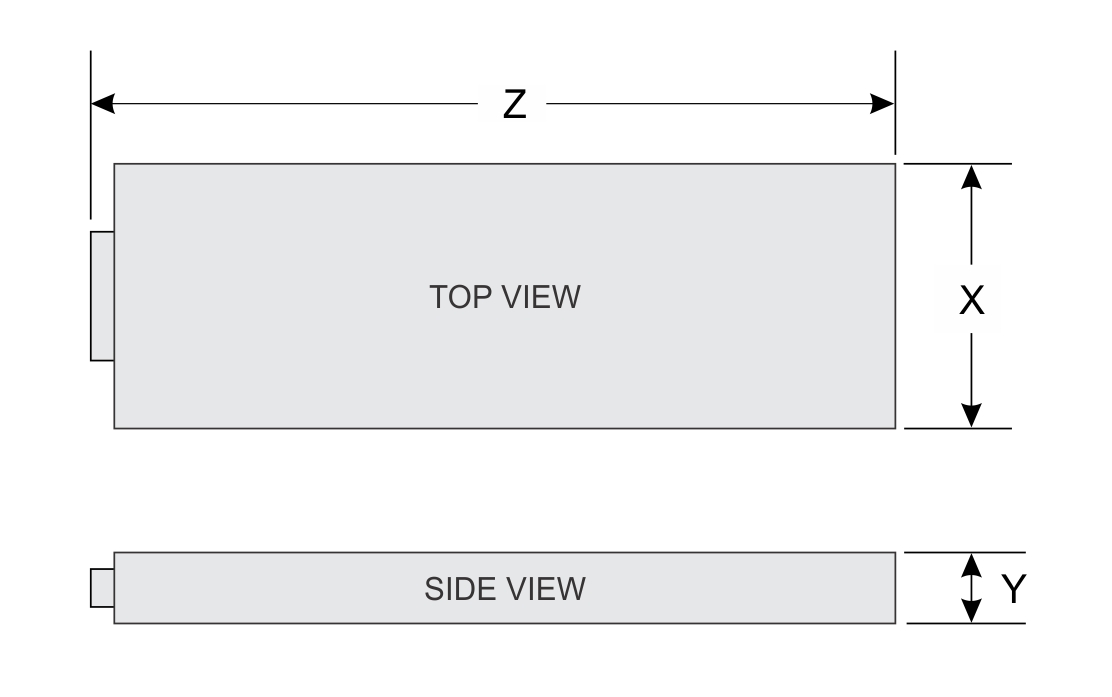
| X | Y | Z |
|---|---|---|
| 187 mm (7.36 inches) | 56.65 mm (2.23 inches) | 691 mm (27.20 inches) |
Chassis weight
| System | Maximum weight (with all sleds and drives) |
|---|---|
| Chassis weight without sled | 132.26 Kg (291.58 lb) |
| Chassis weight with half-width sled (XE7420) | 137.12 Kg (302.29 lb) |
| Chassis weight with full- width full-height sled (XE7440). | 140.93 Kg (310.69 lb) |
| Chassis weight with full- width low-profile sled (XE7440) | 142.81 Kg (341.84 lb) |
Processor specifications
The
PowerEdge
XE7420 sled supports up to two Intel Xeon Scalable processor in each independent sled. Each processor supports up to 26 cores.
Cooling specifications
The PowerEdge XE7100 chassis with two PowerEdge XE7420 nodes/sleds or one PowerEdge XE7440 node/sled has 18 fans. These are divided into three fan zones (Chassis, Node_A, and Node_B), and each zone has six fans.
The chassis fans are single rotor fans, and sled fans are dual rotor fans.
For Half-Width (HW) sled, sled 1 is Node 1 and sled 2 is Node 2.
| PowerEdge systems | Fan numbering |
|---|---|
| XE7100 - Chassis | 1–6 |
| XE7440 (Single sled) | 7–12 , 13-18 |
| XE7420 (Dual sleds) | Node_A: 7–12 , Node_B: 13-18 |
NOTE The reading and reporting of fan sensors are in the order of chassis fans, Node_A and Node_B fans, and sensors numbering is 1-6, 7-12 and 13-18 respectively.
- For XE7420, the sled 1/ node 1 reports six chassis fan sensors (1-6) and sled 1 fan sensors (7-12).
- For XE7420, the sled 2/ node 2 reports six chassis fan sensors (1-6) and sled 2 fan sensors (13-18).
Cooling fan-mapping
| Fan name and configuration | iDRAC sensor number |
|---|---|
| (Chassis) FAN 1 | 38 |
| FAN 2 | 39 |
| FAN 3 | 3A |
| FAN 4 | 3B |
| FAN 5 | 3C |
| FAN 6 | 3D |
| (Node_A) FAN 7 | 3E |
| FAN 8 | 3F |
| FAN 9 | 40 |
| FAN 10 | 41 |
| FAN 11 | 42 |
| FAN 12 | 43 |
| (Node_B) FAN 13 | 44 |
| FAN 14 | 45 |
| FAN 15 | 46 |
| FAN 16 | 47 |
| FAN 17 | E2 |
| FAN 18 | E3 |
NOTE All the numbering are embossed on each fan.
Thermal recommendations
- After one fan rotor failure, you must estimate the fan service time while the system is under steady state.
- It is recommended to limit the minimum service time under 500 seconds.
NOTE For PSU and hard drive no limit is required for the service time.
Supported operating systems
The PowerEdge XE7420 supports the following operating systems:
- Canonical® Ubuntu®
- VMware® ESXi®
- Microsoft® Windows Server®
- Red Hat® Enterprise Linux
- SUSE® Linux Enterprise Server
NOTE For more information about the specific versions and additions, see
https://www.dell.com/ossupport.
System battery
The PowerEdge XE7420 sled uses a CR 2032 3V replaceable lithium coin cell battery.
NOTE There is a system battery in each of the sleds.
Expansion bus specifications
The
PowerEdge
XE7420 sled supports four Generation 3 capable PCIe slots.
| PCIe Slots | Description | Form factor |
|---|---|---|
| x8 DCS Mezz PCIe riser | Slot 1: x8 PCIe Gen3 from processor 1 | Mini PERC form factor |
| x8+x8 OCP Mezz riser | Slot 2: x8 PCIe Gen3 from processor 1 | Standard Open Compute Project (OCP) form factor |
| Slot 3: x8 PCIe Gen3 from processor 1 | ||
| x16 PCIe main riser | Slot 4: x16 PCIe Gen3 processor 1 (for FWFH configuration) | Standard PCIe form factor |
| Slot 7: x16 PCIe Gen3 processor 1 (for FWLP configuration) | ||
| Slot 8: x16 PCIe Gen3 processor 1 (for FWLP configuration) | ||
| Slot 9: x16 PCIe Gen3 processor 1 (for FWLP configuration) | ||
| Slot 10: x16 PCIe Gen3 processor 1 (for FWLP configuration) | ||
| x16 M.2 riser | Slot 5 and 6: x16 PCIe Gen3 from processor 2 | Custom form factor (PERC card) |
Memory specifications
| Memory module sockets | DIMM type | DIMM rank | DIMM capacity | Single processor | Dual processors | ||
|---|---|---|---|---|---|---|---|
| Minimum RAM | Maximum RAM | Minimum RAM | Maximum RAM | ||||
| Sixteen 288-pins | LRDIMM | Octal rank | 128 GB | 128 GB | 1024 GB | 256 GB | 2048 GB |
| RDIMM | Single rank | 8 GB | 8 GB | 64 GB | 16 GB | 128 GB | |
| Dual rank | 16 GB | 16 GB | 128 GB | 32 GB | 256 GB | ||
| 32 GB | 32 GB | 256 GB | 64 GB | 512 GB | |||
| 64 GB | 64 GB | 512 GB | 128 GB | 1024 GB | |||
Drives and storage specifications
The PowerEdge XE7420 enclosure supports SAS and SATA hard drives and Solid State Drives (SSDs).
| Maximum number of drives in the enclosure | Maximum number of drives assigned per sled |
|---|---|
| 100 x 3.5-inch drive systems | 50 SAS or SATA hard drives and SSDs per sled |
| 4 x 2.5-inch drive systems | Four SAS or SATA hard drives or SSDs per sled |
| 4 x 2.5-inch drive systems with NVMe | The NVMe backplane supports either of these configurations:
|
| M.2 SATA drive (optional) | The supported capacity of the M.2 SATA card is up to 240 GB
NOTE The M.2 SATA card can be installed on
the x8 (slot 1) mezzanine riser or
the x16 riser slot (slot 5).
|
| Micro-SD card (optional) for boot (up to 64 GB) | One on each PCIe riser of each sled |
Video specifications
The
PowerEdge
XE7420 sled supports a Matrox G200 integrated graphics card with 16 MB RAM.
| Resolution | Refresh rate (Hz) | Color depth (bits) |
|---|---|---|
| 1024 x 768 | 60 | up to 24 |
| 1280 x 800 | 60 | up to 24 |
| 1280 x 1024 | 60 | up to 24 |
| 1360 x 768 | 60 | up to 24 |
| 1440 x 900 | 60 | up to 24 |
Environmental specifications
The sections below contains information about the environmental specifications of the system.
NOTE For additional information about environmental certifications, please refer to the Product Environmental Datasheet located with the Manuals & Documents on
www.dell.com/poweredgemanuals.
Standard operating temperature specifications
NOTE All components including the DIMMs, communication cards, M.2 SATA, and PERC cards can be supported with sufficient thermal margin if the ambient temperature is equal to or below to the maximum continuous operating temperature listed in these tables except for the Mellanox DP LP card and Intel Rush Creek card.
| Standard operating temperature | Specifications |
|---|---|
| Temperature ranges (for altitude less than 900 m or 2953 ft) | 10°C–35°C (50°F–95°F) with no direct sunlight on the equipment. |
Expanded operating temperature specifications
NOTE When operating in the expanded temperature range, system performance may be impacted.
NOTE When operating in the expanded temperature range, ambient temperature warnings may be reported in the System Event Log.
Operating temperature derating specifications
| Operating temperature derating | Specifications |
|---|---|
| ≤ 35°C (95°F) | Maximum temperature is reduced by 1°C/300 m (1.8°F/984 ft) above 900 meters (2953 ft). |
| 35°C–40°C (95°F–104°F) | Maximum temperature is reduced by 1°C/175 m (1.8°F/574 ft) above 900 meters (2953 ft). |
| 40°C–45°C (104°F–113°F) | Maximum temperature is reduced by 1°C/125 m (1.8°F/410 ft) above 900 meters (2953 ft). |
Relative humidity specifications
| Relative humidity | Specifications |
|---|---|
| Storage | 5% to 95% RH with 27°C (80.6°F) maximum dew point. Atmosphere must be noncondensing always. |
| Operating |
|
Temperature specifications
| Temperature | Specifications |
|---|---|
| Storage | –40°C–65°C (–40°F to 149°F) |
| Continuous operation (for altitude less than 950 m or 3117 ft) | 10°C–35°C (50°F to 95°F) with no direct sunlight on the equipment. |
| Expanded operating temperature | For information about expanded operating temperature, see Expanded Operating Temperature section. |
| Maximum temperature gradient (operating and storage) | 20°C/h (68°F/h) |
NOTE Some configurations require a lower ambient temperature for more information, see the
Standard operating temperature specifications.
Particulate and gaseous contamination specifications
| Particulate contamination | Specifications |
|---|---|
| Air filtration | Data center air filtration as defined by ISO Class 8 per ISO 14644-1 with a 95% upper confidence limit. |
|
NOTE This condition applies only to data center environments. Air filtration requirements do not apply to IT equipment designed to be used outside a data center, in environments such as an office or factory floor.
|
|
|
NOTE Air entering the data center must have MERV11 or MERV13 filtration.
|
|
| Conductive dust | Air must be free of conductive dust, zinc whiskers, or other conductive particles. |
|
NOTE This condition applies to data center and non-data center environments.
|
|
| Corrosive dust | Air must be free of corrosive dust. |
| Residual dust present in the air must have a deliquescent point less than 60% relative humidity. | |
|
NOTE This condition applies to data center and non-data center environments.
|
|
| Gaseous contamination | Specifications |
|---|---|
| Copper coupon corrosion rate | <300 Å/month per Class G1 as defined by ANSI/ISA71.04-2013 |
| Silver coupon corrosion rate | <200 Å/month per Class G1 as defined by ANSI/ISA71.04-2013 |
|
NOTE Maximum corrosive contaminant levels measured at ≤50% relative humidity.
|
|
Maximum vibration specifications
| Maximum vibration | Specifications |
|---|---|
| Operating | 0.26 Grms at 5 Hz to 350 Hz (all operation orientations). |
| Storage | 1.88 Grms at 10 Hz to 500 Hz for 15 min (all six sides tested). |
Maximum shock specifications
| Maximum shock | Specifications |
|---|---|
| Operating | 24 executed shock pulses 6 G in the positive and negative x, y, z axis for up to 11 ms (four pulses on each side of the system). |
| Storage | 6 consecutively executed shock pulses of 71 G in the positive and negative x, y, z axes for up to 2 ms (one pulse on each side of the system). |
Maximum altitude specifications
| Maximum altitude | Specifications |
|---|---|
| Operating | 3048 m (10,000 ft) |
| Storage | 12,000 m (39,370 ft) |