System dimensions
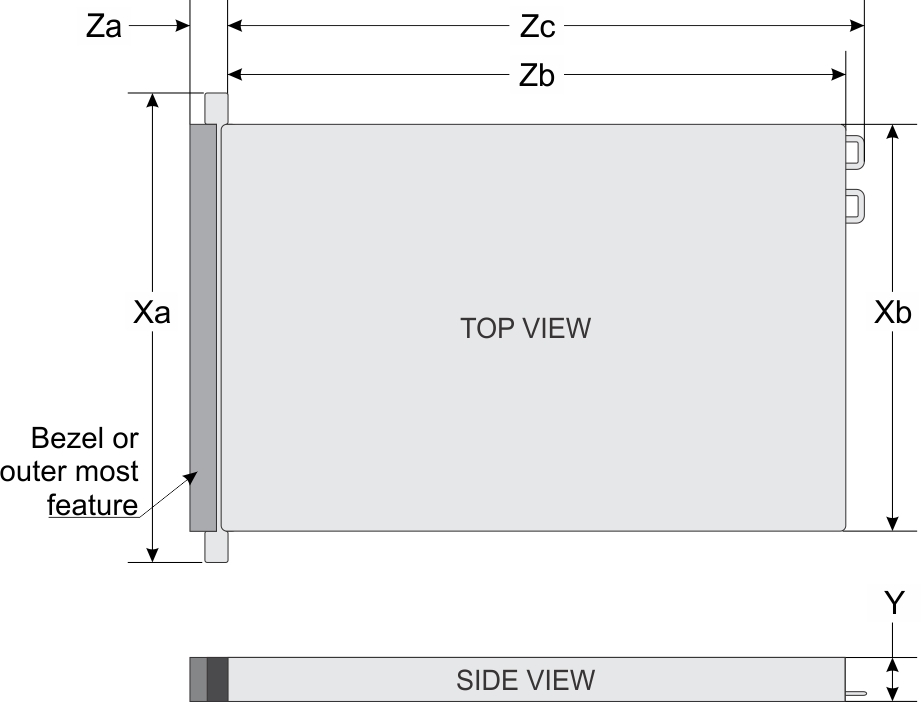
| Xa | Xb | Y | Za (with bezel) | Za (without bezel) | Zb* | Zc |
|---|---|---|---|---|---|---|
| 482 mm (18.97 inches) | 434 mm (17.08 inches) | 86.8 mm (3.41 inches) | 35.84 mm (1.41 inches) | 22 mm (0.87 inches) | 647.07 mm (25.47 inches) | 681.755 mm (26.84 inches) |
* - Zb goes to the nominal rear wall external surface where the system board I/O connectors are located.
Chassis weight
| System | Maximum weight (with all drives/SSDs) |
|---|---|
| 8 x 3.5 inch | 24.4 kg (53.79 lb) |
| 12 x 3.5 inch | 26.61 kg (58.66 lb) |
| 12 x 3.5 inch + 2 x 3.5 inch (rear) | 28.21 kg (62.19 lb) |
| 24 x 2.5 inch | 23.22 kg (51.19 lb) |
Processor specifications
| Processor number | TDP (W) | Core count |
|---|---|---|
| AMD 7601 | 180 W | 32 |
| AMD 7551P | 180 W | 32 |
| AMD 7451 | 180 W | 24 |
| AMD 7401P | 155 W | 24 |
| AMD 7351P | 155 W | 16 |
| AMD 7281 | 155 W | 16 |
| AMD 7251 | 120 W | 8 |
Supported operating systems
The R7415 supports the following operating systems:
- Microsoft Windows Server® with Hyper-V
- Red Hat® Enterprise Linux
- SUSE® Linux Enterprise Server
Virtualization options:
- VMware® ESXi 6.7
PSU specifications
| PSU | Class | Heat dissipation (maximum) | Frequency | Voltage |
|---|---|---|---|---|
| 1600 W AC | Platinum | 6000 BTU/hr | 50/60 Hz | 100–240 V AC, autoranging |
| 1100 W AC | Platinum | 4100 BTU/hr | 50/60 Hz | 100–240 V AC, autoranging |
| 1100 W HVDC | Platinum | 4100 BTU/hr | 50/60 Hz | 100–240 V AC autoranging and 200–380 V DC |
| 1100 W DC | Platinum | 4416 BTU/hr | N/A | (-(48–60)) V DC |
| 750 W AC | Titanium | 2843 BTU/hr | 50/60 Hz | 200–240 V AC, autoranging |
| 750 W AC | Platinum | 2891 BTU/hr | 50/60 Hz | 100–240 V AC, autoranging |
| 750 W Mixed Mode HVDC(for China only) | Platinum | 2891 BTU/hr | N/A | 100–240 V AC autoranging and 240 V DC |
| 750 W Mixed Mode AC | Platinum | 2891 BTU/hr | 50/60 Hz | 100–240 V AC |
| 750 W Mixed Mode DC (for China only) | Platinum | 2891 BTU/hr | N/A | 240 V DC |
| 495 W AC | Platinum | 1908 BTU/hr | 50/60 Hz | 100–240 V AC, autoranging |
| 450 W AC | Bronze | 1871 BTU/hr | 50/60 Hz | 100–240 V AC, autoranging |
System battery specifications
Expansion bus specifications
| Expansion card riser | PCIe slots on the riser | Processor connection | Height | Length | Slot width |
|---|---|---|---|---|---|
| Riser-1B (2U riser) | Slot 2 | Processor 1 | Full Height | Full Length | x16 |
| Riser-1B (2U riser) | Slot 3 | Processor 1 | Full Height | Full Length | x16 |
| Riser-1A (low profile riser right) | Slot 2 | Processor 1 | Low Profile | Half Length | x16 |
| Riser-3A (low profile riser left) | Slot 3 | Processor 1 | Low Profile | Half Length | x16 |
Memory specifications
| Memory module sockets | Memory capacity | Minimum RAM | Maximum RAM |
|---|---|---|---|
| Sixteen 288-pin |
|
|
|
Drives
- Up to 8 x 3.5 inch (SAS, SATA or Nearline SAS) front accessible drives in slots 0 to 7
or
- Up to 12 x 3.5 inch (SAS, SATA or Nearline SAS) front accessible drives in slots 0 to 11
or
- Up to 12 x 3.5 inch (SAS, SATA or Nearline SAS) front accessible drives in slots 0 to 11 + up to 2 x 3.5 inch (SAS, SATA or Nearline SAS) rear accessible drives in slots 12 to 13
or
- Up to 24 x 2.5 inch (SAS, SATA or Nearline SAS) front accessible drives in slots 0 to 23
or
- Up to 12 x 2.5 inch (SAS, SATA or Nearline SAS) front accessible drives in slots 0 to 11 and up to
12 x 2.5 inch NVMe drives in 12 universal slots 12 to 23
or
- Up to 24 x 2.5 inch NVMe drives in bay 0 (slot 0 to 11) and bay 1 (slots 0 to 11)
or
- Up to 8 x 2.5 inch (SAS, SATA or Nearline SAS) front accessible drives in Universal slots 0 to 7 (Bay 0) and up to 16 x 2.5 inch NVMe drives in bay 0 (slots 8 to 11) and bay 1 (slots 0 to 11)
USB ports
- USB 2.0-compliant port on the front panel
- USB 3.0-compliant port on the back panel
- USB 3.0-compliant internal port
The following table provides more information about the USB specifications:
| Front panel | Back panel | Internal USB |
|---|---|---|
| Three USB 2.0-compliant port (One iDRAC Direct (Micro-AB USB) port + two USB 2.0 port)
NOTE:The Micro-AB USB 2.0-compliant port on the front panel can be used only as an iDRAC Direct or a management port.
|
Two USB 3.0-compliant port | One internal USB 3.0 port |
NIC ports
Serial connector
VGA ports
Internal Dual SD Module
Video specifications
| Resolution | Refresh rate (Hz) | Color depth (bits) |
|---|---|---|
| 1024 x 768 | 60 | 8, 16, 32 |
| 1280 x 800 | 60 | 8, 16, 32 |
| 1280 x 1024 | 60 | 8, 16, 32 |
| 1360 x 768 | 60 | 8, 16, 32 |
| 1440 x 900 | 60 | 8, 16, 32 |
| 1600 x 900 | 60 | 8, 16, 32 |
| 1600 x 1200 | 60 | 8, 16, 32 |
| 1680 x 1050 | 60 | 8, 16, 32 |
| 1920 x 1080 | 60 | 8, 16, 32 |
| 1920 x 1200 | 60 | 8, 16, 32 |
Environmental specifications
| Temperature | Specifications |
|---|---|
| Storage | –40°C to 65°C (–40°F to 149°F) |
| Continuous operation (for altitude less than 950 m or 3117 ft) | 10°C to 35°C (50°F to 95°F) with no direct sunlight on the equipment. |
| Fresh air | For information about fresh air, see the Expanded Operating Temperature section. |
| Maximum temperature gradient (operating and storage) | 20°C/h (68°F/h) |
| Relative humidity | Specifications |
|---|---|
| Storage | 5% to 95% RH with 33°C (91°F) maximum dew point. Atmosphere must be non-condensing at all times. |
| Operating | 10% to 80% relative humidity with 29°C (84.2°F) maximum dew point. |
| Maximum vibration | Specifications |
|---|---|
| Operating | 0.26 Grms at 5 Hz to 350 Hz (all operation orientations). |
| Storage | 1.88 Grms at 10 Hz to 500 Hz for 15 min (all six sides tested). |
| Maximum shock | Specifications |
|---|---|
| Operating | Six consecutively executed shock pulses in the positive and negative x, y, and z axes of 6 G for up to 11 ms. |
| Storage | Six consecutively executed shock pulses in the positive and negative x, y, and z axes (one pulse on each side of the system) of 71 G for up to 2 ms. |
| Maximum altitude | Specifications |
|---|---|
| Operating | 30482000 m (10,0006560 ft) |
| Storage | 12,000 m (39,370 ft) |
| Operating temperature derating | Specifications |
|---|---|
| Up to 35°C (95°F) | Maximum temperature is reduced by 1°C/300 m (1°F/547 ft) above 950 m (3,117 ft). |
| 35°C to 40°C (95°F to 104°F) | Maximum temperature is reduced by 1°C/175 m (1°F/319 ft) above 950 m (3,117 ft). |
| 40°C to 45°C (104°F to 113°F) | Maximum temperature is reduced by 1°C/125 m (1°F/228 ft) above 950 m (3,117 ft). |
Particulate and gaseous contamination specifications
| Particulate contamination | Specifications |
|---|---|
| Air filtration | Data center air filtration as defined by ISO Class
8 per ISO 14644-1 with a 95% upper confidence limit. NOTE:This condition applies
to data center environments only. Air filtration requirements do not
apply to IT equipment designed to be used outside a data center, in
environments such as an office or factory floor. NOTE:Air entering the data
center must have MERV11 or MERV13 filtration. |
| Conductive dust | Air must be free of conductive dust, zinc whiskers,
or other conductive particles. NOTE:This condition applies
to data center and non-data center environments. |
| Corrosive dust |
NOTE:This condition
applies to data center and non-data center environments. |
| Gaseous contamination | Specifications |
|---|---|
| Copper coupon corrosion rate | <300 Å/month per Class G1 as defined by ANSI/ISA71.04-1985. |
| Silver coupon corrosion rate | <200 Å/month as defined by AHSRAE TC9.9. |
Standard operating temperature
| Standard operating temperature | Specifications |
|---|---|
| Continuous operation (for altitude less than 950 m or 3117 ft) | 10°C to 35°C (50°F to 95°F) with no direct sunlight on the equipment. |
Expanded operating temperature
| Expanded operating temperature | Specifications |
|---|---|
| Continuous operation | 5°C to 40°C at 5% to 85% RH with 29°C dew point. NOTE:Outside the standard
operating temperature (10°C to 40°C), the system can operate continuously
in temperatures as low as 5°C and as high as 40°C. For temperatures between 35°C and 40°C, de-rate maximum allowable temperature by 1°C per 175 m above 950 m (1°F per 319 ft). |
| ≤ 1% of annual operating hours | –5°C to 45°C at 5% to 90% RH with 29°C dew point. NOTE:Outside the standard
operating temperature (10°C to 40°C), the system can operate down
to –5°C or up to 45°C for a maximum of 1% of its annual operating
hours. For temperatures between 40°C and 45°C, de-rate maximum allowable temperature by 1°C per 125 m above 950 m (1°F per 228 ft). |
Expanded operating temperature restrictions
- Do not perform a cold startup below 5°C.
- The operating temperature specified is for a maximum altitude of 3050 m (10,000 ft).
- Redundant power supply configuration is required.
- GPGPU card is not supported.
- Rear drive configuration is not supported.
- Non-Dell qualified peripheral cards and/or peripheral cards greater than 25 W are not supported.
- 180 W CPU is not supported.
- Cabled PSU is not supported.
Thermal restriction matrix
| Storage configuration | Front | 8 x 3.5-inch drive | 12 x 3.5-inch drive | 12 x 3.5-inch drive | 24 x 2.5-inch drive | 24 x 2.5-inch drive with NVMe | ||
|---|---|---|---|---|---|---|---|---|
| Storage configuration | Rear | N/A | N/A | 2 x 3.5-inch drive | N/A | N/A | ||
| Fan type | Standard fan | Standard fan | High performance fan | Standard fan | High performance fan | |||
| CPU heat sink type | 1.5U heat sink | 1.5U heat sink | 2U heat sink | 1.5U heat sink | 1.5U heat sink | |||
| Processor number | TDP (W) | Core count | Ambient = 35°C | Ambient = 35°C | Ambient = 35°C | Ambient = 35°C | Ambient = 35°C | Ambient = 30°C |
| AMD 7601 | 180 W | 32 | Yes | Yes | Yes | Yes | Yes | Yes |
| AMD 7551P | 180 W | 32 | Yes | Yes | Yes | Yes | Yes | Yes |
| AMD 7451 | 180 W | 24 | Yes | Yes | Yes | Yes | Yes | Yes |
| AMD 7401P | 155 W/170 W | 24 | Yes | Yes | Yes | Yes | Yes | Yes |
| AMD 7351P | 155 W/170 W | 16 | Yes | Yes | Yes | Yes | Yes | Yes |
| AMD 7251 | 120 W | 8 | Yes | Yes | Yes | Yes | Yes | Yes |
| AMD 7281 | 155 W/170 W | 16 | Yes | Yes | Yes | Yes | Yes | Yes |
| AMD 7261 | 155 W/170 W | 8 | Yes | Yes | Yes | Yes | Yes | Yes |
Other thermal restrictions
The list below are other thermal restrictions:
- Mellanox CX4 and CX5 only support up to 35°C ambient.