System dimensions
This section describes the physical dimensions of the system.
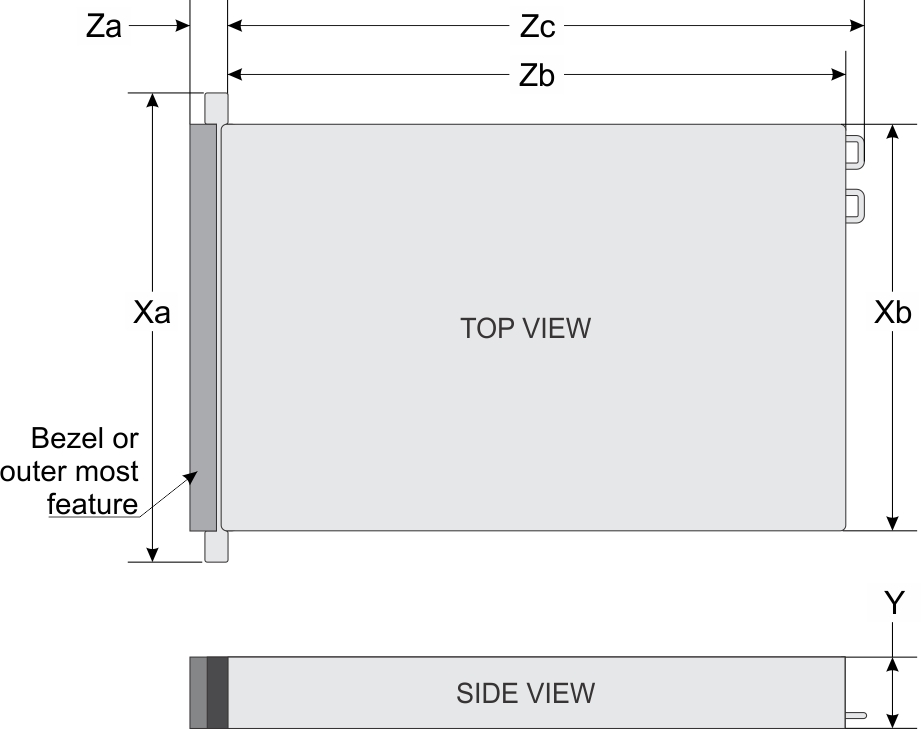
| System | Xa | Xb | Y | Za (with bezel) | Za (without bezel) | Zb | Zc |
|---|---|---|---|---|---|---|---|
| PowerEdge R7425 | 482.0 mm (18.98 inches) | 434.0 mm (17.09 inches) | 86.8 mm (3.42 inches) | 35.84 mm (1.41 inches) | 22.0 mm (0.87 inches) | 677.3 mm (26.66 inches) | 715.63 mm (28.17 inches) |
Chassis weight
| System | Maximum weight (with all drives/SSDs) |
|---|---|
| 2.5 inch | 28.4 kg (62.6 lb) |
| 3.5 inch | 33.4 kg (73.6 lb) |
Processor specifications
The PowerEdge R7425 system supports up to two AMD EPYC™ processors.
Supported operating systems
The PowerEdge R7425 supports the following operating systems:
- Microsoft Windows Server® with Hyper-V
- Red Hat® Enterprise Linux
- SUSE® Linux Enterprise Server3
- VMware® ESXi 6.7
NOTE: : For more information about the specific versions and additions, go to https://www.dell.com/support/home/Drivers/SupportedOS/poweredge-r7425.
PSU specifications
The PowerEdge R7425 system supports up to two AC or DC power supply units (PSUs).
| PSU | Class | Heat dissipation (maximum) | Frequency | Voltage | High line 200v240 V | Low line 100– 140 V | DC | Current |
|---|---|---|---|---|---|---|---|---|
| 495 W AC | Platinum | 1908 BTU/hr | 50/60 Hz | 100–240 V AC, autoranging | 495 W | 495 W | N/A | 6.5 A–3 A |
| 750 W AC | Platinum | 2891 BTU/hr | 50/60 Hz | 100–240 V AC, autoranging | 750 W | 750 W | N/A | 10 A–5 A |
| 750 W AC | Titanium | 2843 BTU/hr | 50/60 Hz | 200–240 V AC, autoranging | 750 W | N/A | N/A | 5 A |
| 750 W Mixed Mode HVDC AC (for China only) | Platinum | 2891 BTU/hr | 50/60 Hz | 100–240 V AC, autoranging | 750 W | 750 W | N/A | 10 A–5 A |
| 750 W Mixed Mode HVDC DC(for China only) | Platinum | 2891 BTU/hr | N/A | 240 V DC, autoranging | N/A | N/A | 750 W | 4.5 A |
| 750 W Mixed Mode AC | Platinum | 2891 BTU/hr | 50/60 Hz | 100–240 V AC | 750 W | 750 W | N/A | 10 A-5 A |
| 750 W Mixed Mode DC (for China only) | Platinum | 2891 BTU/hr | N/A | 240 V DC | 750 W | N/A | 750 W | 5 A |
| 1100 W AC | Platinum | 4100 BTU/hr | 50/60 Hz | 100–240 V AC, autoranging | 1100 W | 1050 W | N/A | 12 A–6.5 A |
| 1100 W DC | N/A | 4416 BTU/hr | N/A | –(48–60) V DC, autoranging | N/A | N/A | 1100 W | 32 A |
| 1100 W Mixed Mode HVDC (for China and Japan only) | Platinum | 4100 BTU/hr | 50/60 Hz | 100–240 V AC, autoranging | 1100 W | 1050 W | N/A | 12 A–6.5 A |
| N/A | 4100 BTU/hr | N/A | 200–380 V DC, autoranging | N/A | N/A | 1100 W | 6.4 A–3.2 A | |
| 1600 W AC | Platinum | 6000 BTU/hr | 50/60 Hz | 100–240 V AC, autoranging | 1600 W | 800 W | N/A | 10 A |
| 2000 W AC | Platinum | 7500 BTU/hr | 50/60 Hz | 100–240 V AC, autoranging | 2000 W | 1000 W | N/A | 11.5 A |
| 2400 W AC | Platinum | 9000 BTU/hr | 50/60 Hz | 100–240 V AC, autoranging | 2400 W | 1400 W | N/A | 16 A |
NOTE: : Heat dissipation is calculated using the PSU wattage rating.
NOTE: : This system is also designed to connect to the IT power systems with a phase to phase voltage not exceeding 240 V.
NOTE: : PSUs rated for 1100 W AC or 1100 W Mixed Mode HVDC and higher require high-line voltage (200–240 V AC) to supply their rated capacity.
System battery specifications
The PowerEdge R7425 system supports CR 2032 3.0-V lithium coin cell system battery.
Expansion card riser specifications
The PowerEdge R7425 system supports up to eight PCI express (PCIe) generation 3 expansion cards that can be installed on the system board using expansion card risers. The following table provides detailed information about the expansion card riser specifications:
| PCIe slot | Riser | Processor connection | Height | Length | Slot width |
|---|---|---|---|---|---|
| 1 | 1A | Processor 1 | Full height | Full length | x16 |
| 1D | Processor 1 | Full height | Full length | x16 | |
| 1E | Processor 1 | Full height | Full length | x16 | |
| 2 | 1D | Processor 1 | Full height | Full length | x8 |
| 1E | Processor 1 | Full height | Full length | x16 | |
| 3 | 1A | Processor 1 | Full height | Full length | x16 |
| 1D | Processor 1 | Full height | Full length | x8 | |
| 4 | 2D | Processor 1 | Full height | Full length | x16 |
| 2A | Processor 2 | Full height | Full length | x16 | |
| 2E | Processor 2 | Full height | Full length | x16 | |
| 5 | 2D | Processor 2 | Full height | Full length | x16 |
| 6 | 2D | Processor 2 | Low profile | Half length | x8 |
| 2A | Processor 2 | Low profile | Half length | x8 | |
| 2C | Processor 2 | Low profile | Half length | x16 | |
| 2E | Processor 2 | Low profile | Half length | x8 | |
| 7 | 3A | Processor 2 | Full height | Full length | x8 |
| 3B | Processor 2 | Full height | Full length | x16 | |
| 8 | 3A | Processor 2 | Full height | Full length | x16 |
| 3B | Processor 2 | Full height | Full length | x16 |
Memory specifications
| DIMM type | DIMM rank | DIMM capacity | Single processor | Dual processors | ||
|---|---|---|---|---|---|---|
| Minimum RAM | Maximum RAM | Minimum RAM | Maximum RAM | |||
| LRDIMM | Quad rank | 64GB | 64GB | 1TB | 128GB | 2TB |
| RDIMM | Single rank | 8GB | 8GB | 128GB | 16GB | 256GB |
| RDIMM | Dual rank | 16GB | 16GB | 256GB | 32GB | 512GB |
| RDIMM | Dual rank | 32GB | 32GB | 512GB | 64GB | 1024GB |
NOTE: : For optimal performance, it is recommended to populate one DIMM per channel with DDR4, 2666 MT/s memory modules on the first slot of each memory channel. The first slot of each channel can be identified as the DIMM slots with white latches. For example, 64 GB system memory capacity can be divided into 8 x 8 GB DIMM slots.
Storage controller specifications
- Internal storage controller cards: PowerEdge RAID Controller (PERC) H330+, PERC H730+, PERC H740P, HBA330, S140, and Boot Optimized Server Storage (BOSS-S1).
- External storage controller cards: PERC H840 and 12Gbps SAS HBA.
Drives
The PowerEdge R7425 system supports SAS, SATA, Nearline SAS hard drives/SSDs, or NVMe drives.
| Configuration | Description |
|---|---|
| 8 drives system |
|
| 12 drives system |
|
| 18 drives system |
|
| 24 drives system |
|
| 24 drives system |
|
| 24 drives system |
|
| 32 drives system |
|
NOTE: : Universal slots are slots that support SAS, SATA hard drives/SSDs, or NVMe drives in the same slot.
NOTE: : Hot swap for the NVMe drives is supported for your system. For more information on correct usage and technical specifications, see the Dell PowerEdge Express Flash NVMe PCIe SSD 2.5 inch Small Form Factor User's Guide at page.
Optical drive
The PowerEdge R7425 system supports one optional slim SATA DVD-ROM drive or DVD +/-RW drive.
USB ports
- Two USB 2.0-compliant ports on the front of the system
- One internal USB 3.0-compliant port
- One optional USB 3.0-compliant port on the front of the system
- One micro USB 2.0-compliant port in the front of the
system for iDRAC Direct
NOTE: : The micro USB 2.0 compliant port on the front of the system can only be used as an iDRAC Direct or a management port.
- Two USB 3.0-compliant ports on the back of the system
NIC ports
- Four RJ-45 ports that support 10, 100 and 1000 Mbps
- Four RJ-45 ports that support 100 M, 1 G and 10 Gbps
- Four RJ-45 ports, where two ports support maximum of 10 G and the other two ports maximum of 1 G
- Two RJ-45 ports that support up to 1 Gbps and 2 SFP+ ports that support up to 10 Gbps
- Four SFP+ ports that support up to 10 Gbps
- Two SFP28 ports that support up to 25 Gbps
NOTE: : You can install up to eight PCIe add-on NIC cards.
NOTE: : For information about Linux network settings, see the Linux® Network Tuning Guide for AMD EPYC™ Processor Based Servers AMD tuning guide.
VGA ports
The Video Graphic Array (VGA) port enables you to connect the system to a VGA display. The PowerEdge R7425 system supports two 15-pin VGA ports on the front and back panels.
Serial connector
The PowerEdge R7425 system supports one serial connector on the back panel, which is a 9-pin connector, Data Terminal Equipment (DTE), 16550-compliant.
IDSDM or vFlash module
- vFlash or
- vFlash and IDSDM
NOTE: : There are two dip switches on the IDSDM or vFlash module for write-protection.
NOTE: : One IDSDM card slot is dedicated for redundancy.
NOTE: : It is recommended to use Dell branded MicroSD cards associated with the IDSDM or vFlash configured systems.
Video specifications
The PowerEdge R7425 system supports integrated Matrox G200eW3 graphics controller with 16 MB of video frame buffer.
| Resolution | Refresh rate (Hz) | Color depth (bits) |
|---|---|---|
| 1024 x 768 | 60 | 8, 16, 32 |
| 1280 x 800 | 60 | 8, 16, 32 |
| 1280 x 1024 | 60 | 8, 16, 32 |
| 1360 x 768 | 60 | 8, 16, 32 |
| 1440 x 900 | 60 | 8, 16, 32 |
| 1600 x 900 | 60 | 8, 16, 32 |
| 1600 x 1200 | 60 | 8, 16, 32 |
| 1680 x 1050 | 60 | 8, 16, 32 |
| 1920 x 1080 | 60 | 8, 16, 32 |
| 1920 x 1200 | 60 | 8, 16, 32 |
NOTE: : 1920 x 1080 and 1920 x 1200 resolutions are only supported in reduced blanking mode.
Environmental specifications
NOTE: : For additional information about environmental certifications, please refer to the Product Environmental Datasheet located with the Manuals & Documents on support.dell.com.
| Temperature | Specifications |
|---|---|
| Storage | –40°C to 65°C (–40°F to 149°F) |
| Continuous operation (for altitude less than 950 m or 3117 ft) | 10°C to 35°C (50°F to 95°F) with no direct sunlight on the equipment. |
| Maximum temperature gradient (operating and storage) | 20°C/h (68°F/h) |
| Relative humidity | Specifications |
|---|---|
| Storage | 5% to 95% RH with 33°C (91°F) maximum dew point. Atmosphere must be non-condensing at all times. |
| Operating | 10% to 80% relative humidity with 29°C (84.2°F) maximum dew point. |
| Maximum vibration | Specifications |
|---|---|
| Operating | 0.26 Grms at 5 Hz to 350 Hz (all three axes). |
| Storage | 1.88 Grms at 10 Hz to 500 Hz for 15 min (all six sides tested). |
| Maximum shock | Specifications |
|---|---|
| Operating | Six consecutively executed shock pulses in the positive and negative x, y, and z axes of 6 G for up to 11 ms. |
| Storage | Six consecutively executed shock pulses in the positive and negative x, y, and z axes (one pulse on each side of the system) of 71 G for up to 2 ms. |
| Maximum altitude | Specifications |
|---|---|
| Operating | 3048 m (10,000 ft) |
| Storage | 12,000 m (39,370 ft) |
| Operating temperature de-rating | Specifications |
|---|---|
| Up to 35°C (95°F) | Maximum temperature is reduced by 1°C/300 m (1°F/547 ft) above 950 m (3,117 ft). |
| 35°C to 40°C (95°F to 104°F) | Maximum temperature is reduced by 1°C/175 m (1°F/319 ft) above 950 m (3,117 ft). |
| 40°C to 45°C (104°F to 113°F) | Maximum temperature is reduced by 1°C/125 m (1°F/228 ft) above 950 m (3,117 ft). |
Standard operating temperature
| Standard operating temperature | Specifications |
|---|---|
| Continuous operation (for altitude less than 950 m or 3117 ft) | 10°C to 35°C (50°F to 95°F) with no direct sunlight on the equipment. |
Expanded operating temperature
| Expanded operating temperature | Specifications |
|---|---|
| Continuous operation | 5°C to 40°C at 5% to 85% RH with 29°C dew point. NOTE: : Outside the standard operating temperature (10°C to 35°C), the system can operate continuously in temperatures as low as 5°C and as high as 40°C. For temperatures between 35°C to 40°C, de-rate maximum allowable temperature by 1°C per 175 m above 950 m (1°F per 319 ft). |
| ≤ 1% of annual operating hours | –5°C to 45°C at 5% to 90% RH with 29°C dew point. NOTE: : Outside the standard operating temperature (10°C to 35°C), the system can operate down to –5°C or up to 45°C for a maximum of 1% of its annual operating hours. For temperatures between 40°C and 45°C, de-rate maximum allowable temperature by 1°C per 125 m above 950 m (1°F per 228 ft). |
NOTE: : When operating in the expanded temperature range, system performance may be impacted.
NOTE: : When operating in the expanded temperature range, ambient temperature warnings may be reported in the System Event Log.
Expanded operating temperature restrictions
- Do not perform a cold startup below 5°C.
- The operating temperature specified is for a maximum altitude of 3050 m (10,000 ft).
- 180 W/200 W CPUs are not supported.
- Redundant power supply unit is required.
- Non-Dell qualified peripheral cards and/or peripheral cards greater than 25 W are not supported.
- PCIe SSD is not supported.
- Mid drive tray is not supported.
- Rear storage devices or drives are not supported.
- GPU is not supported
Thermal restrictions
Following table lists the configuration required for efficient cooling.
| Config number | Storage module | Middle/rear configuration | CPU count | Thermal solution (heat sink) | Shroud and blank | |||||
|---|---|---|---|---|---|---|---|---|---|---|
| 180W/200W CPU | 155W/170W and 120W CPU | Fan | Shroud | DIMM blank | CPU blank | Fan blank | ||||
| 1 | 3.5" x 8 | PCIe x 8 | 1 | 2U HSK, 2JYG2 | 1U STD HSK, GDYH1 | STD x4, 4VKDD | Standard | No | Yes | Yes |
| 2 | 2U HSK, 2JYG2 | 1U STD HSK, GDYH1 | STD x6, 4V1WX | Standard | No | No | No | |||
| GPGPU x 3 | 2 | 1U HPR HSK, 4CFPC | 1U STD HSK, GDYH1 | HPR X6, 15G45 | GPGPU | No | No | No | ||
| 2a | 2.5" x 24 | PCIe x 8 | 2 | 2U HSK, 2JYG2 | 1U STD HSK, GDYH1 | STD x6, 4V1WX | Standard | No | No | No |
| GPGPU x 3 | 2 | 1U HPR HSK, 4CFPC | 1U STD HSK, GDYH1 | HPR X6, 15G45 | GPGPU | No | No | No | ||
| 2b | 2.5"x16 + NVMe x 8 | PCIe x 7 | 2 | 2U HSK, 2JYG2 | 1U STD HSK, GDYH1 | STD x6, 4V1WX | Standard | No | No | No |
| GPGPU x 3 | 2 | 1U HPR HSK, 4CFPC | 1U STD HSK, GDYH1 | HPR X6, 15G45 | GPGPU | No | No | No | ||
| 2d | 2.5" x 32 | Middle 2.5" x 4 + Rear 2.5" x 4 | 2 | 1U HPR HSK, 4CFPC | 1U STD HSK, GDYH1 | HPR X6, 15G45 | No | Yes, x30 5M8WD* | No | No |
| 3a | 3.5" x 12 | PCIe x 8 | 2 | 2U HSK, 2JYG2 | 1U STD HSK, GDYH1 | STD x6, 4V1WX | Standard | No | No | No |
| 3b | 3.5" x 18 | Middle 3.5" x 4 + Rear 3.5" x 2 | 2 | 1U HPR HSK, 4CFPC | 1U STD HSK, GDYH1 | HPR X6, 15G45 | No | Yes, x30 5M8WD* | No | No |
| 4 | NVMe x 24 | PCIe x 7 | 2 | 2U HSK, 2JYG2 | 1U STD HSK, GDYH1 | STD x6, 4V1WX | Standard | No | No | No |
| 4 | GPGPU x 3 | 2 | 1U HPR HSK, 4CFPC | 1U STD HSK, GDYH1 | HPR X6, 15G45 | GPGPU | No | No | No |
Other thermal restrictions
The list below are other thermal restrictions:
- Mellanox CX4 and CX5 only support up to 35°C ambient with limited slots 1, 7, and 8
Ambient temperature limitations
The following table lists configurations that require ambient temperature less than 35°C.
NOTE: : The ambient temperature limit must be adhered to ensure proper cooling and to avoid excess CPU throttling, which may impact system performance.
| Storage configuration | Chassis or hardware configuration | CPU Thermal Design Power (TDP) | CPU heat sink | Fan type | Ambient restriction |
|---|---|---|---|---|---|
12 x 3.5 inch |
Mid (SAS) and rear drive | 200 W/180 W | 1U high performance | High performance | 30°C |
12 x 3.5 inch |
Mid (SAS) and rear drive | 120-170 W | 1U standard | High performance | 35°C |
24 x 2.5 inch |
Mid (SAS) and rear drive | All | 1U high performance for 180/200W 1U standard for 120-170W |
High performance | 35°C |
24 x 2.5 inch |
All PCIe cards | 200 W/180 W | 2U | Standard | 35°C |
12 x 3.5 inch |
All PCIe cards | 200 W/180 W | 2U | Standard | 35°C |
8 x 3.5 inch |
All PCIe cards | 200 W/180 W | 2U | Standard | 35°C |
24 NVMe |
All PCIe cards | 200 W/180 W | 2U | Standard | 35°C |
16 x 2.5 inch SAS + 8 NVMe + 24 NVMe |
All PCIe cards | 120-170 W | 1U standard | Standard | 35°C |
Particulate and gaseous contamination specifications
| Particulate contamination | Specifications |
|---|---|
| Air filtration | Data center air filtration as defined by ISO Class
8 per ISO 14644-1 with a 95% upper confidence limit. NOTE: : The ISO Class 8 condition applies to data center environments only. This air filtration requirement does not apply to IT equipment designed to be used outside a data center, in environments such as an office or factory floor. NOTE: : Air entering the data center must have MERV11 or MERV13 filtration. |
| Conductive dust | Air must be free of conductive dust, zinc whiskers,
or other conductive particles. NOTE: : This condition applies to data center and non-data center environments. |
| Corrosive dust |
NOTE: : This condition applies to data center and non-data center environments. |
| Gaseous contamination | Specifications |
|---|---|
| Copper coupon corrosion rate | <300 Å/month per Class G1 as defined by ANSI/ISA71.04-2013. |
| Silver coupon corrosion rate | <200 Å/month as defined by ANSI/ISA71.04-2013. |
NOTE: : Maximum corrosive contaminant levels measured at ≤50% relative humidity.