
Сегодня покупают
← Вернуться назад
Нужна помощь с конфигурацией?
Пришлите SKU, спецификацию или список требований. Специалист Apltech проверит совместимость компонентов и найдёт актуальные артикулы
Получить консультацию →

Dell PowerEdge M630 Systems (VRTX Enclosure): руководство по обслуживанию

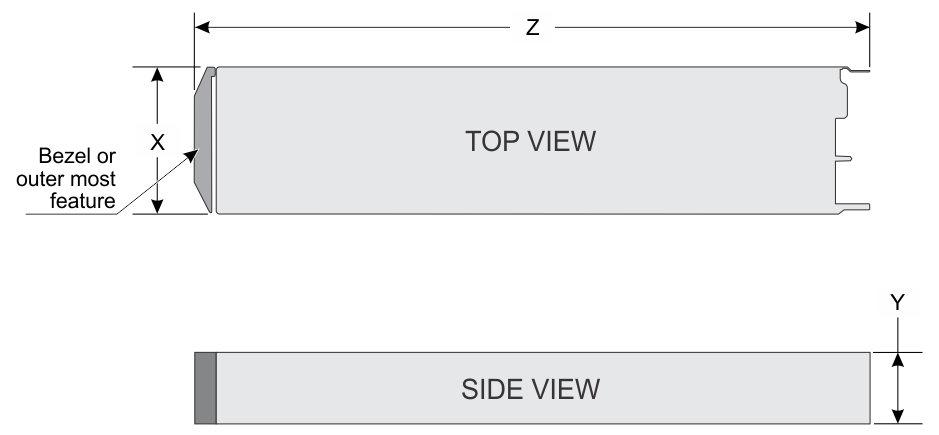
Chassis dimensions

Figure 1. Chassis dimensions
This image shows Chassis dimensions
Table 1. Chassis dimensions of the Dell PowerEdge M630p systemThe Dell PowerEdge M630p system is of 192.3 mm height, 50.3 mm of width, and 544.3 mm depth.

System

XYZ

PowerEdge M630p

192.3 mm

50.3 mm

544.3 mm

Chassis weight

Table 1. Chassis weight The Dell PowerEdge M630p has maximum weight of 6.8 kg (14.99 lb).

System

Maximum weight

PowerEdge M630p

6.8 kg (14.99 lb)

Processor specifications

The PowerEdge M630p system supports up one or two Intel Xeon E5-2600 v3 or E5-2600 v4 product family processors.
CAUTION: For processors of 105 W, 120 W, or 135 W, use heat sinks of 68 mm width.
CAUTION: For processors of 135 W (four cores, six cores, or eight cores) or 145 W, use heat sinks of 86 mm width.
NOTE: Mixing processors of different wattages is not supported.

System battery specifications

The PowerEdge M630p system supports CR 2032 3.0-V lithium coin cell system battery.

Memory specifications

The PowerEdge M630p system supports DDR4 registered DIMMs (RDIMMs) and load-reduced DIMMs (LRDIMMs).
Table 1. Memory specificationsThe system has memory capacity of 64 GB quad rank (LRDIMMs), 32 GB quad rank (LRDIMMs), 4, 8, 16 GB or 32 GB single rank (RDIMMs), 8 GB, 16 GB and 32 GB dual rank (RDIMMs). System supports minimum RAM of 4 GB with single processor and maximum up to 786 GB with a single processor and Up to 1536 GB with a dual processor with speed of 2400 MT/s, 2133 MT/s, DDR4 DIMMs.

Memory module sockets

Memory capacity

Minimum RAM

Maximum RAM

Speed

PowerEdge M630p 64 GB quad rank (LRDIMMs) 4 GB with single processor
  • Up to 768 GB with a single processor
  • Up to 1536 GB with a dual processor

2400 MT/s, 2133 MT/s, or 1866 MT/s, DDR4 DIMMs

32 GB quad rank (LRDIMMs)

2133 MT/s, or 1866 MT/s,, DDR4 DIMMs

4 GB, 8 GB, 16 GB or 32 GB single rank (RDIMMs)

2400 MT/s, 2133 MT/s, or 1866 MT/s, DDR4 DIMMs

8 GB, 16 GB and 32 GB dual rank (RDIMMs)

2400 MT/s, 2133 MT/s, or 1866 MT/s, DDR4 DIMMs

RAID controllers

The PowerEdge M630p system supports PERC H330, PERC H730P, and PERC H730.

PCIe mezzanine card slots

The PowerEdge M630p system supports Two PCIe x8 Gen 2 slots that support PCIe mezzanine cards

Hard drives

ThePowerEdge M630p system supports:
  • Up to two 2.5-inch, hot-swappable SAS, SATA hard drives or SAS or SATA or PCIe SSDs

SSDs

The PowerEdge M630p system supports:
  • Up to four 1.8-inch, hot-swappable SATA SSDs

Optical drive

The PowerEdge M630p system supports external optional USB DVD and one optional SATA DVD-ROM drive or DVD+/-RW drive.

Flash drive

The PowerEdge M630p system supports internal optional USB, internal optional SD card and optional vFlash card (with integrated iDRAC8 Enterprise).

USB ports

The PowerEdge M630p system supports:
  • One USB 2.0-compliant and one USB 3.0-compliant port on the front panel
  • Internal USB 2.0-compliant port
The following table provides more information about the USB specifications:
Table 1. USB specificationsThe system supports One 4-pin, USB 2.0-compliant and one 4-pin, USB 3.0-compliant with Two internal SD cards dedicated for the hypervisor and One SD card dedicated for future vFlash support

System

Front panel

Internal

PowerEdge M630p

One 4-pin, USB 2.0-compliant and one 4-pin, USB 3.0-compliant

  • Two internal SD cards dedicated for the hypervisor
  • One SD card dedicated for future vFlash support

Internal Dual SD Module

The PowerEdge M630p system supports two SD card slots and a USB interface dedicated for the embedded hypervisor. This card offers the following features:
  • Dual card operation — maintains a mirrored configuration by using SD cards in both slots and provides redundancy.
  • Single card operation — single card operation is supported, but without redundancy.

Video specifications

The PowerEdge M630p system supports Matrox G200 VGA controller integrated with iDRAC and 2 GB shared with iDRAC application memory.

Environmental specifications

NOTE: For additional information about environmental measurements for specific system configurations, see Dell.com/environmental_datasheets.
Table 1. Temperature specifications When the system is in continuous operation (for altitude less than 950 m or 3117 ft), the temperature specification ranges from 10°C to 35°C (50°F to 95°F) with no direct sunlight on the equipment. When the system is not in operation, the temperature specification is –40°C to 65°C (–40°F to 149°F). The Maximum temperature gradient for both operation and nonoperational systems is 20°C/h (36°F/h). For information about fresh air, view the Expanded Operating Temperature section.

Temperature

Specifications

Storage –40°C to 65°C (–40°F to 149°F)
Continuous operation (for altitude less than 950 m or 3117 ft) 10°C to 35°C (50°F to 95°F) with no direct sunlight on the equipment.
Fresh air For information about fresh air, see Expanded Operating Temperature section.
Maximum temperature gradient (operating and storage) 20°C/h (36°F/h)
Table 2. Relative humidity specificationsFor a nonoperational system, the ambient relative humidity ranges from 5% to 95% with 33°C (91°F) maximum dew point. Atmosphere must be noncondensing always. For an operational system, the ambient relative humidity ranges from 10% to 80% with 29°C (84.2°F) maximum dew point.

Relative humidity

Specifications

Storage 5% to 95% RH with 33°C (91°F) maximum dew point. Atmosphere must be noncondensing always.
Operating 10% to 80% Relative Humidity with 29°C (84.2°F) maximum dew point.
Table 3. Maximum vibration specificationsThe maximum vibration specification of an operational system is 0.26 Grms at 5 Hz to 350 Hz (all operation orientations).The maximum vibration specification of a nonoperational system is 1.88 Grms at 10 Hz to 500 Hz for 15 min (all six sides tested).

Maximum vibration

Specifications

Operating 0.26 Grms at 5 Hz to 350 Hz (all operation orientations).
Storage 1.88 Grms at 10 Hz to 500 Hz for 15 min (all six sides tested).
Table 4. Maximum shock specificationsThe maximum shock specification of an operational system is six consecutively run shock pulses in the positive and negative x, y, and z axes of 40 G for up to 2.3 ms. The maximum shock specification of a nonoperational system is six consecutively run shock pulses in the positive and negative x, y, and z axes (one pulse on each side of the system) of 71 G for up to 2 ms.

Maximum shock

Specifications

Operating Six consecutively run shock pulses in the positive and negative x, y, and z axes of 40 G for up to 2.3 ms.
Storage Six consecutively run shock pulses in the positive and negative x, y, and z axes (one pulse on each side of the system) of 71 G for up to 2 ms.
Table 5. Maximum altitude specificationsThe maximum altitude of an operational system is 3048 m (10,000 ft). The maximum altitude of a nonoperational system is 12,000 m (39,370 ft).

Maximum altitude

Specifications

Operating 3048 m (10,000 ft).
Storage 12,000 m (39,370 ft).
Table 6. Operating temperature derating specificationsIf the operating temperature of a system is up to 35 °C (95 °F), the maximum temperature is reduced by 1 °C/300 m (1 °F/547 ft) above 950 m (3,117 ft). If the operating temperature of a system ranges from 35 °C to 40 °C (95 °F to 104 °F), the maximum temperature is reduced by 1 °C/175 m (1 °F/319 ft) above 950 m (3,117 ft). If the operating temperature of a system ranges from 40 °C to 45 °C (104 °F to 113 °F), the maximum temperature is reduced by 1 °C/125 m (1 °F/228 ft) above 950 m (3,117 ft).

Temperature

Specifications

Up to 35 °C (95 °F) Maximum temperature is reduced by 1°C/300 m (1°F/547 ft) above 950 m (3,117 ft).
35 °C to 40 °C (95 °F to 104 °F) Maximum temperature is reduced by 1°C/175 m (1°F/319 ft) above 950 m (3,117 ft).
40 °C to 45 °C (104 °F to 113 °F) Maximum temperature is reduced by 1°C/125 m (1°F/228 ft) above 950 m (3,117 ft).

Particulate and gaseous contamination specifications

The following table defines the limitations that help avoid any equipment damage or failure from particulates and gaseous contamination. If the levels of particulates or gaseous pollution exceed the specified limitations and result in equipment damage or failure, you may need to rectify the environmental conditions. Remediation of environmental conditions is the responsibility of the customer.
Table 1. Particulate contamination specifications Air filtration specification: Data center air filtration as defined by ISO Class 8 per ISO 14644-1 should have a 95% upper confidence limit. Note: This condition applies only to data center environments. Air filtration requirements do not apply to IT equipment designed to be used outside a data center, in environments such as an office or factory floor. Note: Air entering the data center must have MERV11 or MERV13 filtration. Conductive dust specification: Air must be free of conductive dust, zinc whiskers, or other conductive particles. Note: This condition applies to data center and nondata center environments. Corrosive dust specification: Air must be free of corrosive dust. Residual dust present in the air must have a deliquescent point less than 60% relative humidity. Note: This condition applies to data center and nondata center environments.

Particulate contamination

Specifications

Air filtration

Data center air filtration as defined by ISO Class 8 per ISO 14644-1 with a 95% upper confidence limit.
NOTE: This condition applies only to data center environments. Air filtration requirements do not apply to IT equipment designed to be used outside a data center, in environments such as an office or factory floor.
NOTE: Air entering the data center must have MERV11 or MERV13 filtration.

Conductive dust

Air must be free of conductive dust, zinc whiskers, or other conductive particles.
NOTE: This condition applies to data center and nondata center environments.

Corrosive dust

  • Air must be free of corrosive dust.
  • Residual dust present in the air must have a deliquescent point less than 60% relative humidity.
NOTE: This condition applies to data center and nondata center environments.
Table 2. Gaseous contamination specifications The following table defines the limitations that help avoid any damages to the IT equipment and/or failure from gaseous contamination.

Gaseous contamination

Specifications

Copper coupon corrosion rate

<300 Å/month per Class G1 as defined by ANSI/ ISA71.04-1985.

Silver coupon corrosion rate

<200 Å/month as defined by AHSRAE TC9.9.

NOTE: Maximum corrosive contaminant levels measured at ≤50% relative humidity.

Expanded operating temperature

Table 1. Expanded operating temperature specifications When the system is in continuous operation, the expanded operating temperature ranges from 5°C to 40°C at 5% to 85% RH with 29°C dew point. NOTE: Outside the standard operating temperature (10°C to 35°C), the system can operate continuously in temperatures as low as 5°C and as high as 40°C. For temperatures between 35°C and 40°C, derate maximum allowable temperature by 1°C per 175 m above 950 m (1°F per 319 ft). When the system is operating at < 1% of annual operating hours, the expanded operating temperature is –5°C to 45°C at 5% to 90% RH with 29°C dew point. NOTE: Outside the standard operating temperature (10°C to 35°C), the system can operate down to –5°C or up to 45°C for a maximum of 1% of its annual operating hours. For temperatures between 40°C and 45°C, derate maximum allowable temperature by 1°C per 125 m above 950 m (1°F per 228 ft).

Expanded operating temperature

Specifications

Continuous operation

5°C to 40°C at 5% to 85% RH with 29°C dew point.

NOTE: Outside the standard operating temperature (10°C to 35°C), the system can operate continuously in temperatures as low as 5°C and as high as 45°C.

For temperatures between 35°C and 40°C, derate maximum allowable temperature by 1°C per 175 m above 950 m (1°F per 319 ft).

< 1% of annual operating hours

–5°C to 45°C at 5% to 90% RH with 29°C dew point.

NOTE: Outside the standard operating temperature (10°C to 35°C), the system can operate down to –5°C or up to 45°C for a maximum of 1% of its annual operating hours.

For temperatures between 40°C and 45°C, de-rate maximum allowable temperature by 1°C per 125 m above 950 m (1°F per 228 ft).

NOTE: When operating in the expanded temperature range, system performance may be impacted.
NOTE: When operating in the expanded temperature range, ambient temperature warnings may be reported on the LCD panel and in the System Event Log.

Expanded operating temperature restrictions

  • Do not perform a cold startup below 5°C.
  • 135 W (4 core, 6 core, or 8 core) and 145 W processors are not supported.
  • Non-Dell qualified peripheral cards and/or peripheral cards greater than 25 W are not supported.
  • PCIeSSD is not supported.
  • When populating the server module slots in the PowerEdge VRTX enclosure with only PowerEdge M630 server modules:
    • Install 86 mm width heat sink for processors of 120 W or more
    • Install 68 mm width heat sink for processors of less than 120 W.
    • If you install a blade with two processors in the M1000e enclosure, all blade slots in the enclosure must have PowerEdge M630 blades with the same configuration (PowerEdge M630 blades with two processors). However, vacant blade slots in the enclosure can be installed with blade blanks.