Dimensions and weight
The following table lists the height, width, depth, and weight of your Dell Pro Max 16 Plus MB16250.
| Description | Values | |
|---|---|---|
| Height: | ||
| Front height |
17.34 mm (0.68 in.) |
|
| Rear height |
18.97 mm (0.75 in.) |
|
| Peak height |
|
|
| Width |
360 mm (14.17 in.) |
|
| Depth |
258.60 mm (10.18 in.) |
|
| Weight NOTE:The weight of your
computer depends on the configuration that you ordered.
|
|
|
Processor
The following table lists the details of the processors that are supported on your Dell Pro Max 16 Plus MB16250.
| Description | Option one | Option two | Option three |
|---|---|---|---|
| Type |
Intel Core Ultra 5 245HX |
Intel Core Ultra 7 265HX |
Intel Core Ultra 9 285HX |
| Wattage |
55 W |
55 W |
55 W |
| Core count |
14 |
20 |
24 |
| Thread count |
14 |
20 |
24 |
| Speed |
Up to 5.1 GHz |
Up to 5.3 GHz |
Up to 5.5 GHz |
| Cache |
26 MB |
36 MB |
40 MB |
| Integrated graphics |
Intel Graphics |
Intel Graphics |
Intel Graphics |
Chipset
The following table lists the details of the chipset that is supported by your Dell Pro Max 16 Plus MB16250.
| Description | Values |
|---|---|
| Chipset |
Intel WM880 |
| Processor |
Intel Core Ultra 5/7/9 |
| DRAM bus width |
64-bit |
| Flash EPROM |
64 MB |
| PCIe bus |
Up to Gen4 |
Operating system
Your Dell Pro Max 16 Plus MB16250 supports the following operating systems:
- Windows 11 Pro
- Windows 11 Home
- Ubuntu Linux 24.04
Memory
The following table lists the memory specifications that are supported by your Dell Pro Max 16 Plus MB16250.
CAMM (Compression Attached Memory Module) is a new type of memory module form factor which uses a land grid array (LGA) and a compression connection, allowing for a smaller and more compact design.
Your Dell Pro Max 16 Plus MB16250 supports both CAMM and CSoDIMM and may have either CAMM or CSoDIMM installed depending on the configuration ordered.
| Description | Values |
|---|---|
| Memory slots |
|
| Memory type |
DDR5 |
| Memory speed |
For computers shipped with one CAMM module:
|
| Maximum memory configuration |
|
| Minimum memory configuration |
|
| Memory size per slot |
For computers shipped with one CAMM module:
|
| Memory configurations supported |
For computers shipped with one CAMM module:
|
External ports and slots
The following table lists the external ports and slots on your Dell Pro Max 16 Plus MB16250.
| Description | Values |
|---|---|
| Network port |
One RJ45 ethernet port (2.5 Gbps) |
| USB ports |
|
| Audio port |
One global headset port |
| Video port(s) |
One HDMI 2.1 FRL port |
| Media-card reader |
|
| Power-adapter port |
USB Type-C power input |
| Security-cable slot |
One security-cable slot (noble lock) |
Internal slots
The following table lists the internal slots of your Dell Pro Max 16 Plus MB16250.
| Description | Values |
|---|---|
| M.2 |
NOTE:To learn more about the features of
different types of M.2 cards, search Dell Support Site.
|
Ethernet
The following table lists the wired ethernet Local Area Network (LAN) specifications of your Dell Pro Max 16 Plus MB16250.
| Description | Values |
|---|---|
| Model |
Intel Ethernet Controller I226-LM |
| Transfer rate |
10/100/1000/2500 Mbps |
Wireless module
The following table lists the Wireless Local Area Network (WLAN) module that is supported on your Dell Pro Max 16 Plus MB16250.
| Description | Values |
|---|---|
| Model number |
Intel BE200 |
| Transfer rate |
Up to 5760 Mbps |
| Frequency bands supported |
2.4 GHz/5 GHz/6 GHz |
| Wireless standards |
|
| Encryption |
|
| Bluetooth wireless card NOTE:The functionality of
the Bluetooth wireless card may vary based on the operating
system. |
Bluetooth 5.4 |
WWAN module
The following table lists the Wireless Wide Area Network (WWAN) module that is supported in your Dell Pro Max 16 Plus MB16250.
| Description | Values |
|---|---|
| Model number |
DW5934e, Qualcomm Snapdragon X72 Global 5G Modem |
| Form factor |
M.2 3052 Key-B |
| Host interface |
PCIe Gen3 |
| Network standard |
|
| Transfer data rate |
|
| Operating frequency bands |
|
| Power supply |
DC 3.135 V to 3.63 V, typical 3.30 V |
| SIM card |
Supported through external SIM slot |
| eSIM with dual SIM (DSSA) |
Supported
NOTE: The availability
of eSIM functionality embedded on the module is dependent on the
region and specific carrier requirements. |
| Antenna diversity |
Supported |
| Radio on/off |
Supported |
| Wake On Wireless WAN |
Supported in Modern Standby mode |
| Operating temperature |
|
| Antenna connector |
|
|
NOTE:For instructions to find your computer's
International Mobile Equipment Identity (IMEI) number, search
Dell
Support Site.
|
|
Audio
The following table lists the audio specifications of your Dell Pro Max 16 Plus MB16250.
| Description | Values | |
|---|---|---|
| Audio controller |
Cirrus Logic CS42L43 |
|
| Stereo conversion |
Supported |
|
| Internal audio interface |
Soundwire |
|
| External audio interface |
Global headset port |
|
| Number of speakers |
Two |
|
| Internal-speaker amplifier |
Supported |
|
| External volume controls |
Keyboard shortcut controls |
|
| Speaker output: | ||
| Average |
2 W + 2 W |
|
| Peak |
2.5 W + 2.5 W |
|
| Microphone |
Dual-array microphones |
|
Storage
This section lists the storage options on your Dell Pro Max 16 Plus MB16250.
Your Dell Pro Max 16 Plus MB16250 supports up to three M.2 2230/2280 solid state drives.
| Storage type | Interface type | Capacity |
|---|---|---|
|
M.2 2230 TLC SSD |
PCIe NVMe Gen4 x4, up to 64 Gbps |
512 GB |
|
M.2 2280 TLC with DRAM SED SSD |
PCIe NVMe Gen4 x4, up to 64 Gbps |
Up to 4 TB |
|
M.2 2280 TLC with DRAM SED SSD |
PCIe NVMe Gen5 x4, up to 128 Gbps |
Up to 2 TB |
Redundant Array of Independent Disks (RAID)
For optimal performance when configuring drives as a RAID volume, Dell Technologies recommends using identical drive models.
RAID 0 (Striped, Performance) volumes benefit from higher performance when drives are matched because the data is split across multiple drives: However, any I/O operations with block sizes larger than the stripe size will be constrained by the slowest drive in the array. For RAID 0 I/O operations where block sizes are smaller than the stripe size, whichever drive the I/O operation targets, determines the performance, which increases variability and results in inconsistent latencies. This variability is particularly pronounced for write operations, and it can be problematic for applications that are latency sensitive. One such example of this is any application that performs thousands of random writes per second in very small block sizes.
RAID 1 (Mirrored, Data Protection) volumes benefit from higher performance when drives are matched because the data is mirrored across multiple drives all I/O operations must be performed identically to both drives, thus variations in drive performance when the models are different result in the I/O operations completing only as fast as the slowest drive. While this does not suffer from the variable latency issue in small random I/O operations as with RAID 0 across heterogeneous drives, the impact is nonetheless large because the higher performing drive becomes limited in all I/O types. One of the worst examples of constrained performance here is when using unbuffered I/O. To ensure that that writes are fully committed to nonvolatile regions of the RAID volume, unbuffered I/O bypasses cache (for example by using the Force Unit Access bit in the NVMe protocol) and the I/O operation will not complete until all the drives in the RAID volume have completed the request to commit the data. This kind of I/O operation completely negates any advantage of a higher performing drive in the volume.
Care must be taken to match not only the drive vendor, capacity, and class, but also the specific model. Drives from the same vendor, with the same capacity, and even within the same class, can have different performance characteristics for certain types of I/O operations. Thus, matching by model ensures that the RAID volume consists of a homogeneous array of drives that deliver all the benefits of a RAID volume without incurring the additional penalties when one or more drives in the volume are lower performing.
Dell Pro Max 16 Plus MB16250 supports RAID with more than one hard drive configuration.
Media-card reader
The following table provides the specification of media cards that are supported by your Dell Pro Max 16 Plus MB16250.
| Description | Values |
|---|---|
| Media-card slot type |
One SD card slot - SD Express 7.0 (PCIe Gen3 x 1) |
| Media-cards supported |
|
|
NOTE:The maximum
capacity of the media-card reader varies depending on the standard
of the media card that is inserted in your computer.
|
|
Keyboard
The following table lists the keyboard specifications of your Dell Pro Max 16 Plus MB16250.
| Description | Values |
|---|---|
| Keyboard lighting technology |
|
| Keyboard layout |
QWERTY |
| Number of keys |
|
| Key pitch |
Horizontal=18.05 mm key pitch Vertical=18.05 mm key pitch |
| Keyboard shortcuts |
Some keys on your keyboard have two symbols on
them. These keys can be used to type alternate characters or to
perform secondary functions.
NOTE:You can define
the primary behavior of the function keys (F1–F12) changing
Function Key Behavior in the BIOS
Setup program.
For more information, see Keyboard
function keys. |
Keyboard function keys
The F1-F12 keys at the top of the keyboard are function keys. By default, these keys are used to perform specific functions defined by the software application in use.
You can run the specific functions that are indicated by the symbols on the function keys by pressing the function key with fn, for example, fn and F1. See the table below for the list of secondary tasks and the key combinations to run them.
| Function key | Primary behavior |
|---|---|
| F1 | Mute or unmute audio |
| F2 | Decrease volume |
| F3 | Increase volume |
| F4 | Mute the microphone |
| F5 | Turn on or turn off backlit keyboard (optional) |
| F6 | Decrease display brightness |
| F7 | Increase display brightness |
| F8 | Switch to external display |
| F9 | Stealth mode |
| F10 | Print screen |
| F11 | Home |
| F12 | End |
| Function key | Secondary behavior |
|---|---|
| fn + F1 | Operating system and application-specific F1 behavior |
| fn + F2 | Operating system and application-specific F2 behavior |
| fn + F3 | Operating system and application-specific F3 behavior |
| fn + F4 | Operating system and application-specific F4 behavior |
| fn + F5 | Operating system and application-specific F5 behavior |
| fn + F6 | Operating system and application-specific F6 behavior |
| fn + F7 | Operating system and application-specific F6 behavior |
| fn + F8 | Operating system and application-specific F8 behavior |
| fn + F9 | Operating system and application-specific F9 behavior |
| fn + F10 | Operating system and application-specific F10 behavior |
| fn + F11 | Operating system and application-specific F11 behavior |
| fn + F12 | Operating system and application-specific F12 behavior |
| fn + Ctrl | Open the application menu |
| fn + Esc | Toggle between multimedia and function key behavior |
| fn + PgUp (cursor up) | Scroll up the document or page |
| fn + PgDn (cursor down) | Scroll down the document or page |
| fn + Home | Move to the beginning of the document |
| fn + End | Move to the end of the document |
| Copilot | Launch Copilot in Windows NOTE: If Copilot in Windows is not available on
your computer, the Copilot key launches Recall. If both Recall
and Copilot in Windows are not available on your computer, the
Copilot key launches Windows Search. For more information about
Copilot in Windows and Recall, search in the Knowledge Base
Resource at the Dell Support Site. |
Camera
The following table lists the camera specifications of your Dell Pro Max 16 Plus MB16250.
| Description | Option 1 | Option 2 | ||
|---|---|---|---|---|
| Number of cameras | One | One | ||
| Camera type | HDR FHD RGB camera | HDR RGB+IR camera | ||
| Camera location | Front camera | Front camera | ||
| Camera sensor type | CMOS sensor technology | CMOS sensor technology | ||
| Camera resolution: | ||||
| Still image | 2.07 megapixels | 8.29 megapixels | ||
| Video | 1920 x 1080 at 30 fps | 1920 x 1080 at 30 fps | ||
| Infrared camera resolution: | ||||
| Still image | Not applicable | 0.23 megapixels | ||
| Video | Not applicable | 640 x 360 at 30 fps | ||
| Diagonal viewing angle: | ||||
| Camera | 80.20 degrees | 88.10 degrees | ||
| Infrared camera | Not applicable | 86.60 degrees | ||
Touchpad
The following table lists the touchpad specifications of your Dell Pro Max 16 Plus MB16250.
| Description | Values | |
|---|---|---|
| Touchpad resolution: |
> 300 DPI |
|
| Touchpad dimensions: | ||
| Horizontal |
133.00 mm (5.23 in.) |
|
| Vertical |
90.00 mm (3.54 in.) |
|
| Touchpad gestures | For more information about the touchpad gestures that are available on:
|
|
Power adapter
The following table lists the power adapter specifications of your Dell Pro Max 16 Plus MB16250.
| Description | Option one | Option two |
|---|---|---|
| Type |
165 W AC adapter |
280 W AC adapter |
| Power-adapter dimensions: | ||
| Height |
22 mm (0.87 in.) |
23 mm (0.91 in.) |
| Width |
66 mm (2.59 in.) |
78 mm (3.07 in.) |
| Depth |
136 mm (5.35 in.) |
162 mm (6.38 in.) |
| Input voltage |
100 VAC–240 VAC |
|
| Input frequency |
50 Hz–60 Hz |
50 Hz–60 Hz |
| Input current (maximum) |
2.20 A |
|
| Output current (continuous) |
|
|
| Rated output voltage |
|
|
| Temperature range: | ||
| Operating |
0°C to 40°C (32°F to 104°F) |
0°C to 35°C (32°F to 95°F) |
| Storage |
–40°C to 70°C (–40°F to 158°F) |
–40°C to 70°C (–40°F to 158°F) |
|
CAUTION:Operating and storage temperature ranges may differ among
components, so operating or storing the device outside these
ranges may impact the performance of specific components.
|
||
Power adapter requirements of Dell Pro Max 16 Plus MB16250
The following table lists the power adapter requirements for your Dell Pro Max 16 Plus MB16250.
| Description | Value |
|---|---|
| Power that is required from a power adapter to achieve optimal performance |
Type-C PDO:
|
| Power that charges the computer at a slower speed NOTE:A warning
message may appear informing you about the use of a
lower-powered adapter and slower charging speed.
|
|
| Minimum power that is required from a power adapter to operate the computer and charge the battery
NOTE:A warning message appears informing you about the use of a lower-powered adapter and slower charging speed.
|
90 W (at 19.50 V and 20 V) |
| USB Power Delivery (PD) fast charging | Supported |
| ExpressCharge mode | Supported NOTE:Ensure that
the computer with a 96 Wh battery is connected to a 165 W
power adapter for this feature to be supported.
NOTE:ExpressCharge mode must also be enabled in the BIOS Setup
screen. Select Power > Battery
Configuration > ExpressCharge, then press
Enter.
|
Battery
The following table lists the battery specifications of your Dell Pro Max 16 Plus MB16250.
| Description | Option one | Option two | |
|---|---|---|---|
| Battery type |
6-cell lithium-ion (96 Wh), ExpressCharge and ExpressChargeBoost, Standard |
6-cell lithium-ion (96 Wh), ExpressCharge and ExpressChargeBoost, LCL |
|
| Battery voltage |
11.70 VDC |
11.70 VDC |
|
| Battery weight (maximum) |
0.38 kg (0.84 lb) |
0.39 kg (0.87 lb) |
|
| Battery dimensions: | |||
| Height |
15.45 mm (0.60 in.) |
15.45 mm (0.60 in.) |
|
| Width |
199 mm (7.83 in.) |
199 mm (7.83 in.) |
|
| Depth |
73 mm (2.87 in.) |
73 mm (2.87 in.) |
|
| Temperature range: | |||
| Operating |
|
|
|
| Storage |
–20°C to 60°C (4°F to 140°F) |
–20°C to 60°C (4°F to 140°F) |
|
| Battery operating time | Varies depending on operating conditions and can significantly reduce under certain power-intensive conditions | Varies depending on operating conditions and can significantly reduce under certain power-intensive conditions | |
| Battery charging time (approximate)
NOTE:You can control the
charging time, duration, start and end time using the Dell Power
Manager application. For more information about Dell Power Manager,
search Dell Support Site.
|
When the computer is turned off:
|
When the computer is turned off:
|
|
| Coin-cell battery |
Not applicable |
Not applicable |
|
|
CAUTION:Operating and storage temperature ranges may differ among components, so operating or storing the device outside these ranges may impact the performance of specific components.
CAUTION:Dell Technologies recommends that you charge the battery regularly for optimal power consumption.
|
|||
Display
The following table lists the display specifications of your Dell Pro Max 16 Plus MB16250.
| Description | Option one | Option two | Option three | |
|---|---|---|---|---|
| Display type |
16-inch Full High Definition+ (FHD+) |
16-inch, Full High Definition Plus (FHD+), Low Blue Light |
16-inch, Ultra High Definition Plus (UHD+), Low Blue Light |
|
| Touch options |
No |
No |
Yes |
|
| Display-panel technology |
Wide-viewing angle (WVA) |
Wide-viewing angle (WVA) |
Wide-viewing angle (WVA) |
|
| Display-panel dimensions (active area): | ||||
| Height |
215.42 mm (8.48 in.) |
215.42 mm (8.48 in.) |
215.28 mm (8.48 in.) |
|
| Width |
344.68 mm (13.57 in.) |
344.68 mm (13.57 in.) |
344.45 mm (13.56 in.) |
|
| Diagonal |
406.46 mm (16.00 in.) |
406.46 mm (16.00 in.) |
406.19 mm (16.00 in.) |
|
| Display-panel native resolution |
1920 x 1200 |
1920 x 1200 |
3840 x 2400 |
|
| Luminance (typical) |
300 nits |
500 nits |
500 nits |
|
| Megapixels |
2.3 |
2.3 |
9.2 |
|
| Color gamut |
NTSC 45% (typical) |
DCI-P3 100% (typical) |
DCI-P3 100% (typical) |
|
| Pixels Per Inch (PPI) |
142 |
141 |
283 |
|
| Contrast ratio (typical) |
1000:1 (typical) |
1000:1 (minimum); 1500:1 (typical) |
1000000:1 (typical) |
|
| Response time (maximum) |
35 milliseconds |
35 milliseconds |
1 millisecond |
|
| Refresh rate |
60 Hz |
30-120 Hz |
30-120 Hz |
|
| Horizontal view angle |
+/- 89 degrees (typical) |
+/- 80 degrees (minimum); +/- 89 degrees (typical) |
+/- 89 degrees (typical) |
|
| Vertical view angle |
+/- 89 degrees (typical) |
+/- 80 degrees (minimum); +/- 89 degrees (typical) |
+/- 89 degrees (typical) |
|
| Pixel pitch |
0.18 mm x 0.18 mm |
0.18 mm x 0.18 mm |
0.09 mm |
|
| Power consumption (maximum) |
4.45 W |
5.20 W |
12.27 W at SDR 120 Hz |
|
| Anti-glare vs glossy finish |
Anti-reflection |
Anti-glare |
Anti-reflection |
|
Fingerprint reader (optional)
The following table lists the specifications of the optional fingerprint-reader of your Dell Pro Max 16 Plus MB16250.
| Description | Values |
|---|---|
| Sensor technology |
Capacitive |
| Sensor resolution |
500 dpi |
| Sensor pixel size |
108 x 88 pixel |
Sensors
The following table lists the sensors of your Dell Pro Max 16 Plus MB16250.
| Sensor support |
|---|
| Accelerometer (for positional sensing) |
| Windows Auto Brightness |
| Gyro + Accelerometer |
| Ambient Light Sensor (only with 8MP camera configuration) |
| Sensor Hub |
| Hall Effect Sensor |
GPU—Integrated
The following table lists the specifications of the integrated Graphics Processing Unit (GPU) supported by your Dell Pro Max 16 Plus MB16250.
| Controller | Memory size | Processor |
|---|---|---|
|
Intel Graphics |
Shared system memory |
Intel Core Ultra 5/7/9 |
GPU—Discrete
The following table lists the specifications of the discrete Graphics Processing Unit (GPU) supported by your Dell Pro Max 16 Plus MB16250.
| Controller | Memory size | Memory type |
|---|---|---|
|
NVIDIA RTX PRO 1000 Blackwell |
8 GB |
GDDR7 |
|
NVIDIA RTX PRO 2000 Blackwell |
8 GB |
GDDR7 |
|
NVIDIA RTX PRO 3000 Blackwell |
12 GB |
GDDR7 |
|
NVIDIA RTX PRO 4000 Blackwell |
16 GB |
GDDR7 |
|
NVIDIA RTX PRO 5000 Blackwell |
24 GB |
GDDR7 |
NPU—Discrete
The following table lists the specifications of the discrete NPU supported by your Dell Pro Max 16 Plus MB16250.
| Controller | Memory size | Memory type |
|---|---|---|
| Qualcomm AIC100 | 64 GB (32 GB per AIC 100 chip) | LPDDR4x |
External display support
The following table lists the external display support for your Dell Pro Max 16 Plus MB16250.
| Graphics card | Supported external displays with laptop display enabled | Supported external displays with laptop display disabled |
|---|---|---|
|
Intel Graphics |
3 |
4 |
|
NVIDIA RTX PRO 1000 Blackwell |
3 |
4 |
|
NVIDIA RTX PRO 2000 Blackwell |
3 |
4 |
|
NVIDIA RTX PRO 3000 Blackwell |
3 |
4 |
|
NVIDIA RTX PRO 4000 Blackwell |
3 |
4 |
|
NVIDIA RTX PRO 5000 Blackwell |
3 |
4 |
Hardware security
The following table lists the hardware security of your Dell Pro Max 16 Plus MB16250.
| Hardware security |
|---|
| One noble lock slot |
| Windows Hello - Fingerprint Reader |
| Trusted Platform Module (TPM) 2.0 discrete |
| FIPS 140-2 certification for TPM |
| Trusted Computing Group (TCG) Certification for TPM |
| Finger Print Reader in Power Button available with and without ControlVault 3 Plus |
| ControlVault 3 Plus Advanced Authentication with FIPS 140-3 Level 3 Certification |
| Contacted Smart Card and ControlVault 3 Plus |
| Contactless Smart Card, NFC, and ControlVault 3 Plus |
| SED (Opal 2.0 only - PCIe Interface) |
| Chassis Intrusion Detection |
Contactless smart card reader
This section lists the contactless smart card reader specifications of your Dell Pro Max 16 Plus MB16250. This module is only available in computers that are shipped with smart card readers.
| Title | Description | Dell ControlVault 3 Plus Contactless smart card reader with NFC |
|---|---|---|
| FeliCa Card Support | Reader and software capable of supporting FeliCa contactless cards | Yes |
| Prox (Proximity) (125 KHz) Card support | Reader and software capable of supporting Prox /Proximity/125 KHz contactless cards | No |
| ISO 14443 Type A Card Support | Reader and software capable of supporting ISO 14443 Type A contactless cards | Yes |
| ISO 14443 Type B Card Support | Reader and software capable of supporting ISO 14443 Type B contactless cards | Yes |
| ISO/IEC 21481 | Reader and software capable of supporting ISO/IEC 21481 compliant contactless cards and tokens | Yes |
| ISO/IEC 18092 | Reader and software capable of supporting ISO/IEC 21481 compliant contactless cards and tokens | Yes |
| ISO 15693 Card Support | Reader and software capable of supporting ISO15693 contactless cards | Yes |
| NFC Tag Support | Supports reading and processing of NFC-compliant tag information | Yes |
| NFC Reader Mode | Support for NFC Forum Defined Reader mode | Yes |
| NFC Writer Mode | Support for NFC Forum Defined Writer mode | Yes |
| NFC Peer-to-Peer Mode | Support for NFC Forum Defined Peer to Peer mode | Yes |
| NFC Proximity OS Interface | Enumerates NFP (Near Field Proximity) device for operating system to use | Yes |
| PC/SC operating system interface | Personal Computer/Smart Card specification for integration of hardware readers into personal computer environments | Yes |
| CCID driver compliance | Common driver support for Integrated Circuit Card Interface Device for operating system level drivers | Yes |
| Dell ControlVault support | The device connects to Dell ControlVault for usage and processing | Yes |
| Interface | Card type | Supported functionality |
|---|---|---|
| NFC Forum (Microsoft Proximity Device) | Type 1 tag | Read/Write NDEF |
| Type 2 tag | Read/Write NDEF | |
| Type 3 tag | Read/Write NDEF | |
| Type 4 tag | Read/Write NDEF | |
| Type 5 tag | Read/Write NDEF | |
| P2P | Exchange NDEF | |
| RFID (Microsoft Smartcard Device) | ISO14443A | Read UUID and APDU Exchange (ISO7816) |
| ISO14443B | Read UUID and APDU Exchange (ISO7816) | |
| Sony FeliCa | Read UUID only | |
| Legacy iClass (ISO15693) | Read UUID only | |
| Mifare Classic | Read UUID only | |
| Low Frequency (125 KHz) | Not supported |
| Manufacturer | Card |
|---|---|
| HID | jCOP readertest3 A card (14443a) |
| 1430 1L | |
| DESFire D8H | |
| DESFIRE 4K Standard - 1450NGGNN | |
| iClass 16K/16 - 2002PGGMN | |
| iClass SR 16K/16 - 2002HPGGMN | |
| iCLASS 2K tag | |
| iCLASS GP - 2003 PGGMN | |
| iClass Clamshell - 2080PMSMV | |
| iClass Prox 16K/16 - 2022BGGMNN | |
| Mifare M1P 1430 NGGNN | |
| iclass Prox 2020BGGMNM | |
| DesFire D8P 1456CSGMN | |
| iCLASS MIFARE Px GM49Y 2623BNPGGBNAB | |
| iCLASS MIFARE Px 8M1L | |
| iClass SEOS JW 5006PGGMN | |
| Crescendo iCLASS Px G8H | |
| iCLASS Seos IY | |
| SEOS JMC4 J1Y 5806VNG1NNN4 | |
| SEOS Key FOB 5266PNNA | |
| SEOS Clamshell 5656PMSAV | |
| SEOS + Prox 5106RGGMNN | |
| SEOS + DESFire 5906PNG1ANN7 | |
| SEOS iClass 5006PGGMN7 | |
| Seos Essential + Prox 551PPGGANN | |
| iCLASS 2K 2000PGGMN | |
| iCLASS 2K 3000PGGMN | |
| MIFARE DESFire 3700CPGGAN | |
| iCLASS DP | |
| DESFire 1Y | |
| NXP/Mifare | Mifare DESFire 8K White PVC card |
| Mifare Classic 1K White PVC card | |
| NXP Mifare Classic S50 ISO card | |
| Mifare DESFire 2K | |
| Mifare Plus S 2K/4K | |
| Mifare Plus X 4K | |
| G&D | idOnDemand - SCE3.2 144K |
| SCE6.0 FIPS 80K Dual + 1K Mifare | |
| SCE6.0 nonFIPS 80K Dual + 1K Mifare | |
| SCE6.0 FIPS 144K Dual + 1K Mifare | |
| SCE6.0 nonFIPS 144K Dual + 1K Mifare | |
| SCE7.0 FIPS 144K | |
| Oberthur | idOnDemand - OCS5.2 80K |
| ID-One Cosmo 64 RSA D V5.4 T = 0 card | |
| ID-One Cosmo 128K V5.5 card | |
| Gemalto | TOP DL GX4 144K card |
| Sony | FeliCa RC-S962 |
| FeliCa RC-S965 | |
| FeliCa RC-S966 | |
| PIVKey | C910 PKI |
| NIST | PIV1 |
| IDENTIV | PIV programmed cards |
| uTrust | |
| Transport cards | Oyster (London) MIFARE DESFire |
| T-Money (Korea) | |
| Octopus Card (Hong Kong) | |
| SUICA (Japan) |
| NFC tag | Supported |
|---|---|
| Tap and do - NFC Forum Type 1 Tag - Topaz 512 (BCM920203) | Yes |
| Tap and do - NFC Forum Type 1 Tag - Topaz 512 (BCM20203T512) | Yes |
| Tap and do - NFC Forum Type 1 Tag - Topaz (BCM20203T96) | Yes |
| Tap and do - NFC Forum Type 2 Tag - Mifare UltraLight | Yes |
| Tap and do - NFC Forum Type 2 Tag - Mifare UltraLight C | Yes |
| Tap and do - NFC Forum Type 2 Tag - NTAG203 | Yes |
| Tap and do - NFC Forum Type 3 Tag - FeliCa Lite RC-S965 | Yes |
| Tap and do - NFC Forum Type 3 Tag - FeliCa RC-S962 | Yes |
| Tap and do - NFC Forum Type 4 Tag - Mifare DESFire EV1Card 2K | Yes |
| Tap and do - NFC Forum Type 4 Tag - Mifare DESFire EV1Card 4K | Yes |
| Tap and do - NFC Forum Type 4 Tag - Mifare DESFire EV1Card 8K | Yes |
| Tap and do - ISO 15693 - Tag-it Plus | Yes |
| HID I-code ISO card | Yes |
Contacted smart card reader
The following table lists the contacted smart card reader specifications of your Dell Pro Max 16 Plus MB16250.
| Title | Description | Dell ControlVault 3 Plus Contacted smart card reader |
|---|---|---|
| ISO 7816-3 Class A Card Support | Reader capable of reading 5 V powered smart card | Yes |
| ISO 7816-3 Class B Card Support | Reader capable of reading 3 V powered smart card | Yes |
| ISO 7816-3 Class C Card support | Reader capable of reading 1.8 V powered smart card | Yes |
| T = 0 support | Cards support character level transmission | Yes |
| T = 1 support | Cards support block level transmission | Yes |
| EMVCo Certified | Formally certified based on EMVCo smart card standards | Yes |
| PC/SC operating system interface | Personal Computer/Smart Card specification for integration of hardware readers into personal computer environments | Yes |
| CCID driver compliance | Common driver support for Integrated Circuit Card Interface Device for operating system level drivers | Yes |
| Windows Certified | Certified by the Windows Hardware Certification program | Yes |
| FIPS 201 (PIV/HSPD-12) Compliant | Device compliant with FIPS 201/PIV/HSPD-12 requirements | Yes |
| ISO 7816-1 Compliant | Specification for the physical characteristics of integrated circuit cards with contacts | Yes |
| ISO 7816-2 Compliant | Specification for the dimensions and location of the contacts | Yes |
| ISO 7816-3 Compliant | Specification for electrical interface and transmission protocols | Yes |
| ISO 7816-4 Compliant | Specification for organization, security, and commands for interchange | Yes |
| Dell ControlVault support | The device connects to Dell ControlVault for usage and processing | Yes |
Operating and storage environment
This table lists the operating and storage specifications of your Dell Pro Max 16 Plus MB16250.
Airborne contaminant level: G1 as defined by ISA-S71.04-1985
| Description | Operating | Storage |
|---|---|---|
| Temperature range |
0°C to 35°C (32°F to 95°F) |
–40°C to 65°C (–40°F to 149°F) |
| Relative humidity (maximum) |
10% to 90% (non-condensing) |
0% to 95% (non-condensing) |
| Vibration (maximum)* |
0.66 GRMS |
1.30 GRMS |
| Shock (maximum) |
110 G† |
160 G† |
| Altitude range |
–15.20 m to 3048 m (–49.87 ft to 10,000 ft) |
–15.20 m to 10,668 m (–49.87 ft to 35,000 ft) |
|
CAUTION:Operating and storage temperature ranges may differ among components, so operating or storing the device outside these ranges may impact the performance of specific components.
|
||
* Measured using a random vibration spectrum that simulates the user environment.
† Measured using a 2 ms half-sine pulse.
Dell support policy
For information about Dell support policy, search Dell Support Site.
Dell low blue light display
Blue light is a color in the light spectrum which has a short wavelength and high energy. Chronic exposure to blue light, particularly from digital sources may disrupt sleep patterns and cause long-term effects such as eye strain, eye fatigue, or damage to the eyes.
The display on this computer is designed to minimize blue light and complies with TÜV Rheinland's requirement for low blue light displays.
Low blue light mode is enabled at the factory, so no further configuration is necessary.
To reduce the risk of eye strain, it is also recommended that you:
- Position the display at a comfortable viewing distance between 20 and 28 inches (50 cm and 70 cm) from your eyes.
- Blink frequently to moisten your eyes, wet your eyes with water, or apply suitable eye drops.
- Take an extended break for 20 minutes every two hours.
- Look away from your display, and gaze at a distant object at 20 ft (609.60 cm) away for at least 20 seconds during each break.
ComfortView Plus
Blue light is a color in the light spectrum which has a short wavelength and high energy. Chronic exposure to blue light, particularly from digital sources may disrupt sleep patterns and cause long-term effects such as eye strain, eye fatigue, or damage to the eyes.
The display on this computer is designed to minimize blue light and complies with TÜV Rheinland's requirement for low blue light displays.
Low blue light mode is enabled at the factory, so no further configuration is necessary.
To reduce the risk of eye strain, it is also recommended that you:
- Position the display at a comfortable viewing distance between 20 and 28 inches (50 cm and 70 cm) from your eyes.
- Blink frequently to moisten your eyes, wet your eyes with water, or apply suitable eye drops.
- Take an extended break for 20 minutes every two hours.
- Look away from your display, and gaze at a distant object at 20 ft (609.60 cm) away for at least 20 seconds during each break.
Using the privacy shutter
- Slide the privacy shutter to the left to access the camera lens.
- Slide the privacy shutter to the right to cover the
camera lens.
Figure 1. Camera shutter 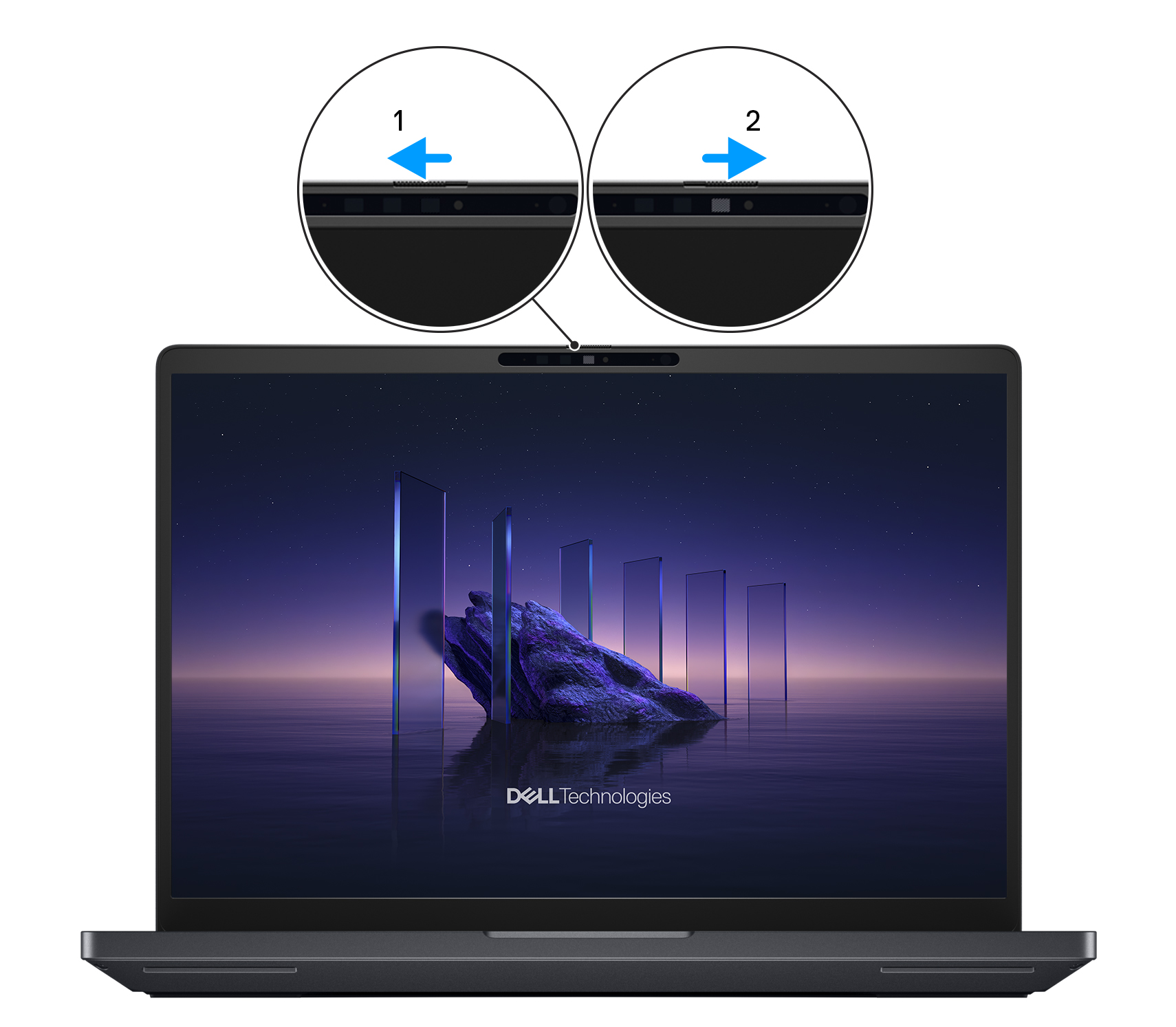
Dell Optimizer
Dell Optimizer is an AI-based software application that allows you to customize your computer settings for power and battery, and more.
- Extend the battery life of your computer with Intelligent Battery Extender and Dynamic Charge.
- Tune the performance, power consumption, cooling, and fan noise with selectable thermal modes.
- Access and secure your computer depending on your physical presence.
- Download and redeem the apps that are purchased with your computer.
For more information about configuring and using these features, search for Dell Optimizer at the Dell Support Site.