Сегодня покупают
← Вернуться назад
Нужна помощь с конфигурацией?
Пришлите SKU, спецификацию или список требований. Специалист Apltech проверит совместимость компонентов и найдёт актуальные артикулы
Получить консультацию →

Dell PowerEdge C6320: руководство по обслуживанию

Chassis dimensions

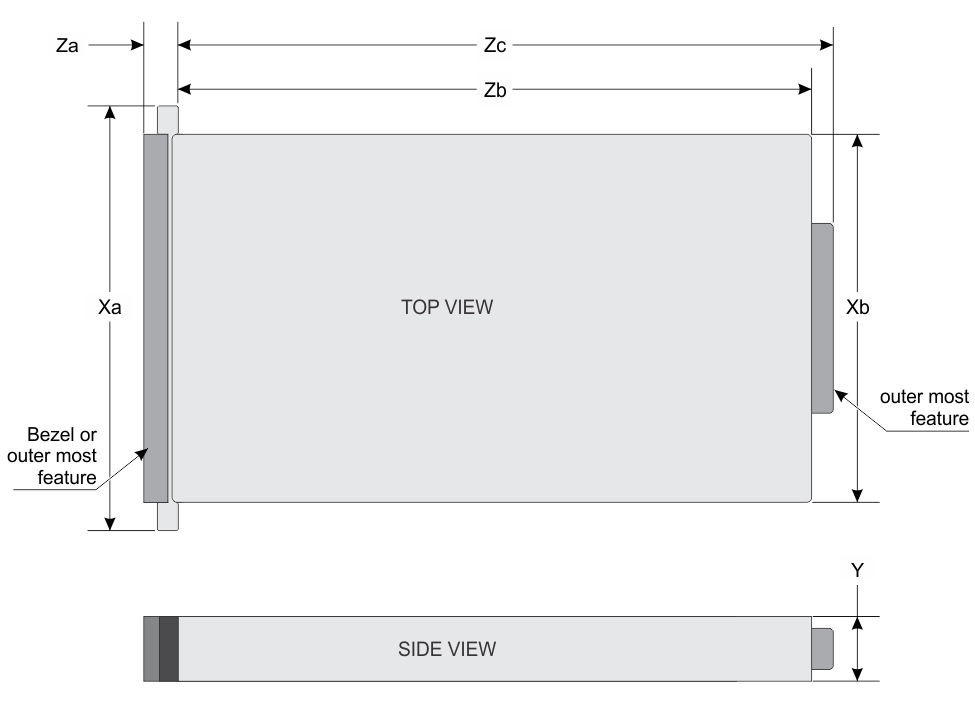
Figure 1. Chassis dimensions of PowerEdge C6300 enclosure
This figure shows the chassis dimensions of the PowerEdge C6300 enclosure.
Table 1. Dimensions of the Dell PowerEdge C6300 enclosureThe dimensions of the PowerEdge C6300 enclosure are as follows: Xa=482.3 mm, Xb=448 mm, Y=86.8 mm, Za (with bezel) =N/A, Za (without bezel) =41.4 mm, Zb=762.1 mm, and Zc=795.9 mm.
XaXbYZa (with bezel)Za (without bezel)ZbZc
482.3 mm448.0 mm86.8 mmN/A41.4 mm762.1 mm795.9 mm

Processor specifications

Dell PowerEdge C6320 supports up to two Intel Xeon E5-2600 v3 or Intel Xeon E5-2600 v4 product family processors in four independent servers.

PSU specifications

Dell PowerEdge C6320 system supports up to two AC or HVDC power supply units (PSUs). Dell PowerEdge C6320 does not support a mixed installation of 1400 W and 1600 W power supply units. The 1400 W and 1600 W power supply units are hot swappable, and supports hot swap in any condition if the system has the power throttling feature enabled.

Table 1. PSU specifications For 1400 W AC power supply units, the maximum heat dissipation is 5220.763 BTU/hr, voltage is 200-240 V AC, and maximum input current is 9 A. Initial inrush current cannot exceed 55 A and secondary inrush current cannot exceed 25 A. For 1600 W AC and voltage of 100-120 V AC, heat dissipation is 5966.586 BTU/hr and maximum input current is 12 A. Initial inrush current and secondary inrush current cannot exceed 35 A. For 1600 W AC and voltage of 200-240 V AC, heat dissipation is 5966.586 BTU/hr and maximum input current is 10 A. For 1400 W HVDC, voltage is 240 V DC, maximum input current is 9 A, and maximum heat dissipation is 5220.763 BTU/hr. Initial inrush current cannot exceed 55 A and Secondary inrush current cannot exceed 25 A.
PSU Heat dissipation (maximum) Frequency Voltage Maximum input current Maximum inrush current (peak)
1400 W AC 5220.763 BTU/hr 50/60 Hz 200-240 V AC 9 A

Initial inrush current cannot exceed 55 A (peak).

Secondary inrush current cannot exceed 25 A (peak).

1600 W AC 5966.586 BTU/hr 50/60 Hz

100-120 V AC

200-240 V AC

12 A

10 A

Initial inrush current and secondary inrush current cannot exceed 35 A (peak).
1400 W HVDC (for China only) 5220.763 BTU/hr 240 V DC 9 A

Initial inrush current cannot exceed 55 A (peak).

Secondary inrush current cannot exceed 25 A (peak).

System battery specifications

Dell PowerEdge C6320 system supports CR 2032 3.0-V lithium coin cell battery.

Memory specifications

Dell PowerEdge C6320 system supports DDR4 registered DIMMs (RDIMMs).

Table 1. Memory specificationsYour system supports 16 memory module sockets of 288-pins each. The system supports 1600 MT/s, 1866 MT/s, 2133 MT/s, or 2400 MT/s DDR4 Registered DIMMs with support for advanced ECC or memory optimized operation. The supported memory capacity is 8 GB, 16 GB, and 32 GB dual-rank. Minimum RAM supported is 16 GB while the maximum RAM supported is 512 GB.
Memory module sockets Architecture Memory capacity Minimum RAM Maximum RAM
Sixteen 288-pin 1600 MT/s, 1866 MT/s, 2133 MT/s, or 2400 MT/s DDR4 Registered DIMMs with support for advanced ECC or memory optimized operation 8 GB, 16 GB, and 32 GB dual-rank 16 GB Up to 512 GB

Environmental specifications

NOTE: For additional information about environmental measurements for specific system configurations, see Dell.com/environmental_datasheets
Table 1. Temperature specifications When the system is in continuous operation (for altitude less than 950 m or 3117 ft), the temperature specification ranges from 10°C to 35°C (50°F to 95°F) with no direct sunlight on the equipment. When the system is not in operation, the temperature specification is –40°C to 65°C (–40°F to 149°F). The maximum temperature gradient for both operation and non-operational systems is 20°C/h (36°F/h). Information about fresh air specification is described in the Expanded Operating Temperature section.
Temperature Specifications
Storage –40° to 65°C (–40° to 149°F) with a maximum temperature gradation of 20°C per hour.
Continuous operation (for altitude less than 950 m or 3117 ft) 10°C to 35°C (50°F to 95°F) with no direct sunlight on the equipment.
Fresh air For information on fresh air, see Expanded Operating Temperature section.
Maximum temperature gradient (operating and storage) 20°C/h (36°F/h)
Table 2. Expanded operating temperature specifications

When the system is in continuous operation, the expanded operating temperature ranges from 5°C to 40°C at 5% to 85% RH with 29°C dew point. NOTE: Outside the standard operating temperature (10°C to 35°C), the system can operate continuously in temperatures as low as 5°C and as high as 40°C. For temperatures between 35°C and 40°C, de-rate maximum allowable temperature by 1°C per 175 m above 950 m (1°F per 319 ft). When the system is continuously operating, the expanded operating temperature is –5°C to 45°C at 5% to 90% RH with 29°C dew point. NOTE: Outside the standard operating temperature (10°C to 35°C), the system can operate down to –5°C or up to 45°C for a maximum of 1% of its annual operating hours. For temperatures between 40°C and 45°C, de-rate maximum allowable temperature by 1°C per 125 m above 950 m (1°F per 228 ft).

The expanded operating temperature restrictions are as follows:
  • Do not perform a cold startup below 5 °C.
  • Maximum 120 W processor is supported.
  • Maximum of eight 3.5-inch or twelve 2.5-inch hard drives are supported with 120 W processor.

The following do not support the expanded operating temperature range:

  • Dell PowerEdge RAID Controller (PERC) H730/H730P cards with CPU TDP ≥ 85 W.
  • Dell PowerEdge RAID Controller (PERC) H330 card with CPU TDP ≥ 120 W.
  • Non Dell-qualified peripheral cards and/or peripheral cards greater than 25 W are not supported.
Expanded operating temperature Specifications
NOTE: When operating in the expanded temperature range, system performance may be impacted.
NOTE: When operating in the expanded temperature range, ambient temperature warnings may be reported on the LCD and in the System Event Log.
Continuous operation 5°C to 40°C at 5% to 85% RH with 29°C dew point.
NOTE: Outside the standard operating temperature (10°C to 35°C), the system can operate down to 5°C or up to 40°C.

For temperatures between 35°C and 40°C, de-rate maximum allowable dry bulb temperature by 1°C per 175 m above 950 m (1°F per 319 ft).

≤ 1% of annual operating hours –5°C to 45°C at 5% to 90% RH with 26°C dew point.
NOTE: Outside the standard operating temperature (10°C to 35°C), the system can operate down to –5°C or up to 45°C for a maximum of 1% of its annual operating hours.

For temperatures between 40°C and 45°C, de-rate maximum allowable dry bulb temperature by 1°C per 125 m above 950 m (1°F per 228 ft).

Expanded operating temperature restrictions
  • Do not perform a cold startup below 5 °C.
  • Maximum 120 W processor is supported.
  • Maximum of eight 3.5 inch or twelve 2.5 inch hard drives are supported with 120 W processor.

The following do not support the expanded operating temperature range:

  • Dell PowerEdge RAID Controller (PERC) H730/H730P cards with CPU TDP ≥ 85 W.
  • Dell PowerEdge RAID Controller (PERC) H330 card with CPU TDP ≥ 120 W.
  • Non Dell-qualified peripheral cards and/or peripheral cards greater than 25 W are not supported.
Table 3. Relative humidity specificationsFor a non-operational system, the ambient relative humidity ranges from 20% to 80% with a maximum humidity gradation of 10% per hour. Atmosphere must be non-condensing at all times. For an operational system, the ambient relative humidity ranges from 5% to 95%.
Relative humidity Specifications
Operating 20% to 80% (noncondensing) with a maximum humidity gradation of 10% per hour
Storage 5% to 95% (non-condensing)
Table 4. Maximum vibration specificationsThe maximum vibration specification of an operational system is 0.26 Grms at 5 Hz to 350 Hz (all operation orientations). The maximum vibration specification of a non-operational system is 1.88 Grms at 10 Hz to 500 Hz for 15 min (all six sides tested).
Maximum vibration Specifications
Operating 0.26 Grms at 5–350 Hz
Storage 1.88 Grms at 10–500 Hz for 15 minutes
Table 5. Maximum shock specificationsThe maximum shock specification of an operational system is six consecutively executed shock pulses in the positive and negative x, y, and z axes of 71 G for up to 2 ms. The maximum shock specification of a non-operational system is six consecutively executed shock pulses in the positive and negative x, y, and z axes (one pulse on each side of the system) of 27 G faired square wave pulse with velocity change at 235 inches per second (597 centimeters per second).
Maximum shock Specifications
Operating One shock pulse in the positive z axis (one pulse on each side of the system) of 31 G for 2.6 ms in the operational orientation.
Storage

Six consecutively executed shock pulses in the positive and negative x, y, and z axes (one pulse on each side of the system) of 71 G for up to 2 ms

Six consecutively executed shock pulses in the positive and negative x, y, and z axes (one pulse on each side of the system) of 27 G faired square wave pulse with velocity change at 235 inches per second (597 centimeters per second)

Table 6. Maximum altitude specificationsThe maximum altitude specification for an operational system ranges from -15.2 m to 3,048 m (-50 to 10,000 ft.). The maximum altitude specification for a non-operational system ranges from -15.2 m to 10,668 m (-50 to 35,000 ft.).
Maximum altitude Specifications
Operating -15.2 m to 3,048 m (-50 to 10,000 ft.)
Storage -15.2 m to 10,668 m (-50 to 35,000 ft.)
Table 7. Airborne contaminant level specificationThe airborne contaminant level is Class G1 as defined by ISA-S71.04-1985.
Specifications
Airborne contaminant level (Class) G1 as defined by ISA-S71.04-1985